
 Workflow artwork
Marketing workflow · English
Video publishing workflow
Editorial artwork for the video publishing workflow in a healthcare marketing programme: planning, publishing and review.
Dental implants educational YouTube thumbnail design with dentist and tooth illustration
Independent studio design by Branding Pioneers — not a commissioned client project.

Behind the work
The brief
Create an original dental video thumbnail that carries a clear healthcare message through its visual hierarchy and format.
Design decisions
Want something like this for your practice?
Discuss a project like thisMore in this discipline
Workflow artworkMarketing workflow · English
Editorial artwork for the video publishing workflow in a healthcare marketing programme: planning, publishing and review.
 Studio design
Independent studio design · English
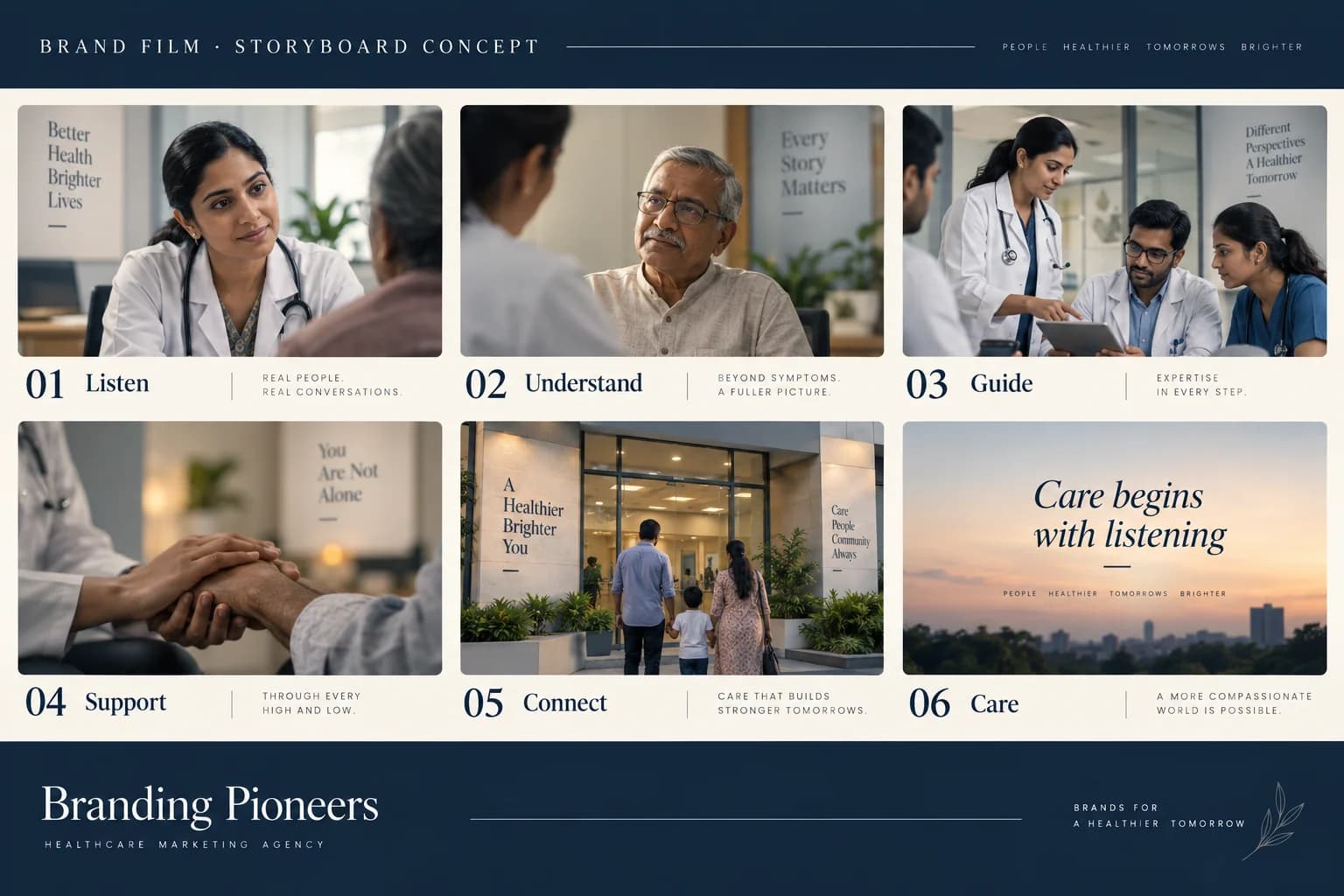
Six-frame healthcare brand-film storyboard design from listening to continuing care.
 Studio design
Independent studio design · English
Heart health educational YouTube thumbnail design with doctor portrait and bold yellow headline
Discuss your project
Three quick questions. We come prepared with a plan for your specialty and city.

 You’ll speak with a senior strategist
From studio to practice
Dental video thumbnail sits in our YouTube & video portfolio. For a practice, the same thinking goes into YouTube channel growth for doctors and YouTube SEO, run as part of our healthcare video marketing work.
The healthcare content marketing guide explains the approach, and procedure explainer videos shows where it goes next. Commissioned results are in the case studies, and our process shows how a brief like this is run.
Practical notes & supporting evidence
Design decision 1Establish one primary message and a clear reading order.
Design decision 2Balance healthcare imagery with legible typography.
Design decision 3Adapt the composition to the intended campaign or print format.
Dental video thumbnail explores this brief: Create an original dental video thumbnail that carries a clear healthcare message through its visual hierarchy and format. The collection is labelled an independent studio design, and its published language is English. Its purpose is to explain the visual approach shown. Use that classification when citing the work, particularly when comparing concepts with commissioned client material elsewhere in the portfolio.
The recorded design decisions are: Establish one primary message and a clear reading order. Balance healthcare imagery with legible typography. Adapt the composition to the intended campaign or print format. Review each decision against the artwork. Look at the relative prominence of the primary message, the amount of supporting information and the way individual formats remain connected. When planning a similar assignment, identify which of these decisions meets your own brief and which needs to change for your brand, audience or service.
A routine dental visit, an implant consultation and a multi-location enquiry need different supporting information. Explain the service available at the relevant location, the clinician’s role and what happens at the initial consultation. Keep promotional pricing connected to its inclusions and approval record. For a chain, check that the enquiry reaches the correct practice and that location-specific availability remains accurate.
Plan a healthcare video around one clear audience question. An educational explanation, a clinician introduction and a service tour need different structures and supporting information. Establish the speaker, the intended audience and the action a viewer can take after watching. For medical statements, prepare the script or discussion outline for professional review. Avoid letting a short format remove the context a viewer needs to understand suitability, uncertainty or the limits of general information.
Titles and thumbnails should describe the topic the video actually covers. Captions and transcripts help people follow the explanation without relying on audio alone. Where a video discusses a service offered by the practice, provide a clear destination for fuller information and current appointment details. A thumbnail library demonstrates how the content was packaged; it does not prove watch time, patient acquisition or a clinical result. Those questions require the appropriate source records and reporting periods.
Record the approved title, speaker attribution, description, thumbnail and destination links with the published video. Keep a way to revise or remove material if a service, clinician affiliation or clinical explanation changes. A series should have a consistent structure while allowing each specialty its own questions. The production brief should also identify consent requirements for anyone appearing on camera and the permissions attached to patient stories or clinical images.
When assessing a channel, keep the platform’s measures separate: impressions, views, watch time and subscriber changes answer different questions. Compare videos with similar purposes rather than interpreting every low-volume educational topic as a failure. If the goal includes enquiries, check the destination page and the practice’s follow-up process. A platform report can document exposure and viewing behaviour for its stated period; the practice’s own intake records are needed to understand appointments resulting from those interactions.
Look first at the problem the collection addresses and the deliverables it actually contains. A website study can explain navigation and information hierarchy. A campaign collection can demonstrate how a message moves through different formats. Identity materials can show consistency across print and digital applications. These are useful design references, but each answers a different question. Choose the example closest to your intended task, then identify the parts you want to explore further rather than requesting a copy of the whole collection.
Write a brief that names your provider, audience, services, existing brand constraints and the action the work should support. Include content ownership and the practical destination of contact requests. When several stakeholders approve the work, agree who has the final decision on medical information, design and operational details. The clearer those responsibilities are, the easier it becomes to review a proposed layout without repeatedly changing the underlying service description or appointment process.
Read the collection at its intended size. Check whether the provider and message remain recognisable, whether supporting copy is legible and whether the next action is easy to understand. Look for consistent terminology across individual pieces. For multilingual work, have the wording reviewed by someone who understands the language and the service context. A translated message can change length, reading order and emphasis, so the layout needs its own review rather than an automatic text replacement.
Keep the distinction between independent studio concepts, client deliverables and editorial workflow artwork visible. Concepts explore possible design approaches. Client collections show the materials or engagement scope identified on their pages. Workflow artwork explains a process visually. None of these categories should be presented as an unverified client result. For a new project, confirm the release checklist and measurement plan separately from design approval, and make sure the source files and approval notes remain available to the team responsible for future updates.