Branding

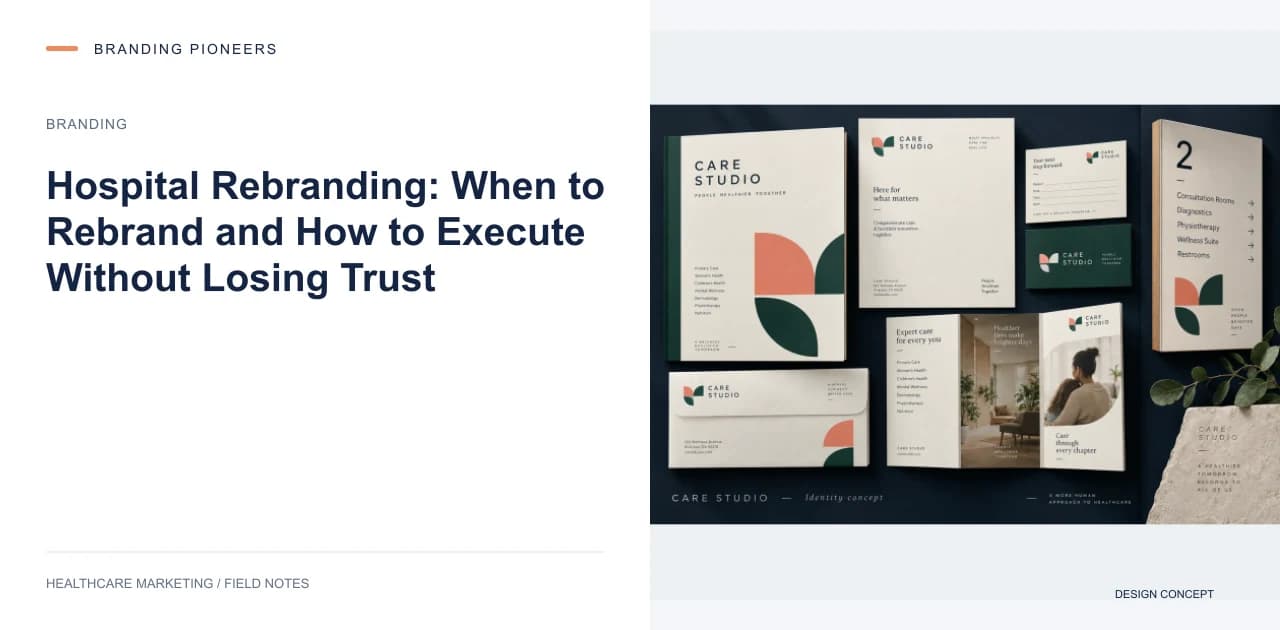
Hospital Rebranding: When to Rebrand and How to Execute Without Losing Trust

Rebranding a hospital is high-stakes — patient relationships, physician loyalty, and community trust are all at risk. Here is the strategic framework for rebranding that strengthens rather than disrupts.

NS
Founder & CEO · June 15, 2025 · 5 min read
FILE · HOSPITAL
Hospital Rebranding: When to Rebrand and How to Execute Without Losing Trust

When Rebranding Makes Sense — and When It Doesn't

Rebranding a hospital is not like rebranding a consumer product. Patients have emotional connections to healthcare institutions. They associate the brand with life-saving moments, the birth of children, and recovery from illness. Disrupting that association without compelling reason can destroy decades of accumulated trust.

Rebranding makes sense in specific scenarios: after a merger or acquisition (two brands must become one), when your brand no longer reflects your capabilities (a community hospital that has grown into a multi-specialty tertiary center), when persistent negative associations need to be overcome (a safety incident, chronic quality issues now resolved), or when expanding to new markets where the existing brand carries no equity.

Rebranding does not make sense when you simply want to look more modern, when a new CEO wants to put their stamp on the organization, or when you are trying to distract from unresolved operational problems. A rebrand that is not supported by genuine operational improvement will be seen through immediately.

Phase 1: Research and Strategy (Months 1-2)

Before touching a logo or choosing a color, invest in understanding your current brand position:

Patient perception audit. Survey 200 to 500 current and former patients on: what they associate with your brand, why they chose your hospital, what they would change, and how they describe your hospital to others. This reveals your actual brand position — which often differs significantly from what leadership assumes.

Physician perception audit. Interview 20 to 30 physicians (both employed and referring) on: what the brand means to them, whether they are proud to be affiliated, and what brand attributes would make them more likely to refer patients. Physician buy-in is critical — they are your most influential brand ambassadors.

Community perception audit. Conduct focus groups with community members who are not current patients to understand awareness, associations, and barriers to choosing your hospital.

Competitive analysis. Audit the branding of every hospital in your competitive set: visual identity, messaging, positioning, and digital presence. Identify the white space — the positioning territory that no competitor has claimed.

From this research, develop a brand strategy that defines: your brand positioning statement, core brand values, target audience segments, brand personality, and messaging architecture.

Phase 2: Brand Identity Development (Months 3-4)

With strategy in place, develop the visual and verbal identity:

Name. If the name is changing (common in mergers), test 3 to 5 options with patient focus groups. Prioritize names that are easy to pronounce, memorable, and evoke the desired brand personality. Avoid generic names that could apply to any institution.

Visual identity. Develop a logo, color palette, typography, and visual system. Healthcare logo design requires a specific approach: avoid cliches (crosses, hearts, caduceus symbols used by every competitor), choose colors that evoke trust and professionalism (blue and green dominate healthcare for good reason, but distinctive applications of these colors set you apart), and ensure the logo works at every size, from a building sign to a mobile app icon.

Brand voice. Define how the brand sounds in writing and speech. Hospitals often default to cold, institutional language: "The patient will be required to present identification upon admission." A human brand voice might say: "Please bring your ID when you arrive — our reception team will take care of the rest." The voice should be authoritative yet warm, professional yet approachable.

Messaging hierarchy. Create a messaging framework with a primary brand message, supporting messages for each audience segment (patients, physicians, employees, community), and department-specific messaging that connects to the master brand.
Phase 3: Internal Launch (Month 5)

The most important audience for your rebrand is internal. If your physicians, nurses, and staff do not understand, believe in, and advocate for the new brand, it will fail regardless of how beautiful the logo is.

Leadership alignment. Present the rebrand to the board and senior leadership first. Ensure unanimous endorsement before proceeding. Any visible dissent at the leadership level will undermine the entire effort.

Staff engagement. Host in-person presentations for every department. Explain the why behind the rebrand, not just the what. Share the research findings that drove the decision. Give every employee branded materials and a personal invitation to be a brand ambassador.

Physician engagement. Meet with physician leaders individually. Physicians care about how the brand reflects their clinical excellence. Show them how the rebrand elevates their practice, not just the institution.

Phase 4: External Launch (Month 6)

Execute the external launch with simultaneous impact across all touchpoints:

Physical. Update building signage, interior wayfinding, staff uniforms, printed materials, stationery, and vehicle wraps. A phased rollout of physical elements over 3 to 6 months is acceptable — but the highest-visibility items (building sign, main entrance, website) should change on launch day.

Digital. Launch the new website, update all social media profiles, update Google Business Profile, and send an email announcement to your entire patient database. The digital launch should be coordinated for a single day for maximum impact.

Media. Issue a press release, pitch stories to local media, and host a community event to unveil the new brand. Frame the rebrand as a story about growth, improvement, and commitment to the community — not just a new logo.

Advertising. Run a 60-to-90-day brand awareness campaign to establish the new identity. Use outdoor, digital, and social media to build recognition quickly.

Phase 5: Post-Launch Measurement (Months 7-12)

Monitor brand metrics monthly after launch:

Aided and unaided awareness. Survey your market quarterly to measure recognition of the new brand. Unaided awareness (respondents mention your hospital without prompting) is the gold standard metric.

Patient volume trends. Monitor new patient registrations, appointment bookings, and admission rates. A successful rebrand should produce no decline in these metrics during transition and measurable improvement within 6 to 12 months.

Digital metrics. Track branded search volume (people searching your hospital name), website traffic, social media following, and online review sentiment.

Employee and physician satisfaction. Re-survey internal stakeholders 6 months after launch to measure whether the rebrand has positively or negatively affected morale and pride.

A well-executed hospital rebrand strengthens community trust, attracts better talent, increases referrals, and differentiates the institution in a competitive market. A poorly executed one — rushed, underresearched, or unsupported by operational reality — can set the organization back years. Take the time to do it right.

FILED UNDERhospital rebrandinghealthcare rebrand strategyhospital brand identitymedical institution rebranding
Stop reading. Start ranking.
Get a free branding audit — we'll show you exactly what's missing.
Book audit →
Author
Founder & CEO · Gurugram, India

Nishu founded Branding Pioneers in 2016 with one rule that hasn't changed since: healthcare only. She'd run digital strategy at a top-10 Indian agency and watched generalist marketing underserve medical clients who needed something built for how patients actually search and decide. So she left to build the specialist instead. It's now an 80-person team working with healthcare brands worldwide.

The Patient Acquisition Blueprint (2026 Edition) — guide cover
Free · 15 pages

The Patient Acquisition Blueprint (2026 Edition)

The exact 90-day patient-acquisition system, step by step.

We never share your details

FREE · 30 MIN
See your branding opportunity gap.

Senior strategist, no boilerplate. Reply within 4 hours.

Book audit → Or call us directly
The Pioneers Brief · weekly
One essay. Three benchmarks. One teardown.
Subscribe — free
The Patient Acquisition Blueprint (2026 Edition) — guide cover
Free for branding readers

The Patient Acquisition Blueprint (2026 Edition)

The exact 90-day patient-acquisition system, step by step.

  • The 90-day patient acquisition operating system
  • Channel-by-channel budget allocation (₹50L–₹5Cr/yr)
  • 12 real, named client engagements walked through
  • ROI tracking spreadsheet (CAC, LTV, payback)
15 pages · Used by 350+ healthcare clients · Updated for AI search

We never share your details

Continue reading

More on branding.

BROWSE ALL →
From the studio

This thinking, applied.

Hospital event invitation design
Print
Event invitation suite
Indraprastha Apollo — breast and cervical cancer screening brochure, poster and social set
Print · Oncology
Apollo — cancer screening print and social set
Healthcare campaign production still
Production
On location — campaign production
LifeCare Hospitals — brand intro
Hospital · Deck
LifeCare Hospitals — brand intro
Vitality wellness brand identity
Branding · Wellness
Vitality — identity for a multi-city launch
Why choose us

Why healthcare brands choose us.

Six reasons hospitals, clinics, and doctors pick a healthcare-only firm over a generalist agency.

  • Healthcare-only

    It's all we do. No retail, no fintech — the whole team thinks in patient journeys, clinical trust, and the way people actually choose a doctor.

  • AI-first systems

    Receptionists, WhatsApp triage, and attribution built in-house — we answer patients in seconds and tie every click to a booked appointment.

  • Compliance built-in

    HIPAA-aware handling, ASCI-reviewed creative, and GDPR/DPDP sign-off on every campaign — our standard, not an upcharge or an afterthought.

  • Senior on every account

    The senior who pitched you stays on the engagement. No bait-and-switch to juniors learning on your budget.

  • Measured to the appointment

    Patient-level attribution across calls, forms, and walk-ins. Monthly reports show booked patients — not just clicks and impressions.

  • Receipts, not promises

    We name our clients and show the work. Quarterly reviews with the numbers attached, every cycle.

The Branding Pioneers healthcare-marketing team at work
Healthcare-only · since 2016
A team that does one thing well.
More from the brief

If this resonated, here’s what else lands.

Adjacent practices, the relevant tools, and the case files where we shipped this thinking against real patient-acquisition targets.

THE PIONEERS BRIEF · WEEKLY

One essay,
three benchmarks,
one teardown.

Healthcare growth, every Thursday morning. No hype, no fluff.