Journalists in India return every year to the same three health stories: dengue after the monsoon, air pollution in the colder months and heat in the late spring and summer. The reporters are not short of material. They are short of local, current, checkable evidence and a clinician who can explain it plainly. A hospital that prepares for these windows can be useful, and being useful is what earns a second call.
This article is for hospital and clinic communications leads who plan a year of media work. It shows how to build an editorial calendar around the three seasonal stories, how to anchor a release in public data so it has a benchmark, what a clinician quote should and should not contain, and how to avoid the pitfalls that turn a useful release into scaremongering or advertising. The calendar and templates are original working tools; any numbers used for illustration come from the sources linked.
The calendar logic
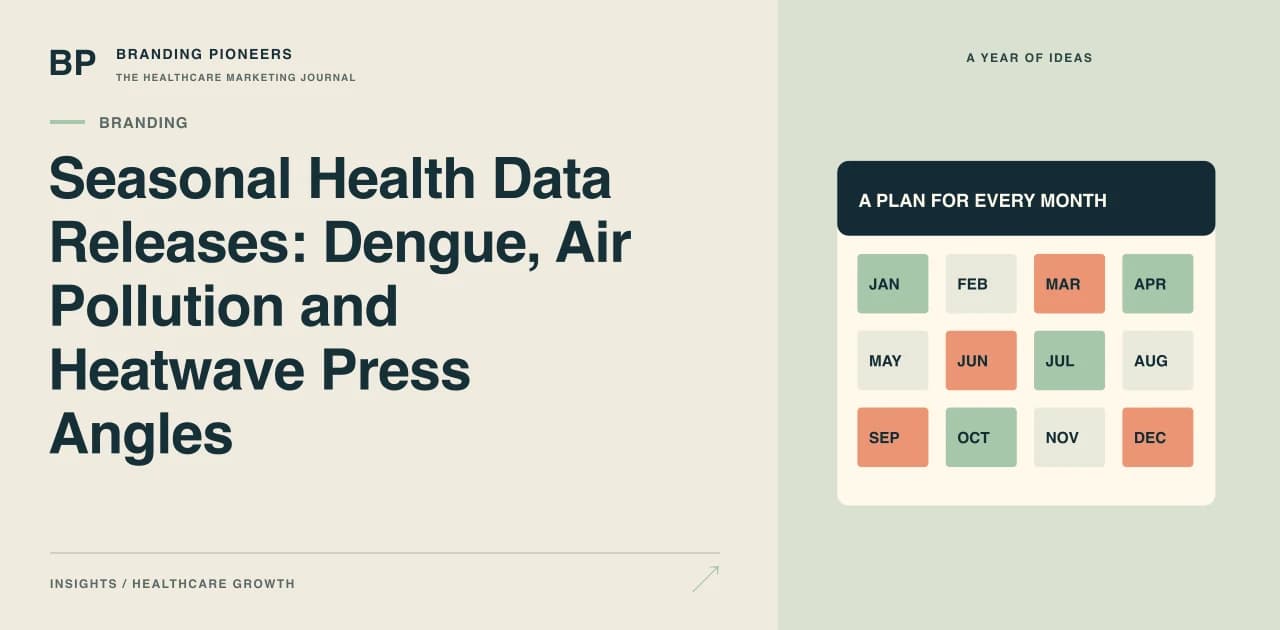
Start from the calendar, then work backwards. A release timed to a rise in cases is useful; one sent after the peak has passed is history. For each story, define three dates: the preparation start, the pitch date and the review date.
| Story | Typical window in much of India | Prepare | Pitch | Public data to benchmark against |
|---|---|---|---|---|
| Dengue | Monsoon and post-monsoon months | Before the monsoon | When local cases begin to rise | National and state dengue case tables |
| Air pollution | Colder months in north India, with local variation | Late summer | As air-quality categories worsen | National air quality index bulletins |
| Heatwaves | Late spring and summer, earlier in the south and east in some years | Winter | When forecasts and warnings issue | Weather department heat bulletins |
The windows vary by region and by year. Use your own hospital's historic admission curve and your state health department's reports to set the dates, and do not rely on a national average that does not match your district.
Anchor each story in a public source
A hospital's own numbers are a single data point. A journalist wants context: is this local pattern unusual? Link each release to an open series.
Dengue
The National Centre for Vector Borne Diseases Control publishes a state-wise table of dengue cases and deaths for 2021 to 2026 (provisional to 30 April 2026). In that table, national totals run from 193,245 cases in 2021 to 233,251 in 2022, 289,235 in 2023, 233,519 in 2024 and 121,824 in 2025. The table carries footnotes, including that West Bengal's later years are partial or not reported, so any national comparison needs a caveat.
Use it this way. Take your own state's row across years, and compare your hospital's anonymised monthly dengue-related presentations to the state's annual rhythm. Do not claim that the hospital's numbers represent the state. Do say what the public series shows and what your hospital is seeing, and let the reader compare.
Heat
The India Meteorological Department's heat bulletin sets out its heat wave criteria: a station reaches at least 40 degrees Celsius for plains, 37 for coastal stations and 30 for hilly regions, plus a departure from normal of 4.5 to 6.4 degrees for a heat wave and more than 6.4 for a severe one, or an actual maximum of at least 45 and 47 degrees respectively. Quote the department's definition when you write "heatwave" so that your use matches what the forecast says.
Air quality
The Central Pollution Control Board runs the National Air Quality Index, which has a method note, public guidelines and reports. Pair any claim about air quality with the board's category and the date and location of the reading. Avoid stating that a hospital's respiratory visits were "caused" by pollution. Association over time is what a hospital's data can show; causation is for epidemiologists.
What the hospital data can add
A release works when it combines a public series with a local, anonymised view. Using the method in the previous piece on turning admissions into stories, choose a metric that is stable and defined:
- Weekly emergency or OPD presentations for a clinician-agreed category
- Age bands, not exact ages
- District-level geography
- The same weeks over several years, so the seasonal curve is visible
Apply small-number suppression, keep the hospital's own total volume visible as a denominator and include a methods box. Our DPDP Act note for marketers explains the data-protection background in general terms. Two additional cautions for seasonal stories: avoid naming a locality with very few cases, and do not release figures that suggest an outbreak where a public health authority has not confirmed one. If in doubt, ask the district health office before you publish.
The release template
Each seasonal release can follow the same five-part structure, so the team can prepare it in advance.
- Headline finding in one sentence with a defined metric and period.
- The benchmark: one line comparing it with the public series, with the link.
- The chart: one chart, labelled axes, source line on the image, same colours every year so editors recognise it.
- The clinician comment: two or three sentences, plain language, cleared by the clinician.
- The methods box: what was counted, what was excluded, limits and a contact for questions.
Publish the chart as an image with a source line and as a downloadable table. Reporters often want the numbers, and giving them in a simple CSV or sheet cuts the time to publication.
What the clinician quote should say
The NMC's October 2026 guidelines give a clear frame. Clause 8.2(iii) permits public-health talks in the doctor's own name and designation without promoting the employer, and clause 5.1 permits educational content that does not promote a practice or solicit patients. Clause 8.1(i) bars fear-based marketing and content that creates unnecessary demand for procedures or diagnostics.
In practice:
- Do explain how the condition presents, what prevention is reasonable and when to seek urgent care, in wording the clinician has approved.
- Do state clearly that the figures are from one hospital and are not a public-health estimate.
- Do not mention the hospital's packages, tests or beds, or invite readers to book.
- Do not use alarm words such as "epidemic" or "surge" unless the public health authority has used them.
- Do not give individual medical advice. Advice for specific symptoms belongs in a consultation.