Saudi Arabia is the fastest-changing healthcare market most international practitioners will encounter. Private capacity is expanding, insurance coverage has widened, and the sector is being deliberately opened under the Kingdom's long-term economic programme. What has not changed is that health advertising is a permissioned activity: you do not simply decide to run a campaign.
For a clinic owner or a specialist building a personal practice, the sequencing matters. Get the approvals and the Arabic foundation right first, and the channels are unusually productive. Get them wrong and you will spend months in rework.
This is a practitioner's summary written by marketers, not legal advice. Regulations change, and enforcement varies. Confirm the current text with your regulator or your own counsel before you publish.
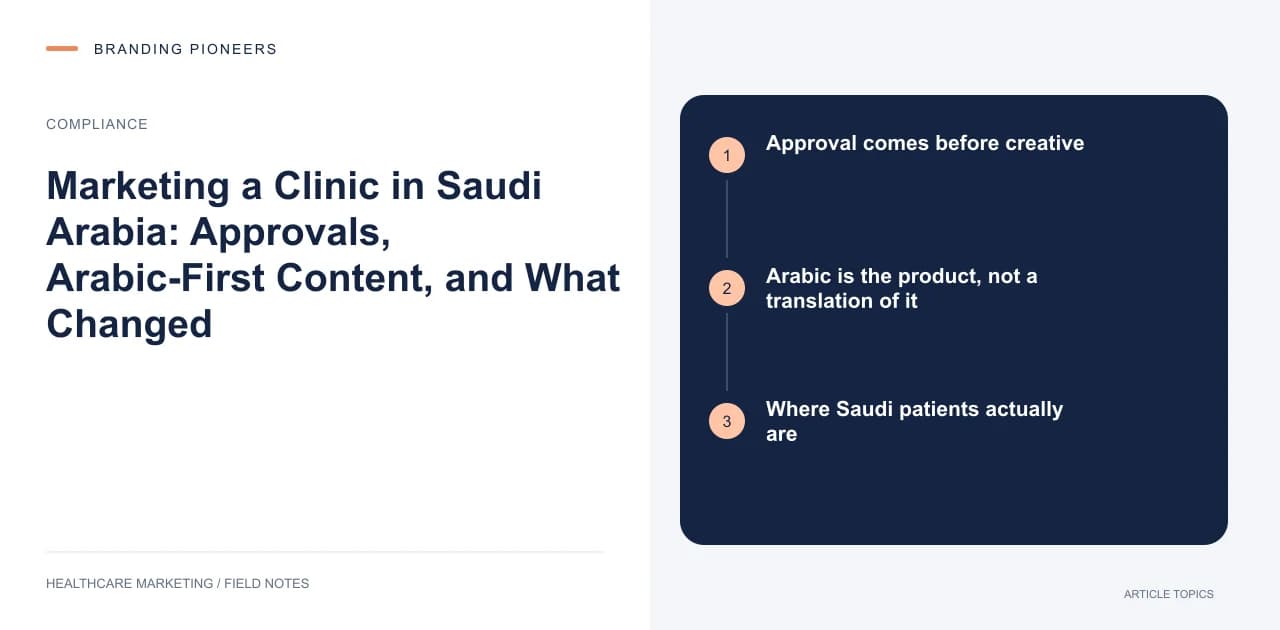
Approval comes before creative
Health advertising in the Kingdom requires authorisation from the Ministry of Health, and claims touching medicines or medical devices bring the Saudi Food and Drug Authority into scope. Professional titles and scope of practice are governed by the Saudi Commission for Health Specialties classification — the specialty you advertise must match the classification you actually hold.
The practical implication for a marketing calendar is that approval lead time is a planning input, not an afterthought. Campaigns built around a date — a new clinic opening, a seasonal health awareness moment, a new service line — need creative locked well before the date, not the week of.
What tends to be rejected is consistent across the region:
- Superlatives and comparative claims. Best, first, only, most advanced.
- Guarantees of outcome, or success rates presented without qualification.
- Price promotions and discounting on medical procedures.
- Before-and-after imagery, particularly for aesthetic and dental work.
- Titles that overstate the practitioner's classification.
- Claims about devices or medicines that are not substantiated and cleared.
Arabic is the product, not a translation of it
The single largest difference between clinics that perform in Saudi digital channels and clinics that do not is whether their Arabic was written or translated. This is not a cultural nicety — it is a search visibility issue with real mechanics behind it.
Patients search for conditions using colloquial terms, not Modern Standard Arabic clinical vocabulary. They mix Arabic and transliterated English within a single query. They use different words in Riyadh, Jeddah and the Eastern Province. Machine translation of an English site produces clinically correct Arabic that nobody actually types, which is why so many well-built Arabic sites get almost no organic traffic.
What to do instead:
- Build the Arabic keyword set natively, from how patients speak, then map it to your services. Do not translate an English keyword list.
- Write Arabic content originally, then produce the English version — not the reverse.
- Get right-to-left layout properly, including forms, numerals, phone fields and date pickers. A broken RTL form is a silent conversion killer.
- Handle both calendar systems where dates appear.
- Set up your Google Business Profile with an Arabic primary presence and correct transliteration, and make sure your practitioner names are consistent everywhere they appear.
Where Saudi patients actually are
Smartphone and social penetration in the Kingdom is among the highest in the world, and the channel mix does not resemble Europe or North America.
Search still decides high-consideration care. For a surgical procedure, a fertility journey, or a specialist consultation, patients research before they enquire, and they research in Arabic. Organic visibility for procedure and condition queries is the durable asset.
Short video drives discovery. Snapchat and TikTok reach is exceptional here, particularly for younger demographics and for aesthetics, dentistry and dermatology. Content that educates in Arabic, delivered by an identifiable and appropriately qualified clinician, outperforms production-heavy brand advertising. Note that influencer arrangements carry their own disclosure and licensing considerations.
WhatsApp is where enquiries live. Forms underperform relative to messaging across the Gulf. A monitored WhatsApp channel with fast, human, Arabic-language responses converts materially better than a contact form that promises a callback. The constraint is that response speed is the whole game — a message answered the next morning has usually already been answered by a competitor.
Insurance shapes the funnel. Coverage and network status frequently determines where a patient goes, so being clear about which insurers you accept, and keeping that accurate, removes an enquiry-stage question that otherwise costs you the patient.