AI & Automation

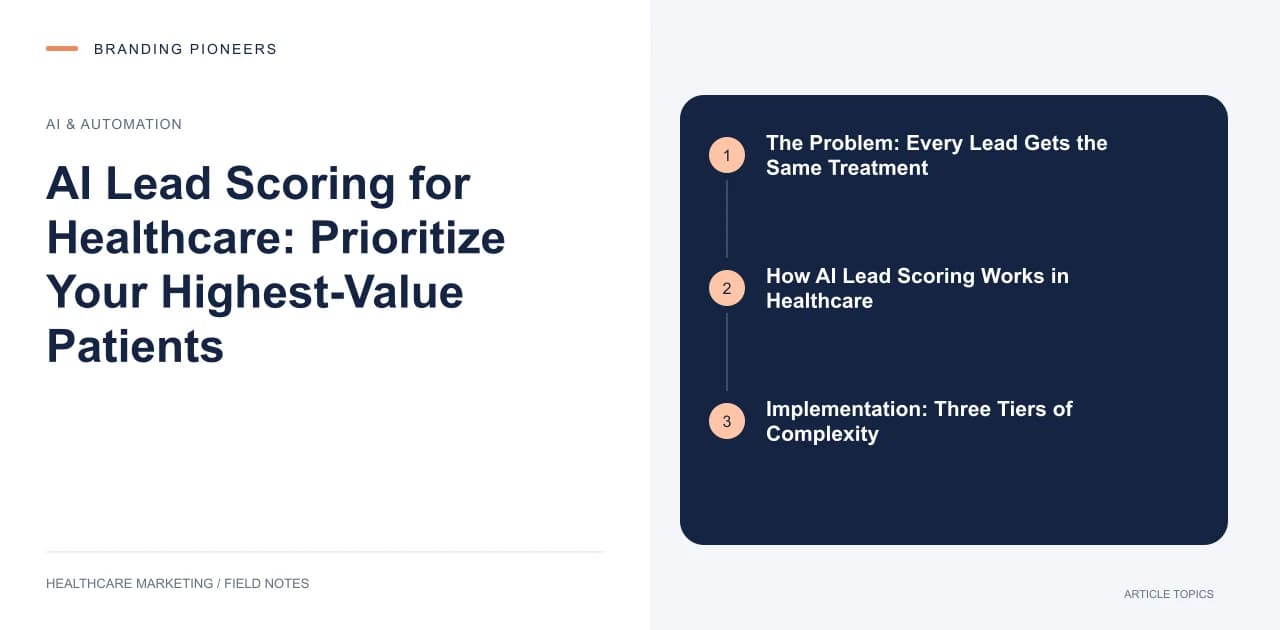
AI Lead Scoring for Healthcare: Prioritize Your Highest-Value Patients

Not all patient inquiries are equal. AI-powered lead scoring helps your team focus on the 20% of leads that generate 80% of revenue. Here is how to implement it without enterprise-level budgets.

AT
Co-Founder & CTO · June 10, 2025 · 4 min read
FILE · AI-LEAD-
AI Lead Scoring for Healthcare: Prioritize Your Highest-Value Patients

The Problem: Every Lead Gets the Same Treatment

Most healthcare practices handle patient inquiries on a first-come, first-served basis. A patient asking about a 2,000-rupee consultation gets the same response speed and attention as one inquiring about a 5-lakh surgical procedure. From an operational standpoint, this is logical. From a revenue standpoint, it is wildly inefficient.

In a typical multi-specialty clinic receiving 200 inquiries per month, roughly 40 leads (20 percent) will generate 80 percent of the practice's revenue. These high-value leads include patients seeking elective surgical procedures, international patients seeking medical tourism packages, patients with complex conditions requiring extended treatment plans, and corporate clients inquiring about employee health programs.

AI lead scoring identifies these high-value leads automatically and ensures they receive priority attention. Practices that implement lead scoring see their revenue per lead increase by 25 to 40 percent because high-value patients are no longer lost in the queue.

How AI Lead Scoring Works in Healthcare

At its core, AI lead scoring assigns a numerical value (typically 0 to 100) to each incoming lead based on how likely they are to become a patient and how valuable that patient would be. The score is calculated from multiple data points:

Behavioral signals: Which pages did the lead visit on your website? A visitor who viewed your joint replacement page, pricing page, and surgeon profile page is a much hotter lead than one who only viewed your homepage. Time on site, number of pages visited, and return visits all contribute to the behavioral score.

Inquiry data: What information did the lead provide? The specific service or specialty requested, the urgency expressed, whether they mentioned insurance or budget, and the communication channel they used (WhatsApp inquiries tend to be higher intent than email forms).

Demographic signals: Location (local patients convert at higher rates than distant ones for most specialties), age range (correlates with procedure likelihood), and referral source (physician referrals convert at 2 to 3 times the rate of self-referrals).

Historical patterns: Over time, the AI model learns which combinations of signals predict high-value conversions in your specific practice. A pattern might emerge that patients over 50 who visit your knee replacement page twice and then submit a form on a weekend evening convert at 45 percent — 3 times your average.

Implementation: Three Tiers of Complexity

Tier 1: Rules-based scoring (start here). Create a spreadsheet scoring model that assigns points based on known high-value behaviors. Service page visited: +10 for surgical, +5 for consultation. Pricing page visited: +15. Phone call: +10. WhatsApp: +8. Email form: +5. International inquiry: +20. Physician referral mentioned: +25.

This takes one afternoon to set up in most CRM systems (HubSpot, GoHighLevel, Salesforce) and immediately provides your team with a prioritized lead list.

Tier 2: Automated scoring with CRM integration. Configure your CRM to automatically calculate lead scores based on website behavior tracking, form data, and email engagement. Leads above a threshold (say, 60 out of 100) are flagged for immediate response by your best team member. This requires a CRM with lead scoring capabilities and website tracking integration.

Tier 3: Machine learning scoring. Feed your historical conversion data — which leads became patients and what was their lifetime value — into a machine learning model. The model identifies patterns you would never find manually and continuously improves its predictions. This requires at least 6 to 12 months of conversion data and is most appropriate for practices with 500-plus monthly inquiries.
Response Protocols Based on Lead Score

Lead scoring is only valuable if it changes behavior. Establish clear response protocols:

Hot leads (score 75+): Immediate response — within 5 minutes during business hours, within 15 minutes after hours. Assign to your most experienced patient coordinator. Personalize the response with specifics about their inquiry. Offer a same-day or next-day callback from a doctor.

Warm leads (score 40 to 74): Response within 1 hour. Standard but personalized outreach via their preferred channel. Offer a consultation booking within the current week.

Cool leads (score below 40): Response within 4 hours. Automated but helpful response with relevant information and an invitation to book. Enter into a nurturing email or WhatsApp sequence.

This tiered response system ensures your team's limited time is allocated to the leads with the highest revenue potential.

Tracking and Refining Your Scoring Model

No scoring model is accurate from day one. Track the correlation between lead scores and actual outcomes: did high-scoring leads actually convert at higher rates? Did they generate higher revenue?

Review these metrics monthly: conversion rate by score bracket, average revenue by score bracket, false positives (high-scoring leads that did not convert), and false negatives (low-scoring leads that turned out to be high-value).

Adjust your scoring weights based on what the data shows. If you discover that WhatsApp inquiries convert at 3 times the rate of email forms (common in India and the Middle East), increase the weight of the WhatsApp signal. If Saturday inquiries for cosmetic procedures convert at 2 times the weekday rate, add a time-of-inquiry factor.

The Revenue Impact

Healthcare practices that implement even basic lead scoring typically see three outcomes within the first quarter: 25 to 40 percent increase in revenue per lead (because high-value patients are no longer lost), 15 to 20 percent reduction in average response time for high-value inquiries, and 10 to 15 percent improvement in overall conversion rate (because front-desk resources are better allocated).

For a practice generating 50 lakhs per month from new patient inquiries, a 25 percent improvement in revenue per lead translates to an additional 12.5 lakhs per month — from the same volume of inquiries, handled by the same team, with no additional marketing spend.

FILED UNDERAI lead scoring healthcarepatient lead prioritizationhealthcare lead managementAI patient qualification
Stop reading. Start ranking.
Get a free ai & automation audit — we'll show you exactly what's missing.
Book audit →
Author
Co-Founder & CTO · Gurugram, India

Arush builds the systems the rest of the company runs on — the patient-acquisition pipelines, the AI chatbots, the analytics that tie a single click to a booked appointment. If a campaign reports a number, it's because something his team built is tracking it.

The Patient Acquisition Blueprint (2026 Edition) — guide cover
Free · 15 pages

The Patient Acquisition Blueprint (2026 Edition)

The exact 90-day patient-acquisition system, step by step.

We never share your details

FREE · 30 MIN
See your ai & automation opportunity gap.

Senior strategist, no boilerplate. Reply within 4 hours.

Book audit → Or call us directly
The Pioneers Brief · weekly
One essay. Three benchmarks. One teardown.
Subscribe — free
The Patient Acquisition Blueprint (2026 Edition) — guide cover
Free for ai & automation readers

The Patient Acquisition Blueprint (2026 Edition)

The exact 90-day patient-acquisition system, step by step.

  • The 90-day patient acquisition operating system
  • Channel-by-channel budget allocation (₹50L–₹5Cr/yr)
  • 12 real, named client engagements walked through
  • ROI tracking spreadsheet (CAC, LTV, payback)
15 pages · Used by 350+ healthcare clients · Updated for AI search

We never share your details

Continue reading

More on ai & automation.

BROWSE ALL →
From the studio

This thinking, applied.

ReviewMagnet — Automated review generation for Google Business profiles
Product
ReviewMagnet
Healthcare social media growth reporting
Social
Social growth reporting
Impact Ortho Centre — laptop, tablet and phone build
Web · Responsive
Impact Ortho Centre — across devices
Arush Thapar — Co-Founder, Branding Pioneers
Founder
Arush Thapar
Technology empowerment for healthcare brands
MarTech
Technology for healthcare teams
Why choose us

Why healthcare brands choose us.

Six reasons hospitals, clinics, and doctors pick a healthcare-only firm over a generalist agency.

  • Healthcare-only

    It's all we do. No retail, no fintech — the whole team thinks in patient journeys, clinical trust, and the way people actually choose a doctor.

  • AI-first systems

    Receptionists, WhatsApp triage, and attribution built in-house — we answer patients in seconds and tie every click to a booked appointment.

  • Compliance built-in

    HIPAA-aware handling, ASCI-reviewed creative, and GDPR/DPDP sign-off on every campaign — our standard, not an upcharge or an afterthought.

  • Senior on every account

    The senior who pitched you stays on the engagement. No bait-and-switch to juniors learning on your budget.

  • Measured to the appointment

    Patient-level attribution across calls, forms, and walk-ins. Monthly reports show booked patients — not just clicks and impressions.

  • Receipts, not promises

    We name our clients and show the work. Quarterly reviews with the numbers attached, every cycle.

The Branding Pioneers healthcare-marketing team at work
Healthcare-only · since 2016
A team that does one thing well.
More from the brief

If this resonated, here’s what else lands.

Adjacent practices, the relevant tools, and the case files where we shipped this thinking against real patient-acquisition targets.

THE PIONEERS BRIEF · WEEKLY

One essay,
three benchmarks,
one teardown.

Healthcare growth, every Thursday morning. No hype, no fluff.

ai lead scoring healthcare practices · Portfolio

Healthcare websites: selected work

Explore the collection →