NewNMC’s advertising guidelines for doctors are in force from 6 Oct 2026. See what to change, and get a free compliance auditNew NMC advertising rules for doctors: what to change
AI & Automation

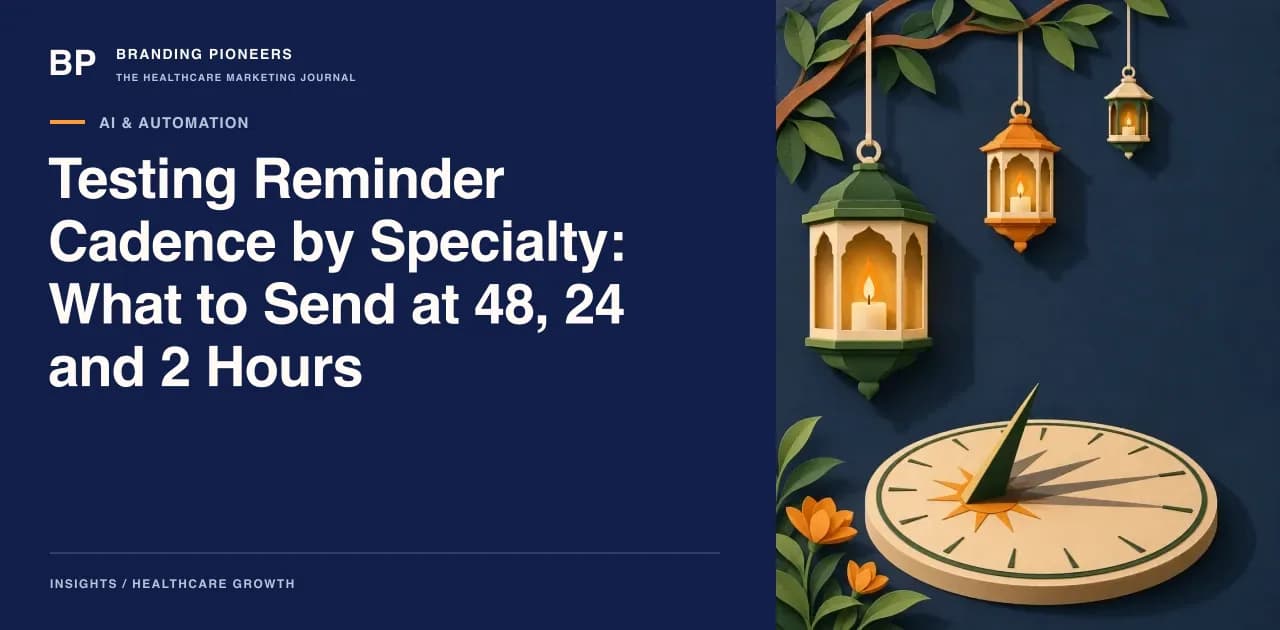
Testing Reminder Cadence by Specialty: What to Send at 48, 24 and 2 Hours

Design a clean experiment for 48, 24 and 2-hour reminders in dental, IVF and diagnostics: what each touch should say, WhatsApp cost rules, randomisation and decision rules.

Testing Reminder Cadence by Specialty: What to Send at 48, 24 and 2 Hours

Almost every clinic that sends appointment reminders uses the same schedule: one message a day before, maybe another on the morning. It is a habit, not a tested design. A dental recall, an IVF monitoring scan and a fasting blood test have different reasons for being missed, and one cadence cannot serve all three.

This article is for clinic managers, operations leads and marketing teams who send reminders by WhatsApp, SMS or call and want to find out, with an experiment, what to send at 48, 24 and 2 hours before an appointment for each specialty. It covers the content of each touch, the channel rules that affect cost, and how to run a clean test. It does not report results. The right cadence depends on your patients, and any number I gave you would be invented.

If you want the broader case for automating reminders, read how to reduce no-shows with automation first. This post assumes you have reminders in place and want to improve them.

What each reminder is for

Treat the three touches as three jobs, not three copies of the same text.

48 hours: planning and rescheduling. The purpose is to give the patient time to change the appointment. At this point, people still have flexibility, and the clinic still has time to refill a slot. Include the date, time, doctor and clinic, a one-tap way to confirm, and a simple way to reschedule. Preparation instructions that need time belong here.

24 hours: preparation and logistics. The purpose is to make attending easy. Include location and parking or landmark, what to bring (prescriptions, previous reports, insurance details), and any preparation required, such as fasting or stopping a product. A clinician must approve every preparation instruction.

2 hours: the nudge. The purpose is to prevent forgetting and to resolve last-minute doubts. Keep it short: time, place, a map link, and a number to call if they are running late. At this point, rescheduling frees little value, so the message should make it easy to arrive, not to cancel.

Specialty differences to design for

Why patients miss appointments differs by specialty, so the messages and timing should too. These are hypotheses to test, based on how each service works, not findings.

Dental

Many dental no-shows are low-urgency visits such as a check-up or a scale-and-polish, booked weeks ahead, and then forgotten or deprioritised. Consider a longer lead: a reminder at 7 days for appointments booked more than three weeks out, then 48 hours, then the morning of the visit. The 48-hour message should make rescheduling easy, because a patient who would otherwise skip may reschedule if it takes one tap. For procedures with an anxious component, such as an extraction or a root canal, test whether a calm explanation of what will happen reduces cancellations. Keep clinical language approved by the dentist.

IVF and fertility

Appointments are tied to cycle days, so a missed scan can disrupt a treatment cycle. Reminders matter more, and so does tone. The 48-hour touch should confirm the scan or consultation and offer a direct line to the coordinator. The 24-hour touch should carry any clinic-specified preparation, such as bladder instructions for a scan, written and approved by the clinician. The 2-hour touch should be brief and discreet. Avoid anything that reveals the nature of treatment in the message preview, because a phone may be seen by others. Test whether a named coordinator in the message lifts confirmations compared with a generic sender name.

Diagnostics and imaging

The main failure is not forgetting but preparation: patients arrive unfasted, with a full bladder when they should not, or without the referral. A no-show here often follows a late realisation that preparation was impossible. Test an earlier preparation message at 48 hours with a confirmation request, and a repeat at 24 hours. The 2-hour message for a fasting test might simply confirm the time and remind the patient to follow the instructions already provided. Instructions must come from the lab's clinical lead.

The channel rules that shape cost

If you use WhatsApp, the Meta pricing model affects your design. According to the official WhatsApp Business Platform pricing documentation, a 24-hour customer service window opens when a user messages you, and non-template messages can be sent only inside that window. Template messages are the only type allowed outside it. Templates are categorised as marketing, utility or authentication. Utility templates sent within an open window are free, utility and authentication templates outside it are charged, and marketing templates are charged whichever window state applies. Each approved template is charged by the category assigned at the time of use, so check the category Meta gives your reminder.

Three practical consequences for reminder tests:

  1. A reminder 48 hours before a visit is almost always outside a customer service window, so it needs an approved template and incurs a per-message charge. Compare costs across cadences, not only attendance.
  2. A patient reply opens a window. If your 48-hour template asks for a confirmation reply, the reply opens a 24-hour window in which you can send free-form messages, such as parking instructions, without another template charge.
  3. Do not slip promotional content into a reminder. Keep reminders strictly about the appointment, so they remain utility messages. Adding an offer risks reclassification as marketing, with different pricing and consent expectations. The rates themselves change, so read the current page before budgeting.

Check your consent records as well. Patients should have agreed to receive messages from you on the channel you use, and DPDP obligations are phasing in, with most due from May 2027, as this legal summary explains. Put the opt-in source on the contact record.

If you plan, schedule and track WhatsApp outreach in one place, WaCRS is built to plan WhatsApp campaigns and manage the resulting conversations. Any tool that can randomise and log works for the experiment below.

Want this applied to your practice? Get a free ai & automation audit.

Book my free audit

Designing the experiment

Choose one outcome and one question

Primary outcome: attended (checked in, or seen) versus no-show, with late cancellation freeing the slot treated as a separate outcome. Secondary outcomes: confirmed, rescheduled before the slot, and cost per attended appointment.

Ask one question per test. "Does adding a 2-hour message reduce no-shows in dental follow-ups?" is a test. "What is the best cadence?" is not.

Randomise at the right level

Randomise by appointment or, better, by patient, so that one person does not receive different cadences on different visits within the test period. Never randomise by day or by clinician unless you have no alternative, because staff, weather and traffic then confound the result. Use a deterministic hash of the patient ID so assignment is reproducible and auditable.

A control group is essential. In most tests the control is your current cadence. A three-arm design might look like this:

Arm48 hours24 hours2 hours
A (control)NoneStandard textNone
BPlanning message with confirm and rescheduleStandard textNone
CPlanning message with confirm and reschedulePreparation and logisticsShort nudge with map

Run each arm within the same specialty and the same clinics.

Size the test honestly

You need enough appointments to detect a difference you would care about. Decide the smallest improvement worth the extra cost, say two attended appointments in every hundred, and use a standard two-proportion power calculation to find the sample. Plug in your baseline no-show rate from the last quarter. If the sample you need is larger than you can collect in eight weeks, test a bigger change, merge arms or accept a wider interval. A test too small to read is worse than none because it breeds false confidence.

As a hypothetical illustration of the arithmetic, a clinic with a baseline no-show rate of 0.18 that wants to detect a drop to 0.15 needs a few thousand appointments per arm. Use a calculator with your own numbers rather than this figure.

Control the confounders

  • Exclude appointments booked less than 48 hours ahead from the 48-hour test, since they cannot receive the message.
  • Stratify by new versus follow-up patients, as their behaviour differs.
  • Keep content constant except the thing being tested. Change timing in one test and wording in another.
  • Avoid test windows containing festivals, exam seasons or monsoon disruption, or record them and compare like for like.
  • Log delivery status. If a message was not delivered, analyse it as "assigned" for an intention-to-treat view, and separately as "delivered".

Log the right data

For every appointment: patient_hash, specialty, clinic, appointment_type, lead_time_hours, arm, touch_sent_at, touch_delivered_at, touch_read_at, confirmed_at, rescheduled_at, attended, cost_per_message. This makes it possible to calculate cost per attended appointment per arm later.

Read the result

Compare attendance between arms with a confidence interval, not just a point difference. Report absolute differences in attended appointments, and the cost for each extra appointment attended. If arm C improves attendance slightly but adds several paid messages per patient, the right answer may be to keep B. Look at subgroups only as hypotheses for the next test, since slicing a small sample many ways finds patterns that are noise.

Write down the decision rule before the test starts: "We adopt arm C if attendance exceeds control by at least this margin and cost per extra attended appointment stays under this figure." That prevents post-hoc justification.

Content guardrails

  • No clinical advice beyond clinician-approved instructions.
  • No patient-identifying information in the message text beyond what is needed. Remember lock-screen previews.
  • Do not state the reason for the visit if it is sensitive.
  • Offer opt-out in every message series, and honour it.
  • Avoid urgency and guilt phrases that could pressure patients, and keep any fee policy clear and factual.

Where to start

  1. Pick one specialty and one question, and pull last quarter's no-show rate for it.
  2. Draft the 48, 24 and 2-hour templates, have a clinician approve preparation text, and submit templates as utility.
  3. Randomise by patient into two or three arms; log the fields above.
  4. Run for a pre-set period or sample size.
  5. Read results against the decision rule, then change one thing and test again.

For further reading, see our guide to automating appointment reminders, the WhatsApp automation service page, the WhatsApp healthcare guide and the no-show rate glossary entry.

Filed underappointment reminder cadence no showreminder timing experiment clinicWhatsApp appointment reminders costdental IVF diagnostics remindersreduce no shows reminder schedule

About the author

Co-Founder & CTO · Gurugram, India

Arush builds the systems the rest of the company runs on — the patient-acquisition pipelines, the AI chatbots, the analytics that tie a single click to a booked appointment. If a campaign reports a number, it's because something his team built is tracking it.

Free guide · 15 pages

The Patient Acquisition Blueprint

A 90-day plan from first search to booked appointment.

The Pioneers Brief — one essay, three benchmarks, one teardown, every Thursday. Subscribe free →

Free ai & automation audit

Your next chapter starts with a conversation.

Three quick questions. We come prepared with a plan for your specialty and city.

  • A 30-minute call with a healthcare specialist
  • Your top three growth opportunities, in writing
  • Honest advice — even if that means not hiring us
  • No obligation and no hard sell
You’ll speak with a senior strategist
Consultations are hosted by Arush Thapar’s team.
Step 1 of 3Takes 30 seconds

What do you want to improve first?

Details stay privateNo obligationReply within 1 working day

Client portfolio · Healthcare websites

Work relevant to testing reminder cadence by specialty what to send at 48 24 and.

Explore client work →