The True Cost of No-Shows
The average healthcare practice has a no-show rate of 20 to 30 percent. For a practice with 40 daily appointments at an average revenue of 200 dollars per visit, a 25 percent no-show rate means 10 empty slots per day. That is 2,000 dollars in lost revenue daily or roughly 500,000 dollars annually.
But the costs go beyond lost revenue. Empty slots disrupt scheduling efficiency, extend wait times for patients who did show up, and create stress for staff who have to manage the unpredictability.
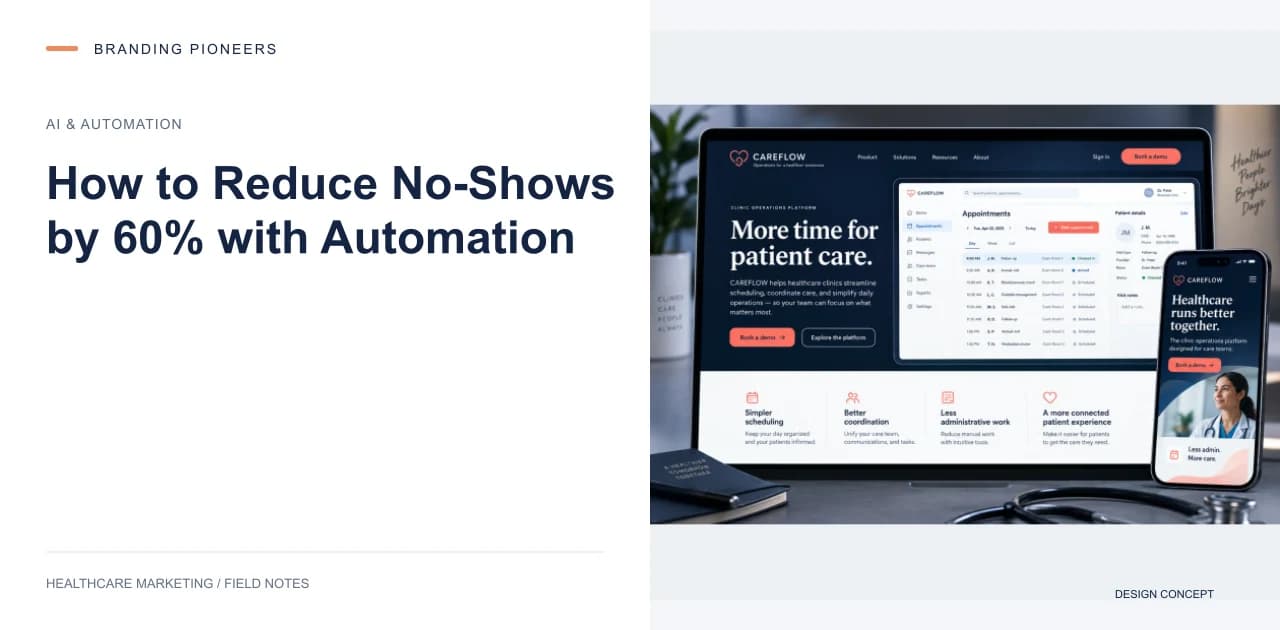
Practices that combine automated reminders, smarter scheduling and simple behavioural nudges bring their no-show rate down substantially — the size of the drop depends on the starting point and how consistently the reminders run. Here is the exact system.
The Multi-Touch Reminder System
A single appointment reminder is not enough. Patients need multiple touchpoints across multiple channels. Our recommended cadence is:
At booking: immediate confirmation via the patient's preferred channel (WhatsApp, SMS, or email) with date, time, doctor name, address, and preparation instructions.
Seven days before: a reminder message that includes a one-tap confirm or reschedule option. This early touchpoint catches scheduling conflicts before the appointment day.
48 hours before: a second reminder with preparation instructions (fasting requirements, documents to bring, etc.). This is the most important reminder — patients are close enough to the appointment to take action but still have time to reschedule.
Two hours before: a final reminder with driving directions or a link to the virtual waiting room for telehealth appointments. This catches patients who confirmed but forgot as the day got busy.
Channel Selection Matters
Not all reminder channels are equal. WhatsApp messages get opened far more reliably than SMS, and SMS in turn outperforms email. Phone calls are highly effective but expensive in staff time.
The optimal approach uses multiple channels. Send the seven-day and 48-hour reminders via WhatsApp or SMS (whichever the patient prefers). Send the two-hour reminder via SMS for immediacy. Use phone calls only for high-value appointments or patients who have not confirmed through digital channels.
Confirmation with Friction Reduction
Every reminder should include a low-friction confirmation mechanism. "Reply C to confirm" or a one-tap button in WhatsApp. The fewer steps required, the higher the confirmation rate.
When a patient confirms, your system should log the confirmation in the appointment record and stop sending further reminders. When a patient does not confirm after the 48-hour reminder, flag the appointment for staff follow-up — a personal phone call at this point catches most at-risk appointments.
Automated Waitlist Management
When a patient cancels or indicates they need to reschedule, your system should automatically notify the next person on your waitlist. "An appointment with Dr. Sharma on Thursday at 10am has opened up. Would you like to take it? Reply YES to book."
This fills cancellation slots automatically without staff intervention. Practices using automated waitlist management fill 60 to 70 percent of cancelled slots, compared to 10 to 15 percent with manual processes.
Smart Scheduling Practices
Automation alone is not enough. Scheduling practices also impact no-show rates.
Avoid scheduling appointments more than two weeks out for routine visits. No-show rates increase linearly with lead time — appointments booked three weeks ahead have double the no-show rate of appointments booked one week ahead.
Offer online self-scheduling. Patients who actively choose their appointment time are more committed than patients given a time by staff. Self-scheduled appointments have 15 to 20 percent lower no-show rates.
Double-book historically high-no-show slots. If data shows that Monday 8am has a 35 percent no-show rate, schedule two patients for that slot. On days when both show up, you will need a buffer — but on most days, the overbooking compensates for the expected no-show.
Behavioral Nudges
Small psychological interventions can reduce no-shows by 10 to 15 percent on top of reminder systems.
State the no-show impact in your confirmation message: "Your appointment is reserved for 30 minutes — if you cannot make it, please reschedule so another patient can use this slot." Emphasizing the impact on others tends to be more effective than financial penalties.
Ask the patient to verbally commit at booking: "Can we count on you to be there?" This verbal commitment triggers consistency bias — people who say yes feel psychologically compelled to follow through.
The Technology Stack
At minimum, you need a practice management system that supports automated SMS or WhatsApp reminders. Many modern systems like GoHighLevel, Cliniko, and Jane App include these features natively.
For a more sophisticated setup, integrate your PMS with a WhatsApp API platform and a CRM. This enables the multi-touch, multi-channel reminder system described above, plus automated waitlist management and no-show tracking analytics.
Track your no-show rate monthly by provider, day of week, time of day, and appointment type. Use this data to identify patterns and refine your scheduling and reminder strategies continuously.
Filed underreduce patient no-showsappointment reminder automationno-show reduction healthcarepatient scheduling automation

About the author
Arush Thapar
Co-Founder & CTO · Gurugram, India
Arush builds the systems the rest of the company runs on — the patient-acquisition pipelines, the AI chatbots, the analytics that tie a single click to a booked appointment. If a campaign reports a number, it's because something his team built is tracking it.
Free guide · 17 pages
The Patient Acquisition Blueprint
A 90-day plan from first search to booked appointment.