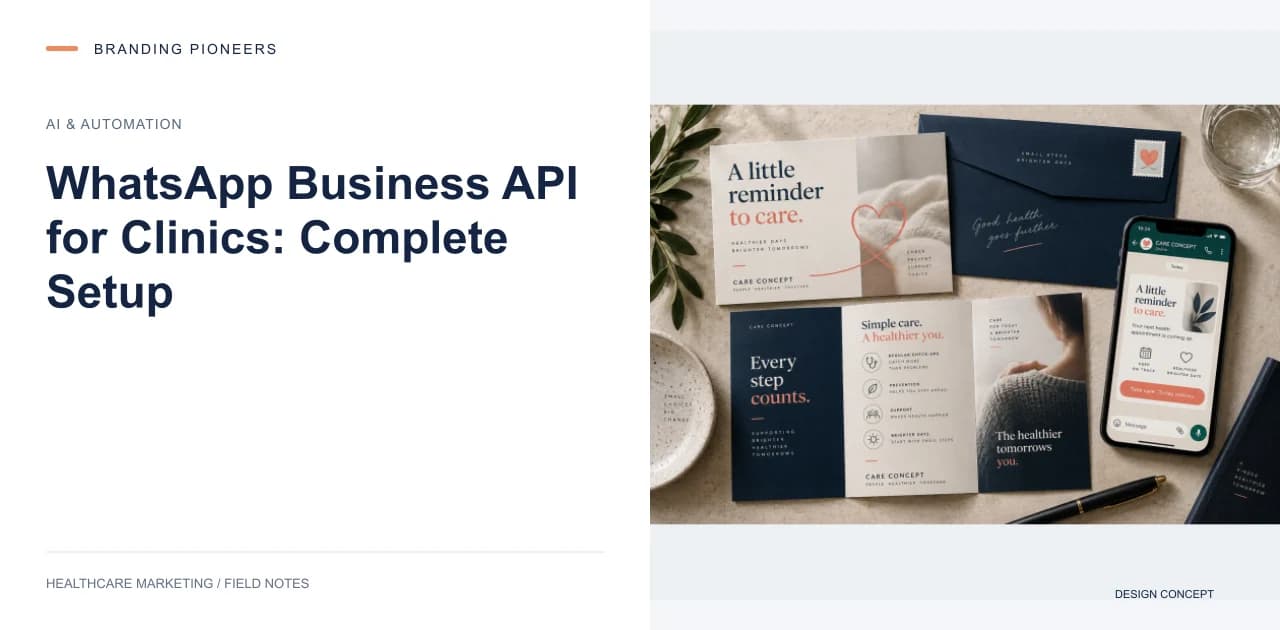
Why WhatsApp Beats Email and SMS for Patient Communication
Email open rates in healthcare tend to be low. SMS does somewhat better. WhatsApp messages get opened by nearly everyone who receives them. Patients not only open WhatsApp messages — they respond to them, usually within minutes rather than the hours it can take for an email reply.
For clinics in India, the Middle East, and many parts of Asia, WhatsApp is the default communication channel. Patients prefer it, and practices that use it effectively see higher booking rates, fewer no-shows, and better patient satisfaction scores.
The key distinction is between WhatsApp Business App (free, limited to one device, manual) and WhatsApp Business API (paid, multi-device, automatable). For any practice seeing more than 30 patients per day, the API is worth the investment.
Understanding WhatsApp Business App vs API
WhatsApp Business App (Free)
Best for solo practitioners or very small clinics. You get a business profile, away messages, quick replies, and labels for organizing chats. But it works on only one device, you cannot integrate it with your CRM or booking system, and you cannot automate conversations beyond basic away messages.
WhatsApp Business API
Designed for businesses at scale. Multiple team members can respond from different devices. It integrates with CRM platforms like GoHighLevel, HubSpot, and custom systems. You can build automated workflows, chatbots, and broadcast campaigns. And it connects to your appointment booking system for automated confirmations and reminders.
The API is not a standalone app — you access it through a Business Solution Provider (BSP) like Twilio, MessageBird, Gupshup, or WATI.
Step 1: Choose Your BSP
Your Business Solution Provider handles the technical integration between your systems and WhatsApp's API. For healthcare clinics, we recommend evaluating based on ease of setup (some BSPs require heavy developer involvement — others offer no-code platforms), CRM integration (does it connect to your existing practice management system), chatbot capabilities (can you build conversation flows without coding), pricing (BSPs charge per conversation or per message, plus WhatsApp's own conversation fees), and compliance features (message logging, consent management, data residency).
For most mid-size clinics, platforms like WATI or Gallabox offer the best balance of features and simplicity. For larger hospital systems that need deep customization, Twilio or MessageBird provide more flexibility.
Step 2: Register Your Business Number
You need a dedicated phone number for WhatsApp Business API. This can be a new number or an existing business number (but it cannot already be connected to WhatsApp Business App or personal WhatsApp — you will need to disconnect it first).
Register your business through Meta Business Manager. You will need your business name, website, business registration documents, and a brief description. Verification takes 2 to 7 business days.
Step 3: Create Message Templates
WhatsApp requires pre-approved message templates for any messages you initiate (as opposed to responding to patient messages). Templates need to be submitted to Meta for review and approval before use.
Essential templates for clinics include appointment confirmation ("Your appointment with Dr. [name] is confirmed for [date] at [time]. Reply YES to confirm or RESCHEDULE to change."), appointment reminder (24-hour advance reminder with the same confirmation mechanism), post-visit follow-up ("Thank you for visiting [clinic name]. How are you feeling? Reply if you need anything."), review request ("We hope your visit went well. Would you take 30 seconds to share your experience? [Google Review Link]"), and lab results notification ("Your [test] results are ready. Please visit [patient portal link] or call us to discuss.").
Step 4: Build Automation Workflows
The real power of WhatsApp API is automation. Set up workflows that trigger automatically based on events in your practice management system.
When a new appointment is booked, send a confirmation message with the doctor's name, date, time, address, and preparation instructions. Twenty-four hours before the appointment, send a reminder. If the patient does not confirm, trigger a follow-up message or a phone call from your front desk.
After the visit, send a follow-up message at the appropriate interval. Three days later, send a review request. For patients who need follow-up appointments, send a recall reminder at the clinically appropriate time.
Step 5: Set Up Multi-Agent Access
Configure your BSP so that multiple team members can handle WhatsApp conversations simultaneously. Assign conversations based on department (billing questions route to billing, appointment requests route to front desk) or use round-robin assignment.
Ensure your team understands response time expectations. Patients expect WhatsApp responses within minutes, not hours. If a message comes in outside business hours, set up auto-replies that acknowledge the message and provide a timeframe for response.
Compliance Considerations
WhatsApp messages containing patient health information must comply with privacy regulations applicable in your jurisdiction. For HIPAA-covered entities, ensure your BSP has a Business Associate Agreement in place. Regardless of jurisdiction, obtain consent before initiating WhatsApp communication and give patients an easy way to opt out.
Never send diagnostic results via WhatsApp without proper security measures. Use WhatsApp to notify patients that results are available, then direct them to a secure patient portal.
Filed underWhatsApp Business API clinicshealthcare WhatsApp automationWhatsApp for doctorspatient communication WhatsApp

About the author
Arush Thapar
Co-Founder & CTO · Gurugram, India
Arush builds the systems the rest of the company runs on — the patient-acquisition pipelines, the AI chatbots, the analytics that tie a single click to a booked appointment. If a campaign reports a number, it's because something his team built is tracking it.
Free guide · 17 pages
The Patient Acquisition Blueprint
A 90-day plan from first search to booked appointment.