Strategy

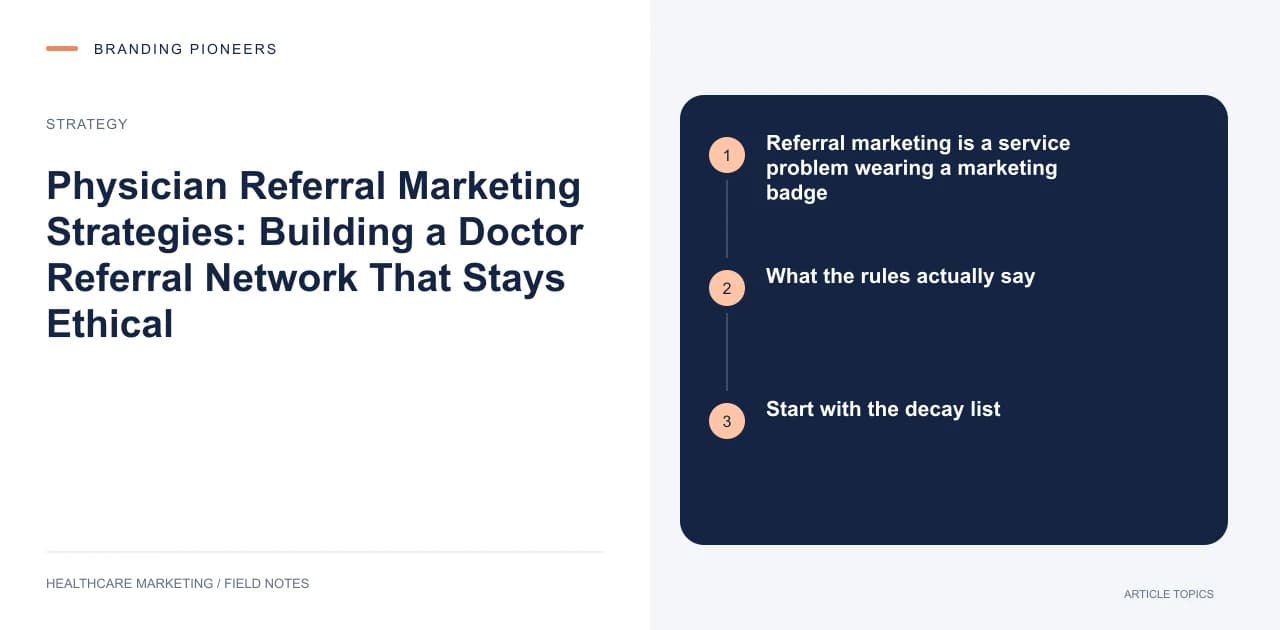
Physician Referral Marketing Strategies: Building a Doctor Referral Network That Stays Ethical

Every hospital says it wants more referrals. Almost none of them can name the ten doctors who stopped referring last quarter. That list is the whole strategy.

NS
Founder & CEO · November 9, 2026 · 7 min read
FILE · PHYSICIA
Physician Referral Marketing Strategies: Building a Doctor Referral Network That Stays Ethical

Ask a hospital's marketing team how the referral network is doing and you will get a number for referrals received. Ask which referring doctors sent fewer patients this quarter than last, and the room goes quiet.

That second list is the entire discipline. Referral volume is an output. Referring relationships are the thing you can actually manage, and they decay quietly — not with a complaint, but with a doctor who had one bad experience with your discharge summary and started sending patients down the road instead.

Referral marketing is a service problem wearing a marketing badge

A general practitioner referring a patient to a specialist is making a decision with the same information problem the patient has, and less time to solve it. They are asking: will this consultant see my patient quickly, will they treat them well, will I hear back, and will the patient still be my patient afterwards.

Everything that grows a referral network answers one of those four questions. Nothing else does — not a brochure, not a dinner, not a glossy department profile.

Which is why the work sits half in marketing and half in operations, and why programmes owned entirely by marketing tend to plateau. The marketing team can make the promise. Only the department can keep it.

What the rules actually say

This is the part where healthcare referral marketing diverges sharply from every other kind of partner marketing, and the divergence is not optional.

In India, the National Medical Commission — which replaced the Medical Council of India in 2020 under the NMC Act 2019 — sets the professional conduct regulations that bind registered practitioners. Giving or receiving any commission, cut, or fee-split for a referral is prohibited. The practice has a local nickname and a long history and it is still prohibited. Read the current regulations at nmc.org.in rather than relying on what the previous generation of hospital business development did.

In the United States, two separate laws apply. The federal Anti-Kickback Statute prohibits offering or receiving anything of value to induce referrals for services payable by a federal healthcare programme. The Stark Law restricts physician self-referral for designated health services. Both have safe harbours and exceptions, both carry serious consequences, and neither is a matter for the marketing department to interpret alone. The OIG publishes guidance; your counsel reads it before you design any programme that involves money, space, staff, or equipment moving between organisations.

What is permitted in both countries is substantial: education, access, communication, clinical collaboration, and doing your job well enough that referring doctors want to keep referring. That is more than enough to build on.

Start with the decay list

Pull every referral received over the last two years, grouped by referring doctor and by quarter. Then sort by the change.

Three groups fall out. Doctors who have increased — find out what changed and whether it is repeatable. Doctors who are steady — protect them; they are the base. Doctors who have dropped or stopped — this is the list, and it is almost always shorter and more fixable than the effort spent chasing new referrers.

Call the third group. Not a survey, not an email — a call from a consultant, not from marketing, asking what happened. The answers are usually specific and unflattering: the report took three weeks, nobody could get through on the number, the patient was moved to another consultant without being told, the discharge summary had no medication list.

Each of those is fixable in operations and none of them is fixable with a brochure.

What referring doctors need from you

The report, back fast, and readable. This is the single most influential thing in the relationship. A consultation note that arrives within days, names the findings, states the plan, and says explicitly what the referring doctor should do next is worth more than any amount of outreach.

A line that reaches a human. Not the main switchboard. A number or a WhatsApp line that a referring doctor can use and get an answer on the same day, staffed by someone who can check a slot and book it.

Clear sub-specialty scope. Referring doctors send patients to the wrong consultant constantly, because your department page lists nine names and no interests. Say who does what. It reduces both misrouting and the awkward internal handovers that follow.

Honest waiting times. A doctor who is told two weeks and sees four weeks stops referring. A doctor told four weeks and given four weeks refers again.

The patient back. The fear that a referral becomes a permanent transfer is real and rarely discussed. Say the opposite out loud, in writing, and then behave accordingly.

The physician liaison, and what the role is actually for

A liaison — the role exists under different titles in Indian hospitals and is formalised in American health systems — spends their week visiting referring practices. Done badly it is a person delivering pens. Done well it is a field service role: collecting the complaints that never reach the hospital, fixing access problems on the spot, briefing practices on new services, and reporting back which relationships are cooling.

Two things make the role work. A CRM record for each referring practice, with visit history, issues raised, and issues resolved — not a spreadsheet of names. And the authority to escalate: a liaison who can get a slot released or a report chased earns trust that a liaison who can only listen never will.

The systems side of this is covered on our patient referral system page, with the tracking layer on referral tracking.
Build the digital side for doctors, not for patients

Almost every hospital website is written for patients, which means a referring doctor landing on it finds marketing copy and no referral route.

What a referral section needs: a one-page referral form that does not require an account, direct contact details for each department, sub-specialty interests per consultant, typical waiting times, what to send with the patient, and how the report comes back. A referring doctor should be able to complete a referral from a phone between patients.

If you have the appetite for it, a doctor-facing portal where a referring practice can see status and download the report removes the phone call that currently consumes your secretary's afternoon — the build is described on our doctor referral platform page. Start with the form. Most hospitals do not have a working one.

The second network nobody manages

Referring doctors are the obvious network. Two others feed most hospitals and are usually unowned.

Diagnostic centres and imaging labs see patients before you do, and the radiologist who spots something has an opinion about where that patient should go next. The relationship is built the same way — turnaround, access, and a consultant who takes the call.

Pharmacies, physiotherapists, dentists, and optometrists refer more than hospitals expect, particularly in Indian cities where they are often the first point of contact for a symptom. None of this involves payment, and none of it works as a mailing list. It works when somebody from the hospital has actually met them.

Write down who owns each of those relationships. If the answer is nobody, that is the finding.

Where referral programmes go wrong

Three failures repeat.

The programme becomes a hospitality budget. Dinners and gifts are the part of referral marketing that is easiest to organise and, in both India and the United States, the part most likely to create a regulatory problem. Spend the money on turnaround instead.

The data lives in one consultant's head. When they retire or move, the network goes with them, because nothing was ever recorded against the hospital's name.

Referrals are counted but never acknowledged. A referring doctor who never hears that their patient was seen, treated, and discharged has no evidence the referral was worth making.

Measure referrers, not referrals

Four numbers, reviewed monthly.

Active referring doctors — how many sent at least one patient this quarter. Growth here is the health of the network. New referrers — how many sent their first. Lapsed referrers — how many stopped, which is the early warning nobody watches. Report turnaround — median days from consultation to report received, per department. This is your service level, and it predicts the other three.

Referral volume will follow those four. Watching volume alone tells you the network changed after it has already changed. The wider department-level picture sits in our hospital marketing guide, and the admissions side in increasing IPD admissions.

What to do first

  1. Build the decay list and have a consultant call the doctors on it.
  2. Measure report turnaround by department and publish it internally.
  3. Put one reachable number in place for referring doctors and staff it.
  4. Write the sub-specialty interests on every consultant profile.
  5. Put a referral form on the website that works on a phone.

None of that involves anything of value changing hands, which is the point. The compliant version of referral marketing is also the version that works, because what referring doctors respond to is competence.

---

If you want a view of how your referral pathways look from a referring doctor's side — what they can find, who they can reach, and how fast — get a free audit and we will send the findings whether or not you work with us. Or book a strategy call to talk through the programme.

FILED UNDERphysician referral marketing strategiesdoctor referral marketingphysician referral programphysician liaison
Stop reading. Start ranking.
Get a free strategy audit — we'll show you exactly what's missing.
Book audit →
Author
Founder & CEO · Gurugram, India

Nishu founded Branding Pioneers in 2016 with one rule that hasn't changed since: healthcare only. She'd run digital strategy at a top-10 Indian agency and watched generalist marketing underserve medical clients who needed something built for how patients actually search and decide. So she left to build the specialist instead. It's now an 80-person team working with healthcare brands worldwide.

The Patient Acquisition Blueprint (2026 Edition) — guide cover
Free · 15 pages

The Patient Acquisition Blueprint (2026 Edition)

The exact 90-day patient-acquisition system, step by step.

We never share your details

FREE · 30 MIN
See your strategy opportunity gap.

Senior strategist, no boilerplate. Reply within 4 hours.

Book audit → Or call us directly
The Pioneers Brief · weekly
One essay. Three benchmarks. One teardown.
Subscribe — free
The Patient Acquisition Blueprint (2026 Edition) — guide cover
Free for strategy readers

The Patient Acquisition Blueprint (2026 Edition)

The exact 90-day patient-acquisition system, step by step.

  • The 90-day patient acquisition operating system
  • Channel-by-channel budget allocation (₹50L–₹5Cr/yr)
  • 12 real, named client engagements walked through
  • ROI tracking spreadsheet (CAC, LTV, payback)
15 pages · Used by 350+ healthcare clients · Updated for AI search

We never share your details

Continue reading

More on strategy.

BROWSE ALL →
From the studio

This thinking, applied.

Video production and video SEO for healthcare brands
Video · SEO
Video built to rank and convert
Meta Ads reach and delivery reporting
Meta Ads
Meta Ads — delivery and reach reporting
Dental practices and DSOs — healthcare marketing by Branding Pioneers
Vertical
Dental practices and DSOs
The Branding Pioneers engagement process
Process
How an engagement runs
Always-on social management for healthcare brands
Social
Always-on social management
Why choose us

Why healthcare brands choose us.

Six reasons hospitals, clinics, and doctors pick a healthcare-only firm over a generalist agency.

  • Healthcare-only

    It's all we do. No retail, no fintech — the whole team thinks in patient journeys, clinical trust, and the way people actually choose a doctor.

  • AI-first systems

    Receptionists, WhatsApp triage, and attribution built in-house — we answer patients in seconds and tie every click to a booked appointment.

  • Compliance built-in

    HIPAA-aware handling, ASCI-reviewed creative, and GDPR/DPDP sign-off on every campaign — our standard, not an upcharge or an afterthought.

  • Senior on every account

    The senior who pitched you stays on the engagement. No bait-and-switch to juniors learning on your budget.

  • Measured to the appointment

    Patient-level attribution across calls, forms, and walk-ins. Monthly reports show booked patients — not just clicks and impressions.

  • Receipts, not promises

    We name our clients and show the work. Quarterly reviews with the numbers attached, every cycle.

The Branding Pioneers healthcare-marketing team at work
Healthcare-only · since 2016
A team that does one thing well.
More from the brief

If this resonated, here’s what else lands.

Adjacent practices, the relevant tools, and the case files where we shipped this thinking against real patient-acquisition targets.

THE PIONEERS BRIEF · WEEKLY

One essay,
three benchmarks,
one teardown.

Healthcare growth, every Thursday morning. No hype, no fluff.

physician referral marketing strategies · Portfolio

Healthcare websites: selected work

Explore the collection →