Strategy

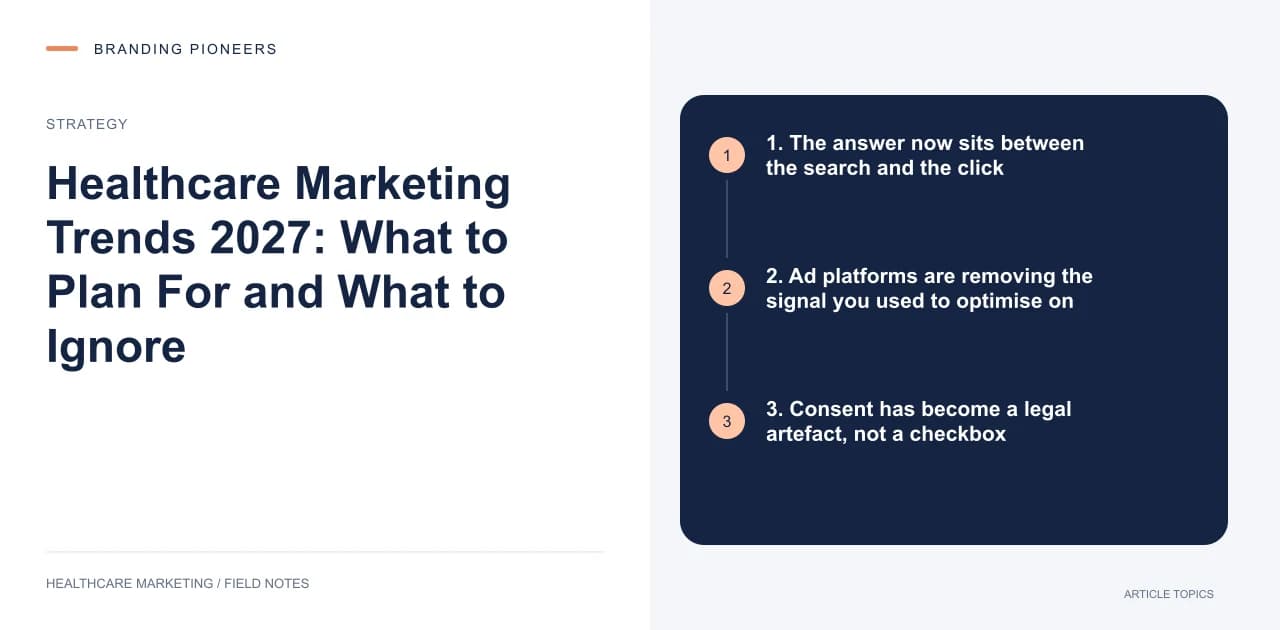
Healthcare Marketing Trends 2027: What to Plan For and What to Ignore

No predictions dressed up as data. Six things that are observable right now, what follows from each of them for a clinic's plan, and the list of trends worth ignoring.

NS
Founder & CEO · December 16, 2026 · 7 min read
FILE · HEALTHCA
Healthcare Marketing Trends 2027: What to Plan For and What to Ignore

Most trend articles are a forecast with a confident tone and no source. They work because nobody checks them in December of the following year.

This one is built differently. Everything below is something you can observe today — a platform behaviour, a published rule, a change in where patients are landing. The prediction part is only the inference: if this is true now, here is what it means for what you build next year. Where the inference is uncertain, it says so.

For what changed over the past twelve months, the 2026 trends post still holds up and is worth reading alongside this.

1. The answer now sits between the search and the click

Observable: Google shows AI-generated answers on a large share of health queries and has an AI Mode alongside classic results. ChatGPT and other assistants have search built in and cite sources. Patients ask questions in full sentences and get a synthesised reply.

What follows is not "SEO is dead". It is that the first sentence of your page is now doing a job it did not used to do. A page that builds to its answer over four paragraphs is not quotable. A page that answers in the first two sentences and then explains is.

Two practical consequences. Attribution gets worse before it gets better — a patient can read your content inside an assistant and arrive later as direct traffic, so the channel that did the work is not the channel that gets credit. And authorship stops being a nice-to-have: a named clinician with verifiable credentials, a reviewed date, and a real address is what makes content citable. That is the same E-E-A-T requirement search has applied to health content for years, now with a second consumer.

2. Ad platforms are removing the signal you used to optimise on

Observable: Meta's health and wellness policies restrict what health advertisers can pass back and target on. Google restricts several health categories and varies the rules by country. Neither Google nor Meta signs a business associate agreement, so no patient-identifying data should be reaching them at all.

What follows: optimisation moves from the platform to your own systems. Offline conversion import, where you send the platform the fact that an appointment was attended rather than that a form was filled, becomes the way campaigns learn. Fewer, better conversion events beat many noisy ones. And server-side tagging becomes a normal part of a healthcare setup rather than an advanced one.

The clinics that will be in trouble are the ones whose entire optimisation depends on a pixel firing on a thank-you page.

Observable, and checkable at source. In India, the DPDP Act 2023 and the DPDP Rules 2025 set the requirements for notice and consent, with the Data Protection Board of India as the regulator. In the UAE, the Personal Data Protection Law sits alongside Federal Law No. 2 of 2019 on the use of ICT in health fields, which restricts health data leaving the country. Saudi Arabia's Personal Data Protection Law is overseen by SDAIA. In the US, HIPAA governs protected health information, and it governs only the US.

What follows: consent management stops being a legal department problem and becomes a marketing dependency, because it determines what you are allowed to measure. The practical version is unglamorous — a consent banner that actually controls tag firing, a record of what each patient agreed to, a data processing agreement with every vendor that touches an enquiry, and a clear answer to where your CRM's servers are. Our compliance section keeps the market-by-market version of this in one place.

4. Reviews are regulated now, not just reputational

Observable: the United States Federal Trade Commission has a rule addressing fake reviews and testimonials, including buying reviews and suppressing negative ones. The United Kingdom's Digital Markets, Competition and Consumers Act 2024 contains a fake review ban. In India, the Central Consumer Protection Authority has issued guidelines on online reviews alongside a Bureau of Indian Standards framework.

What follows: review gating — screening patients and only inviting the happy ones to post publicly — moves from a grey tactic to a legal exposure, and in the US it always sat awkwardly with platform policy anyway. The compliant version is duller and works better: ask everyone, make it easy, answer the negative ones without disclosing anything about the patient, and fix what the reviews are telling you.

5. The named clinician is the format

Observable: short video is where discovery happens on Instagram and YouTube, and in healthcare the accounts that hold attention are the ones with an actual clinician on camera rather than a brand voice.

What follows: the production budget matters less than the scheduling. Ninety seconds, one question, the real doctor, no promotional framing, posted on the page it belongs to. The constraint is clinician time, and the practices that do this well solve it by batching — one afternoon a quarter produces a season of content.

One market note that keeps being ignored in globally written trend pieces: TikTok has been banned in India since 2020. An India-facing plan built around it is not a plan.
6. AI in the front office is ordinary now

Observable: chat and voice assistants that handle enquiries, answer routine questions and book appointments are widely deployed and no longer novel.

What follows is a change in where the risk sits. The failure mode is not that the assistant gives a wrong medical answer — a properly scoped one does not attempt clinical advice. The failure mode is handoff: a patient who needs a human gets stuck in a loop, or a message arrives at two in the morning and nobody sees it until Tuesday. Specify the escalation path before you specify the conversation tree, and review the transcripts weekly for the first month.

7. Cost is a search category, and most clinics refuse to serve it

Observable: patients search for the price of a procedure in volume, in every market, and the pages that rank for those searches are usually aggregators, forums and competitors rather than the hospitals that perform the procedure.

The reason is internal rather than technical. Publishing a price feels like a commercial exposure, so the page never gets written, and the patient forms their expectation somewhere else.

What follows is not a demand that you publish a single number. It is that a page explaining what determines the cost — the variables, what is included, what is not, what changes it, and how to get an accurate figure — outperforms both silence and a bare price. The patient who arrives having read it is easier to consult with, and the enquiry is better qualified. Clinics that have done this generally report the opposite of what they feared: fewer price-shopping calls, not more.

How to tell a real shift from a repackaged one

A useful filter, because next year will produce a lot of both.

Ask what specifically changed — a platform behaviour, a published rule, a measurable change in patient behaviour. If the answer is a sentiment rather than an event, it is not a trend.

Ask who is affected if it is false. A genuine shift has consequences for someone. A repackaged one only has consequences for the person selling the response to it.

And ask what it would cost to ignore for twelve months. Most of what appears on these lists costs nothing to ignore for a year, which is a reasonable default when your measurement is not yet in order. The four things at the end of this post are the ones that do cost something.

What to ignore

Anything sold as a guarantee of ranking or of placement in an AI answer. Nobody controls either, and the people selling it know that.

Rebranded versions of things that already exist. A large share of what will be announced as new next year is existing practice with a new acronym. If the description could be replaced with "write good pages and mark them up properly" without losing meaning, it is not new.

Trend lists with no regulator in them. Healthcare marketing is shaped more by NMC, ASCI, the FTC, DHA and the data protection authorities than by any platform feature. A forecast that mentions none of them is about marketing in general, not about yours.

The metaverse-shaped item. Every year one channel gets promoted on the strength of potential rather than patients. Let someone else fund the experiment and read their write-up.

What to actually put in the plan

If you take four things into next year: fix measurement so a booked appointment is what you optimise on; make your clinical pages answer in the first two sentences and attribute them to real clinicians; get consent handling into a state you could explain to a regulator; and get your doctors on camera for one afternoon a quarter.

None of that is a trend. It is the work that the trends keep pointing at. The healthcare marketing guide is where the full version of that plan sits, and our SEO service covers the search half of it.

---

If you want to know which of the six shifts above your practice is currently exposed to — and which of them you have already quietly solved — get a free audit and we will mark it against your site and your accounts. Or book a strategy call before you lock next year's budget.

FILED UNDERhealthcare trends 2027digital marketing trends 2027healthcare marketing trends
Stop reading. Start ranking.
Get a free strategy audit — we'll show you exactly what's missing.
Book audit →
Author
Founder & CEO · Gurugram, India

Nishu founded Branding Pioneers in 2016 with one rule that hasn't changed since: healthcare only. She'd run digital strategy at a top-10 Indian agency and watched generalist marketing underserve medical clients who needed something built for how patients actually search and decide. So she left to build the specialist instead. It's now an 80-person team working with healthcare brands worldwide.

The Patient Acquisition Blueprint (2026 Edition) — guide cover
Free · 15 pages

The Patient Acquisition Blueprint (2026 Edition)

The exact 90-day patient-acquisition system, step by step.

We never share your details

FREE · 30 MIN
See your strategy opportunity gap.

Senior strategist, no boilerplate. Reply within 4 hours.

Book audit → Or call us directly
The Pioneers Brief · weekly
One essay. Three benchmarks. One teardown.
Subscribe — free
The Patient Acquisition Blueprint (2026 Edition) — guide cover
Free for strategy readers

The Patient Acquisition Blueprint (2026 Edition)

The exact 90-day patient-acquisition system, step by step.

  • The 90-day patient acquisition operating system
  • Channel-by-channel budget allocation (₹50L–₹5Cr/yr)
  • 12 real, named client engagements walked through
  • ROI tracking spreadsheet (CAC, LTV, payback)
15 pages · Used by 350+ healthcare clients · Updated for AI search

We never share your details

Continue reading

More on strategy.

BROWSE ALL →
From the studio

This thinking, applied.

Video production and video SEO for healthcare brands
Video · SEO
Video built to rank and convert
Google reviews and ratings management
Reputation
Review and rating operations
Healthcare SEO that surfaces in AI search
Service
SEO
A selection of the doctors and specialists we have produced work with
Doctors
A few of them — full interviews on request
Vizer — investor and go-to-market deck design system
Deck · Diagnostics
Vizer — investor and go-to-market deck
Why choose us

Why healthcare brands choose us.

Six reasons hospitals, clinics, and doctors pick a healthcare-only firm over a generalist agency.

  • Healthcare-only

    It's all we do. No retail, no fintech — the whole team thinks in patient journeys, clinical trust, and the way people actually choose a doctor.

  • AI-first systems

    Receptionists, WhatsApp triage, and attribution built in-house — we answer patients in seconds and tie every click to a booked appointment.

  • Compliance built-in

    HIPAA-aware handling, ASCI-reviewed creative, and GDPR/DPDP sign-off on every campaign — our standard, not an upcharge or an afterthought.

  • Senior on every account

    The senior who pitched you stays on the engagement. No bait-and-switch to juniors learning on your budget.

  • Measured to the appointment

    Patient-level attribution across calls, forms, and walk-ins. Monthly reports show booked patients — not just clicks and impressions.

  • Receipts, not promises

    We name our clients and show the work. Quarterly reviews with the numbers attached, every cycle.

The Branding Pioneers healthcare-marketing team at work
Healthcare-only · since 2016
A team that does one thing well.
More from the brief

If this resonated, here’s what else lands.

Adjacent practices, the relevant tools, and the case files where we shipped this thinking against real patient-acquisition targets.

THE PIONEERS BRIEF · WEEKLY

One essay,
three benchmarks,
one teardown.

Healthcare growth, every Thursday morning. No hype, no fluff.