Most hospital marketing plans are forty slides long and nobody opens them after February.
The reason is not laziness. It is that the document was written to be approved rather than to be used. It describes ambitions rather than decisions, it allocates money without naming what it is buying, and it contains no sentence that anyone could later be wrong about.
A plan that gets used has the opposite properties. It is short enough to read in one sitting, it says what you will not do, and it contains numbers that came out of your own systems. Here is a nine-section structure that produces that, with the arithmetic laid out so you can fill it from your books rather than from a benchmark someone made up.
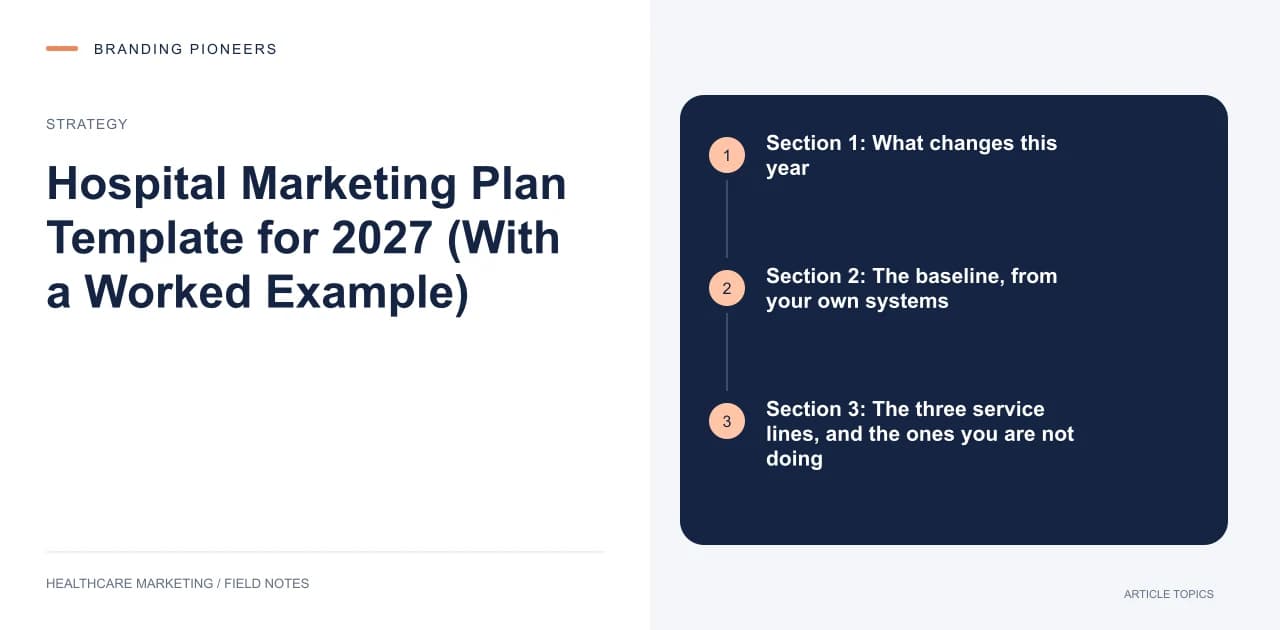
Section 1: What changes this year
One page. Not a summary of the plan — a statement of what will be different.
Three sentences is usually enough. "We are moving budget out of X and into Y. We are prioritising these three service lines and pausing work on the others. We are fixing measurement first, because we could not defend last year's spend."
If you cannot write this page, the rest of the plan is last year's plan with the dates changed.
Section 2: The baseline, from your own systems
This is the section that makes the plan real, and the one most often skipped because the data is uncomfortable to assemble.
For the last twelve months, pull: enquiries by source, consultations booked, consultations attended, procedures performed, and revenue by service line. From your HIS, your CRM and your call logs — not from the agency's dashboard.
Then write down what you could not find out. That list is a work item for the coming year, and it belongs in the plan as one.
Section 3: The three service lines, and the ones you are not doing
Hospitals lose more marketing money to breadth than to bad execution. A plan that promotes every department promotes none of them.
Pick three. Choose them on contribution and capacity together — a service line with margin but no available slots is not a growth target, it is a scheduling problem. Then name, explicitly, the departments that will not get campaign support this year, and tell them before they read it in the plan.
The refusal is the most useful page in the document. It is also the one that needs the medical director's signature.
Section 4: The patient this plan is for
Per service line, one paragraph. Who they are, what they searched, what they were afraid of, what made them delay, and who else was in the decision. For an elderly parent's procedure, the person searching is often the adult child; for an aesthetic treatment, the person searching is the patient; for oncology, it is usually both, separately, on different devices.
Write it from what your front desk hears, not from a persona template.
Section 5: The channel plan, per service line
Not a channel budget for the hospital. A channel plan for each of the three service lines, because they do not behave the same way.
For each: which channel produces the first contact, which produces the booking, what content has to exist for it to work, and what the handover to the call centre looks like. A channel with no named content requirement and no named owner is a line item, not a plan.
State the compliance constraint here too rather than in an appendix, because it changes what you can build. India's NMC ethical advertising guidelines of 6 October 2026 and ASCI's code shape what a doctor or hospital can claim, and they rule out testimonials, before-and-after posts, offers and superlatives; NABH standards require that published claims are supportable from operational data; and the DPDP Act 2023 with the DPDP Rules 2025 governs what you may do with patient contact data, under the Data Protection Board of India. If any of your marketing is US-facing, HIPAA applies to that part and not to the rest.
Section 6: Budget, derived rather than guessed
This is where plans usually invent a percentage. Do the arithmetic instead — it takes ten minutes and it is defensible in a board meeting.
Work backwards from the revenue target:
- Patients needed = revenue target for the service line ÷ your average case value for that service line
- Enquiries needed = patients needed ÷ your enquiry-to-patient conversion rate
- Budget = enquiries needed × your cost per enquiry
Every input comes from Section 2. If you do not have one of them, you have found the reason your budget arguments go in circles.
Then hold back a portion of the annual budget, unallocated, for the middle of the year. Something will turn out to work better than expected and you will want to buy more of it. A fully committed budget cannot respond to its own results.
The marketing budget planner will run this arithmetic for you, and the healthcare marketing budget guide goes into how the inputs are sourced when your systems are incomplete.
Section 7: Compliance pre-flight
One page listing what gets checked before anything is published, and by whom.
Claim substantiation. Patient consent for every image, testimonial and case study, remembering that in India consent does not make a promotional testimonial or before-and-after permissible (NMC para 6.2). Doctor credentials verified against records. Advertising permits where the market requires them — DHA, Department of Health — Abu Dhabi or MOHAP in the UAE, the Ministry of Health and SFDA in Saudi Arabia. Review handling, including the rule that you never solicit reviews only from patients you expect to be happy.
Name the person who signs off. A compliance step with no name attached does not happen.
Section 8: Who owns what
A table. Every channel, the internal owner, the external vendor if there is one, and the date of the standing review.
Include the front desk. The most common failure in hospital marketing is not campaign performance — it is a campaign performing into a phone line nobody picks up after six in the evening.
Section 9: Reporting cadence and the stop rule
Monthly review of the numbers from Section 2. Quarterly review of the plan itself.
And a stop rule, written in advance: what result, by what date, would cause you to end a channel. Deciding this in January is a governance decision. Deciding it in August is an argument.
Adapting it for a single-site clinic
The nine sections hold at any size — what changes is how long each takes.
A single-site clinic can do the whole thing in an afternoon. Section 2 comes from the practice management system rather than a data team. Section 3 picks one service line rather than three. Section 8 will often name the same person against every row, which is fine as long as it is written down, because the failure mode for a small clinic is not conflicting owners, it is assuming someone is covering something.
The section that gets skipped at small scale and should not is Section 9, the stop rule. A hospital can absorb a channel that quietly does nothing for a year. A clinic on a fixed monthly budget cannot, and the stop rule is what makes the cut happen in March rather than the following December.
The worked example (illustrative)
The following is illustrative — the numbers are placeholders to show the shape of the arithmetic, not results from any client.
Take a multi-specialty hospital choosing orthopaedics, cardiology and maternity as its three lines. For orthopaedics, the finance team supplies an average case value from last year's billing; the board sets a revenue target for the line. Dividing the second by the first gives the number of procedures needed.
The CRM says how many enquiries produced one procedure last year — including the ones that fell out at consultation, which is where most hospital funnels leak. Dividing the procedures needed by that conversion rate gives the enquiry target. Multiplying the enquiry target by last year's cost per enquiry gives the budget for the line.
Do the same for cardiology and maternity. Add the three, add the hold-back, and you have a budget built from your own operations. If the total is larger than the hospital will approve, the conversation becomes a real one: either the revenue target moves, or the conversion rate has to improve, or the cost per enquiry has to come down — and each of those is a different piece of work with a different owner.
That is the whole value of the template. It converts "we need more marketing budget" into three specific, arguable statements.
What makes plans fail
Three things, consistently.
No baseline, so nothing can be judged. No refusal, so the budget spreads thin across every department that asked. And no owner for the middle of the funnel, so enquiries arrive and nobody converts them.
The template above is mostly designed to prevent those three. Our templates library has the working versions of the budget and reporting sheets, and the measurement page covers how to wire the baseline if Section 2 is currently impossible for you. Our own engagement tiers and minimum terms are published on the pricing page if an external partner is part of the plan.
---
If you want the baseline built before you write the plan — what your channels actually produced last year, and which of the Section 2 inputs you are missing — get a free audit. Or book a strategy call and we will work through the nine sections with your numbers.
Filed underhospital marketing plan templatehealthcare marketing plan templatehospital marketing plan examplesmedical marketing plan template

About the author
Nishu Sharma
Founder & CEO · Gurugram, India
Nishu founded Branding Pioneers in 2016 with one rule that hasn't changed since: healthcare only. She'd run digital strategy at a top-10 Indian agency and watched generalist marketing underserve medical clients who needed something built for how patients actually search and decide. So she left to build the specialist instead. It's now an 80-person team working with healthcare brands worldwide.
Free guide · 17 pages
The Patient Acquisition Blueprint
A 90-day plan from first search to booked appointment.