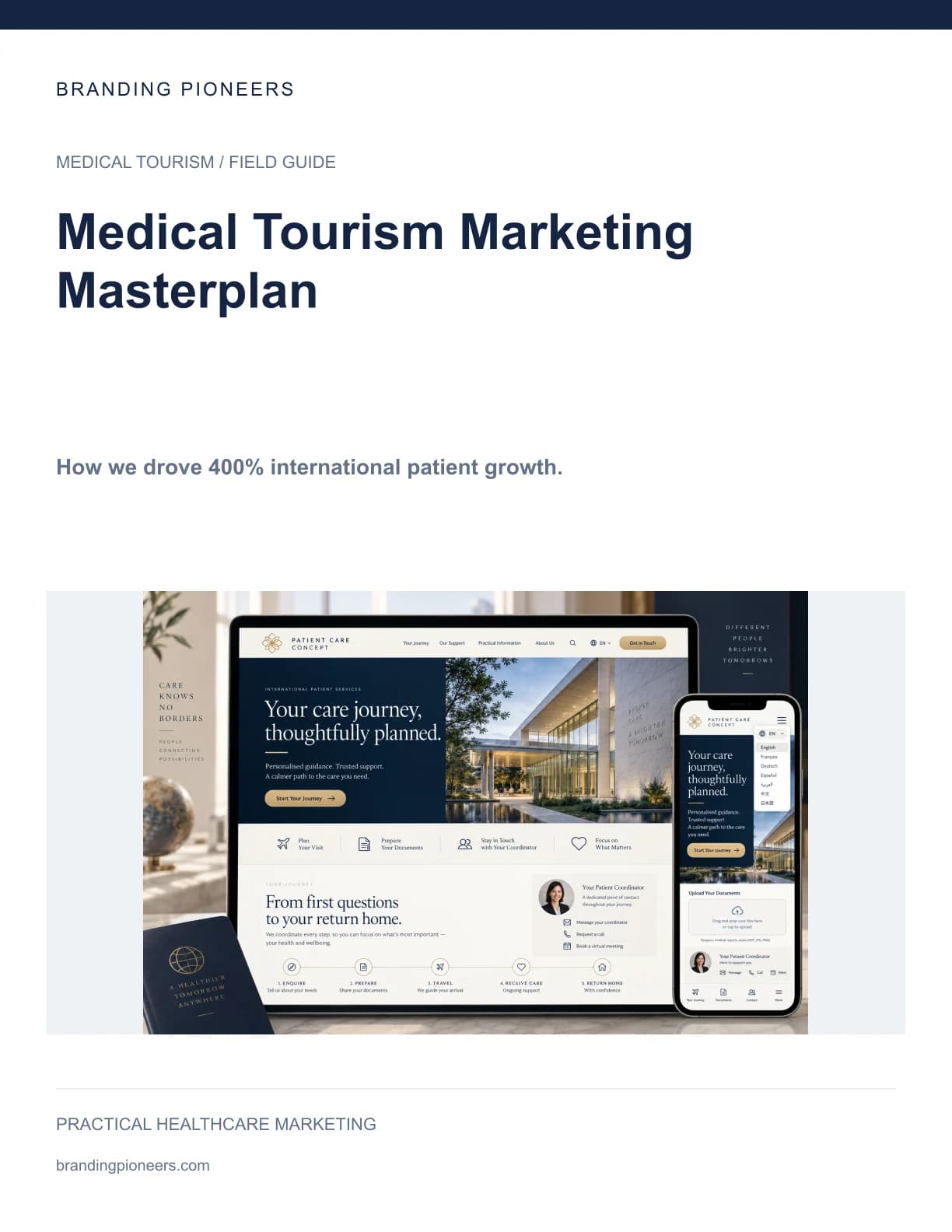
This medical tourism marketing guide is for hospitals, specialty centres and facilitators who want to attract patients from other countries. Medical tourism marketing works differently from local healthcare marketing: decisions take longer, families and referring doctors are involved, trust has to be built from thousands of kilometres away, and the journey from first message to arrival involves visas, travel and cost estimates.
After reading, you should be able to choose target countries with a clear rationale, plan a multilingual website, set up international SEO and cross-border Google Ads, run a WhatsApp-first enquiry process, present pricing transparently and measure return on investment from enquiry to treatment and follow-up.
The guide is written mainly from the perspective of providers in India and the GCC serving patients from Africa, the Middle East, South Asia, Central Asia and beyond, but the principles apply wherever you are. Rules on advertising, visas and patient data vary, so check current requirements for each market.
The Medical Tourism Market
Health tourism is driven by people who travel abroad for treatment for a handful of recurring reasons: the treatment is unavailable or has long waiting lists at home, it is unaffordable at home, they want a specific specialist or technology, or they trust a particular country's healthcare system. Understanding which of these applies to each target market shapes everything else.
Who the patients are
- Patients from countries with limited specialist capacity, seeking cardiac surgery, oncology, transplants, neurosurgery, orthopaedics or paediatric surgery.
- Patients facing long waits or high costs at home, often for elective procedures such as joint replacement, IVF, dental work or cosmetic surgery.
- Diaspora patients returning to their country of origin for care, often with family support.
- Wellness travellers, a separate segment with different expectations.
Who influences the decision
Rarely the patient alone. Family members, local doctors, employers, insurers, government sponsorship schemes in some countries, and facilitators all play a part. Your marketing must reach and reassure each of them.
What patients worry about
- Will the treatment work, and who is responsible if it does not?
- How much will it really cost, including stay and travel?
- Is the hospital and doctor genuinely qualified?
- Can I communicate with the team in my language?
- What happens after I return home?
- Is the facilitator or agent trustworthy?
Every chapter in this guide addresses one or more of these concerns.
Competition
You compete with hospitals in your own country and with other destinations. Patients compare destinations on perceived quality, cost, travel time, visa ease, language and cultural familiarity. Be honest about where your offer is strong and focus there.
What not to do
Avoid quoting market-size figures and growth projections in your patient-facing materials; they do not help a patient decide and are often unreliable. Patients care about their treatment, their doctor and their cost. See the medical tourism glossary entry for definitions and our medical tourism solutions page for the service overview.
Target Country Selection
In international patient marketing, trying to attract patients from everywhere usually produces a thin presence everywhere. Choose a small number of countries and serve them properly.
Criteria for choosing markets
| Factor | Questions to ask |
|---|---|
| Existing demand | Do you already receive patients from this country? From which specialties? |
| Clinical fit | Is there unmet need there for treatments you are strong in? |
| Access | Are there direct flights? How easy is the visa process for this nationality? |
| Language | Can your team communicate in the patients' language, or will you hire coordinators or interpreters? |
| Cultural fit | Can you meet dietary, religious and family expectations? |
| Competition | Which other destinations and hospitals are already active there? |
| Regulation | Are there restrictions on advertising health services to residents of that country? |
| Payment | How do patients pay? Self-pay, government sponsorship, insurance, employer? |
Start with your own data
Review the last few years of international patient records: nationality, specialty, source of enquiry, treatment value, outcome of the enquiry. Patterns often reveal that two or three countries account for most of your international patients. Build on those first.
Plan the depth of investment
For each chosen country, decide:
- Which specialties you will promote.
- Which languages content will be in.
- Whether you need an in-country partner, representative office or facilitator.
- What budget you will allocate to SEO, ads and partnerships.
Review annually
Visa policies, flight routes, currency movements and local healthcare capacity change. A market that was attractive three years ago may have changed. Revisit your selection every year.
Example (illustrative)
A cardiac and orthopaedic hospital finds that most of its international patients come from two East African countries and one Central Asian country. Rather than launching campaigns in a dozen new markets, it builds dedicated content in English, French and Russian, hires a Russian-speaking coordinator and partners with a referring doctor network in each country. The principle is focus; the specific countries will differ for you.
Multilingual Website Strategy
For most international patients, your website is the first serious evaluation of your hospital. If it is only in one language, or poorly translated, you lose them before the conversation starts.
Which languages
Choose based on your target countries. Common choices for providers in India and the GCC include English, Arabic, French, Russian, Bengali, Swahili, Amharic and Uzbek, depending on markets. Do not add a language unless you can also respond to enquiries in it.
Translation is not enough
Machine translation alone produces content that sounds wrong to native speakers and can contain dangerous clinical errors. Use native-speaking medical translators, then have content reviewed by clinicians where possible. Better still, write content for each market: Arabic-speaking patients from the Gulf and French-speaking patients from West Africa have different concerns, travel patterns and payment arrangements.
What each language version needs
- Treatment pages for your priority specialties.
- Doctor profiles with languages spoken.
- An international patient section: how the process works, visa support, accommodation, airport transfer, interpreters, payment methods, follow-up after return.
- Clear contact options: WhatsApp number, phone with country code, a form that accepts medical reports.
- Accreditation and quality information, explained simply.
- Local time zone availability.
Technical setup
- Use separate URLs for each language (subfolders such as /ar/ or /fr/ are common).
- Implement hreflang tags correctly so search engines show the right version.
- Support right-to-left layout for Arabic, Urdu and Persian.
- Make sure fonts render all required scripts.
- Ensure pages load quickly on mobile networks in your target countries.
Do not
- Auto-redirect visitors based on IP address without letting them choose the language.
- Publish only the homepage in other languages, leaving everything else in English.
- Show prices in a currency that patients cannot relate to without explanation.
See multilingual websites for the build side.
International SEO
International patients research online, often for weeks, before contacting a hospital. International SEO makes sure your pages appear when they search in their language and from their country.
Keyword research per market
Search behaviour differs by country and language. Patients in one market may search for the procedure name, others for the condition, others for "treatment in [your country]" or "best hospital in [your city]". Research keywords in each language with native speakers, not by translating your English keyword list.
Typical intent patterns include:
- "[procedure] in [destination country]"
- "[procedure] cost in [destination country]"
- "best hospital for [condition] in [destination city]"
- "[doctor name]" searches after a referral
Content that ranks and converts
- Detailed procedure pages in each language explaining the treatment, length of stay, recovery before flying home, cost factors and what is included.
- Pages explaining the medical travel process: sending reports, receiving an opinion, visa letter, travel, admission, discharge, follow-up.
- Doctor profiles that show qualifications and experience clearly.
- Frequently asked questions in each language.
Using the same clinical content across languages is fine as long as it is properly localised, not duplicated text in English.
Technical points
- hreflang tags between equivalent pages in each language.
- Structured data for the hospital, doctors and FAQs.
- An XML sitemap including all language versions.
- Fast load times on slower connections.
Authority and trust signals
Search engines and patients both look for signs of credibility: named clinical reviewers, accreditation, published research or conference participation by your doctors, and mentions on reputable sites in target countries. Earn coverage through genuine expertise, such as doctors writing for health publications or speaking at international conferences.
Local listings
If you have representative offices or partner clinics in target countries, ensure they have accurate local listings.
Realistic timelines
International SEO in competitive specialties takes time. Combine it with paid search and partnerships while organic visibility builds. See multilingual SEO for the detailed process.
Google Ads Across Borders
Paid search lets you reach patients in target countries quickly. It needs careful structure because costs, competition and search behaviour vary sharply by market.
Campaign structure
- One campaign per country (or tight country group) and language, so budgets and results are separate.
- Ad groups by procedure or specialty.
- Landing pages in the patient's language, specific to the procedure.
Targeting
- Target by location of presence (people physically in the country) where possible, rather than people merely interested in it.
- Consider targeting diaspora communities separately where they are significant.
- Schedule ads for hours when your coordinators can respond, adjusted for time zones.
Keywords and negatives
Focus on high-intent procedure and destination terms. Add negatives for jobs, training, visa services unrelated to treatment, free treatment and irrelevant locations. Review search terms weekly at first.
Ad copy
- Write in the patient's language, natively.
- Emphasise what matters to international patients: specialist experience, accreditation, coordinated travel support, language support, clear estimates.
- Avoid guaranteed outcomes, unverifiable claims and misleading price comparisons.
- Check whether the target country restricts health advertising from foreign providers. Some markets have rules on promoting medical services to their residents, and Google applies country-specific healthcare policies.
Conversion tracking
Track WhatsApp clicks, calls, form submissions and report uploads. Then follow each enquiry in your CRM to estimate, booking, arrival and treatment. International cycles are long, so judge campaigns over months, not weeks.
Budget allocation
Start with a modest test budget per market. Expand where cost per qualified enquiry and conversion to treatment justify it. Our multilingual ads service covers the setup and management.
Common mistakes
- One worldwide campaign in English.
- Sending all clicks to an English homepage.
- Judging success on clicks or form fills without tracking arrivals.
- Running ads when nobody is available to reply.
Patient Logistics Marketing
For international patients, logistics are part of the product. Clear, well-communicated support for visas, travel, accommodation and follow-up can be the deciding factor between two hospitals of similar clinical standing.
Map the journey and publish it
Show patients exactly what happens:
- Send medical reports by WhatsApp or email.
- Receive a specialist opinion and treatment estimate.
- Optional video consultation.
- Receive an invitation letter for the visa application.
- Arrange travel; hospital confirms airport pickup.
- Arrival, accommodation, admission.
- Treatment and recovery.
- Discharge, fitness-to-fly guidance and return.
- Follow-up consultations remotely and coordination with the home doctor.
Publish this on your international patient pages in each language, with realistic timings.
Visa support
For India, patients typically apply for a medical visa, and companions apply for medical attendant visas. Requirements and processes, including e-visa availability, vary by nationality and change over time. Explain what documents the hospital provides and point patients to the official government source for current rules rather than restating details that may change. Never promise visa approval.
Practical services worth highlighting
- Airport pickup and drop.
- Help finding nearby accommodation for families, with a range of budgets.
- Interpreters or coordinators who speak the patient's language.
- Halal, vegetarian or other dietary arrangements.
- Prayer rooms, local SIM cards and currency exchange guidance.
- International payment options.
Work with facilitators ethically
Facilitators can help patients navigate an unfamiliar system. If you work with them, have written agreements, set service standards, and make sure patients understand any fees they pay to the facilitator. Avoid arrangements that encourage facilitators to steer patients for commission rather than clinical suitability. See medical tourism facilitators for more on this segment.
After discharge
Follow-up is where many hospitals fall short. Share discharge summaries, offer remote follow-up consultations and help the patient's home doctor continue care. Patients who feel looked after after returning home are more likely to recommend you to others.
Building Trust Internationally
An international patient is trusting you with their health, their savings and their family's travel, often without ever having visited your country. Trust has to be earned through evidence, not slogans.
Trust signals that matter
- Accreditation. NABH accreditation in India and JCI accreditation internationally are widely recognised. Explain what they mean in plain language and display them accurately.
- Doctor credentials. Qualifications, training, international fellowships and experience, presented clearly in each language.
- Transparency. Clear estimates, explained inclusions and exclusions, and a named coordinator.
- Real people. Photos and videos of your actual doctors, coordinators and facilities.
- Communication. Fast, accurate responses in the patient's language.
Patient stories
Patient stories can be powerful but must be handled carefully. Use only genuine stories with documented, informed consent, do not imply that results are typical or guaranteed, and check whether the destination and target country rules restrict testimonials in health advertising. Never fabricate or embellish.
Video consultations before travel
A video call with the treating specialist before travel reduces uncertainty more than any marketing material. It lets the patient and family ask questions, understand the plan and judge the doctor for themselves.
Local presence
Representative offices, partner doctors or regular outreach clinics in target countries build trust because patients can meet someone in person. These require investment and must comply with the laws of the host country, including any rules on medical practice and advertising.
Respond to concerns openly
Families will ask about risks, complications and what happens if something goes wrong. Answer honestly. Explain how complications are handled and what costs might change. Patients notice evasive answers.
Reputation across borders
International patients check reviews on Google and other platforms, and often ask in community groups or social media in their own language. Monitor these channels and respond professionally. Complaints from one country can affect your reputation across that whole community.
What erodes trust quickly
- Prices that rise significantly after arrival without clear explanation.
- Delayed or inconsistent communication.
- Claims of "best" or "guaranteed".
- Coordinators who are unreachable after discharge.
Our medical tourism marketing agency page outlines how we approach trust-building for hospitals.
WhatsApp & Communication
In many medical tourism markets, WhatsApp is the main way patients and families communicate. A WhatsApp-first enquiry process often matters more than any website form.
Set up properly
- Use the WhatsApp Business Platform for a hospital or facilitator handling significant volume, so multiple coordinators can respond from one number with proper records.
- Display the WhatsApp number prominently on every international page and in every ad.
- Use a click-to-WhatsApp link that opens a chat with a pre-filled message identifying the patient's language or country.
Response standards
- Acknowledge every enquiry quickly, even if the full response takes longer.
- Set realistic expectations: "Our cardiologist will review your reports and we will send an opinion and estimate within a set number of working days."
- Respond in the patient's language.
- Cover time zones with shifts or clear auto-replies.
Handling medical reports
Patients will send scans, reports and prescriptions over WhatsApp. Have a secure internal process for moving these into your records, restricting access and deleting copies from personal devices. Data protection obligations apply under India's Digital Personal Data Protection Act and the laws of other countries where you operate; take specialist advice.
Structured conversation flow
- Greeting and language selection.
- Collect basic details: name, country, condition, contact preference.
- Request reports.
- Coordinator confirms receipt and timeline.
- Specialist opinion and estimate shared.
- Follow-up on questions and next steps.
- Travel support once the patient decides.
A chatbot can handle steps 1 and 2 out of hours, but medical opinions and estimates must come from people.
Consent and messaging rules
Only send promotional messages to people who have opted in, and follow WhatsApp's commerce and business policies, which restrict some healthcare content. Our answer on whether WhatsApp marketing is legal for healthcare covers the main points.
Measure
Track response time, enquiries per country, report receipt rate, estimate-to-decision rate and arrivals. These show where the conversation process loses patients.
The WhatsApp healthcare guide covers setup and automation in more depth.
Pricing Strategy
Cost is a major reason many patients consider travelling for treatment. How you present prices affects both how many patients choose you and how much they trust you.
Principles
- Be transparent. Give written estimates with clear inclusions (surgeon fees, room, implants, medicines, investigations, length of stay) and exclusions.
- Explain variability. State plainly what could change the cost: complications, longer stay, additional investigations, implant choice.
- Use one price for the same service. Charging international patients significantly more than domestic patients for identical care, without clear reason, damages trust if discovered. If there are genuine additional costs (coordination, interpreters, extended stay), show them separately.
- Quote in a currency patients understand, with the exchange rate basis and validity period.
Packages
Fixed-price packages for common procedures (joint replacement, cardiac bypass, IVF cycles) help patients compare and plan. Define what happens if the patient needs more than the package covers.
Facilitator fees
If facilitators are involved, make sure the patient knows whether the facilitator is paid by them, by the hospital or both. Hidden commissions that inflate patient costs are unethical and harm the destination's reputation. Disclose arrangements appropriately and follow applicable law.
Publishing prices
Publishing indicative price ranges on your website for common procedures can attract enquiries and filter out patients for whom the treatment is unaffordable. If you publish, keep them current and explain that final costs depend on clinical assessment. Our answer on medical tourism marketing costs covers the marketing side of the budget.
Avoid
- Advertising "lowest price" or comparative price claims you cannot substantiate.
- Discounts that create urgency or pressure ("book this week to save").
- Estimates that omit predictable costs.
Payment practicalities
Explain accepted payment methods, deposit requirements, refund policy and how international transfers work. Keep receipts and invoices clear for patients who may need to claim from insurers or sponsors at home.
Measuring International ROI
Medical tourism marketing has long cycles and many steps between first contact and treatment. Measuring return requires tracking every stage, by country and specialty.
The international funnel
| Stage | Metric |
|---|---|
| Reach | Website sessions and ad impressions by country and language |
| Enquiry | WhatsApp chats, calls, forms, emails by country and source |
| Qualification | Enquiries that sent medical reports |
| Opinion | Specialist opinions and estimates sent |
| Decision | Patients who confirmed travel |
| Arrival | Patients who arrived and were admitted |
| Revenue | Treatment revenue per patient, by country and specialty |
| Advocacy | Referrals from past international patients, reviews |
Calculating return
For each country and channel, compare marketing cost (ads, content, translation, facilitator fees, coordinator time, travel for outreach) with the margin from treated patients. Because cycles are long, look at rolling six- or twelve-month windows rather than single months.
Worked example (illustrative only)
Imagine a hospital spends a fixed amount on campaigns for one country over six months. It records how many enquiries came in, how many sent reports, how many received estimates, how many travelled, and the contribution margin from those patients. Dividing margin by spend gives the return; looking at each conversion step shows where to improve. If many patients send reports but few travel, the issue may be estimates, communication or visa support rather than advertising.
Attribution challenges
- Patients often research for weeks and contact through a different channel from the one that first reached them.
- Facilitators may introduce patients who first found you online.
- Family members may make the enquiry.
Ask every patient how they first heard about you, and record it alongside digital source data.
Act on the data
- Shift budget to countries and specialties with the best return.
- Fix the conversion step that loses the most patients.
- Review coordinator response times and estimate turnaround.
- Revisit market selection annually.
The ROI calculator helps structure these figures.
If you want help planning or running international patient acquisition, Branding Pioneers provides medical tourism marketing for hospitals and facilitators, and you can begin with a free consultation.