AI & Automation

AI Receptionist for Clinics: What It Handles, Where It Fails, and How to Roll One Out

The competition an AI receptionist is beating is not your receptionist. It is voicemail. Where the call volume actually leaks, what these systems handle, where they break, and a four-stage rollout.

NS
Founder & CEO · October 23, 2026 · 8 min read
FILE · AI-RECEP
AI Receptionist for Clinics: What It Handles, Where It Fails, and How to Roll One Out

The argument for an AI receptionist is not that it is smarter than the person at your front desk. It obviously is not.

The argument is that your front desk is on another call, or checking in a patient, or at lunch, or gone for the day — and during those hours the phone still rings, and nobody picks it up. The competition an AI receptionist is beating is not your receptionist. It is voicemail.

Once you frame it that way, the rollout decisions get much easier, because you know which calls you are trying to catch and which ones you are not.

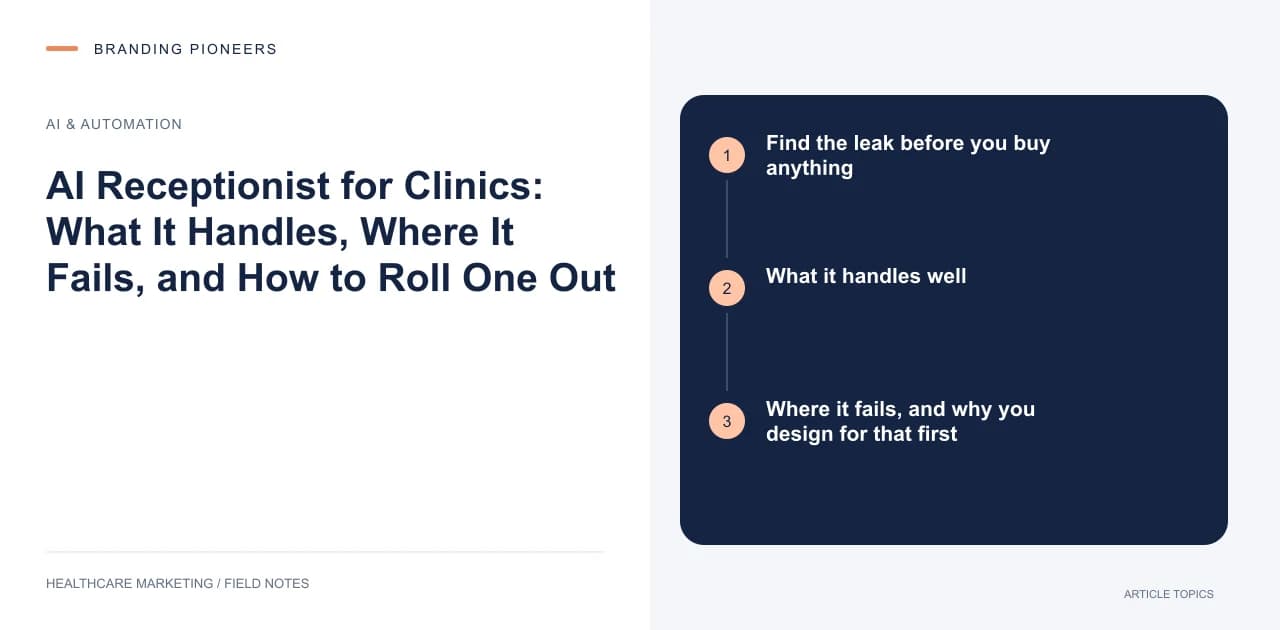
Find the leak before you buy anything

Pull a month of call data from your phone system. You want four numbers: total inbound calls, missed calls, calls missed while another call was in progress, and calls that arrived outside opening hours.

Most practices have never looked at this, and the result is usually uncomfortable. The pattern is consistent — a spike at opening time that the desk cannot absorb, a dead hour at lunch, and a long tail in the evening when working patients finally have a moment.

Those three windows are the business case. If they are small, an AI receptionist is a convenience. If they are large, it is the highest-return thing on your list, ahead of any campaign. This is the same diagnosis we run in front desk not converting calls, and it is worth doing with real data rather than an impression.

What it handles well

Current voice systems are genuinely reliable on a narrow set of jobs, all of which are high-volume and low-judgement:

New patient enquiries — capturing name, number, what they are calling about, and offering the next available slot.

Appointment booking, rescheduling and cancellation, provided it can write to the actual calendar.

Repetitive information: opening hours, parking, which floor, which insurers you accept, whether a referral is needed, what to bring, how to prepare for a scan.

After-hours message capture with a structured summary, so the morning callback list is a list rather than seven voicemails.

Routing — getting a pharmacy, a hospital or a lab to the right extension instead of the general queue.

That is not a small set. In most clinics it is the majority of inbound volume.

Where it fails, and why you design for that first

It fails on clinical questions, and it must be built to refuse them rather than attempt them. A patient asking whether their chest pain is serious needs a human, immediately and unconditionally.

It fails on distress. Someone crying, someone shouting, someone describing a symptom with panic in their voice. Detection here is imperfect, so the escalation threshold should be set generously.

It fails on names and spellings, more in some markets than others. Indian names with regional spelling variants, Arabic names transliterated three different ways, and any caller who switches between Hindi and English mid-sentence will break a system tuned on North American English. Test in the languages your patients actually speak before you sign.

It fails on exceptions — the patient who is also the doctor's cousin, the insurer that needs a manual pre-authorisation, the appointment that has to be moved because the consultant is in theatre.

And it fails, in a specific and damaging way, when it is too good at sounding human. A caller who discovers late in a conversation that they have been talking to software feels tricked. Say what it is in the first sentence.

Write the escalation rules before the greeting

The most common implementation error is spending three weeks perfecting the conversation and an afternoon on the handoff. Reverse it.

Three triggers should move a call to a human without negotiation: the caller asks for one, in any wording; the system hears an urgency or distress signal; or two consecutive turns fail to make progress.

Then decide what "a human" means at two in the morning. If the answer is nobody, the system must say so honestly and give the emergency instruction — not offer to take a message from someone having a cardiac event.

The emergency script comes first in the call flow, not last. Before the menu, before the greeting pleasantries: if this is an emergency, hang up and call the local emergency number, stated explicitly for your country.

Integration is the whole project

A voice agent that cannot write to your calendar is an expensive answering machine. The vendor demo will not make this obvious, because the demo runs against a mock booking system.

Ask these before you sign. Does it write directly to our practice management system or EHR, or to a separate calendar that someone reconciles by hand? What happens when the two disagree? Can it see real availability per consultant, including blocked theatre days? Can it collect the fields our registration actually needs? Where do transcripts live, for how long, and can we export them?

If the honest answer to the first question is "a separate calendar", you are buying a message-taking service, and you should price it as one. That integration work is where the real cost of these projects sits — the AI and automation services side of a deployment is usually a larger line item than the voice licence itself.
Voice and chat are not the same product

Clinics often buy one and assume it covers the other. They fail differently.

Voice is a latency problem. A pause longer than about a second reads as a dropped call, so the system has to commit to an answer before it has heard the full sentence. That makes interruptions, background noise and hold music genuinely hard, and it is why voice agents are tuned to be brisk and slightly rigid.

Chat is a context problem. The patient will wander, attach a photograph of a prescription, ask three questions in one message, and come back two days later expecting the thread to be remembered. Chat can be slower and more careful, and it can hand over a transcript to a human cleanly, which voice cannot.

In India and the Gulf, WhatsApp usually carries more enquiry volume than the phone for anything that is not urgent, so a voice-only deployment leaves the larger channel untouched.

What it does not replace

It does not replace the person who recognises a returning patient's voice, notices that a family sounds worried, or decides to squeeze someone in.

The practices that get the most out of these systems use them to hand the front desk back its attention — fewer interruptions during check-in, no queue at nine in the morning, no backlog of voicemails at opening. The staff do the judgement calls. The software does the repetition. A deployment sold as a headcount reduction usually gets rolled back within a year.

A receptionist call contains health information by definition, and the rules depend entirely on where you operate.

In the United States, a vendor handling that data is a business associate and must sign a business associate agreement. If a vendor will not, the conversation ends there. In India, the Digital Personal Data Protection Act, 2023 and the Digital Personal Data Protection Rules, 2025 apply, with the Data Protection Board of India as regulator — consent has to be specific to the purpose, and your vendor is a data processor you need a contract with. In the UAE, the relevant health data rules come through the DHA and MOH depending on the emirate. Do not import American terminology into a Gulf or Indian deployment; it signals that nobody checked.

Call recording consent is separate from all of that and is often stricter. Announce recording at the start of the call and log the consent.

And disclose the AI. "You're speaking with an automated assistant for [clinic name]" costs you nothing and removes an entire class of complaint.

Roll it out in stages, not at once

The deployments that fail are the ones that go live on the main number on a Monday.

Stage one, after-hours only, for two weeks. The downside is bounded — those calls were previously going to voicemail — and you get a transcript set to review.

Stage two, overflow during opening hours. It answers only when the desk is already on a call. Two more weeks.

Stage three, first answer on the main line during defined windows, with a fast path to a human.

Stage four, if it is earning its place, outbound work: appointment reminders, recall calls, waitlist filling. Outbound is a different risk profile and deserves its own review.

At every stage, somebody reads or listens to a sample of calls weekly. Not a dashboard — actual calls. Every clinic that has been burned by one of these skipped that step.

Measure containment honestly

Vendors report a containment rate, and it is usually defined as "the call did not transfer". That definition counts a caller who gave up as a success.

Define it yourself: a contained call is one where the caller got what they rang for. Then track booked appointments by source, escalation rate, average handling time compared with the desk, abandonment, and the proportion of after-hours calls that turned into a next-day appointment.

Costs vary by model — per minute, per seat, or a platform fee plus usage — and anyone quoting a flat number without seeing your call volume is guessing. Budget separately for the integration, which is the part that overruns.

What to do first

  1. Pull the call report. Missed, after-hours, missed-while-busy.
  2. Write the escalation rules and the emergency script before you look at vendors.
  3. Confirm the integration path into your booking system, in writing.
  4. Confirm the data agreement for your jurisdiction.
  5. Go live after hours only, and read the transcripts for two weeks.
  6. Expand only when the transcripts stop surprising you.

The AI chatbot implementation guide covers the chat side of the same problem, and the two should be planned together — a patient who starts on WhatsApp and then phones should not have to repeat themselves.

---

If you want an outside read on how many calls your practice is currently losing and what an automated front desk would realistically catch, get a free audit and we will send the findings either way. Or book a strategy call if you would rather walk through the rollout.

FILED UNDERai receptionist for clinicsai front desk for medical officeai receptionist for dental clinicsai voice receptionist for clinicsai receptionist for hospitals
Stop reading. Start ranking.
Get a free ai & automation audit — we'll show you exactly what's missing.
Book audit →
Author
Founder & CEO · Gurugram, India

Nishu founded Branding Pioneers in 2016 with one rule that hasn't changed since: healthcare only. She'd run digital strategy at a top-10 Indian agency and watched generalist marketing underserve medical clients who needed something built for how patients actually search and decide. So she left to build the specialist instead. It's now an 80-person team working with healthcare brands worldwide.

The Patient Acquisition Blueprint (2026 Edition) — guide cover
Free · 15 pages

The Patient Acquisition Blueprint (2026 Edition)

The exact 90-day patient-acquisition system, step by step.

We never share your details

FREE · 30 MIN
See your ai & automation opportunity gap.

Senior strategist, no boilerplate. Reply within 4 hours.

Book audit → Or call us directly
The Pioneers Brief · weekly
One essay. Three benchmarks. One teardown.
Subscribe — free
The Patient Acquisition Blueprint (2026 Edition) — guide cover
Free for ai & automation readers

The Patient Acquisition Blueprint (2026 Edition)

The exact 90-day patient-acquisition system, step by step.

  • The 90-day patient acquisition operating system
  • Channel-by-channel budget allocation (₹50L–₹5Cr/yr)
  • 12 real, named client engagements walked through
  • ROI tracking spreadsheet (CAC, LTV, payback)
15 pages · Used by 350+ healthcare clients · Updated for AI search

We never share your details

Continue reading

More on ai & automation.

BROWSE ALL →
From the studio

This thinking, applied.

Meta Business Partner badge
Platforms
Meta Ads
Healthcare marketing performance analytics dashboards
Analytics
Reporting built for clinical teams
GlobeCore — mental health and psychological services, Atlanta: hero and service pathways
Web · Mental health
GlobeCore Atlanta — hero and service pathways
Meddy Books — Appointment booking and patient CRM for medical practices
Product
Meddy Books
Meta Ads reach and delivery reporting
Meta Ads
Meta Ads — delivery and reach reporting
Why choose us

Why healthcare brands choose us.

Six reasons hospitals, clinics, and doctors pick a healthcare-only firm over a generalist agency.

  • Healthcare-only

    It's all we do. No retail, no fintech — the whole team thinks in patient journeys, clinical trust, and the way people actually choose a doctor.

  • AI-first systems

    Receptionists, WhatsApp triage, and attribution built in-house — we answer patients in seconds and tie every click to a booked appointment.

  • Compliance built-in

    HIPAA-aware handling, ASCI-reviewed creative, and GDPR/DPDP sign-off on every campaign — our standard, not an upcharge or an afterthought.

  • Senior on every account

    The senior who pitched you stays on the engagement. No bait-and-switch to juniors learning on your budget.

  • Measured to the appointment

    Patient-level attribution across calls, forms, and walk-ins. Monthly reports show booked patients — not just clicks and impressions.

  • Receipts, not promises

    We name our clients and show the work. Quarterly reviews with the numbers attached, every cycle.

The Branding Pioneers healthcare-marketing team at work
Healthcare-only · since 2016
A team that does one thing well.
More from the brief

If this resonated, here’s what else lands.

Adjacent practices, the relevant tools, and the case files where we shipped this thinking against real patient-acquisition targets.

THE PIONEERS BRIEF · WEEKLY

One essay,
three benchmarks,
one teardown.

Healthcare growth, every Thursday morning. No hype, no fluff.