The Technology Gap Is Now a Patient Acquisition Gap
Two hospitals. Same city. Similar specialties. Similar physician talent. Similar bed capacity.
Hospital A runs a fully integrated marketing technology stack: AI-powered chatbot that handles the large majority of patient inquiries without human intervention, CRM that automatically segments patients by condition and sends personalized follow-up sequences, predictive analytics that identifies high-value patient cohorts, and automated campaigns triggered by patient behavior data.
Hospital B has a website, a Facebook page managed by a receptionist who posts when she has time, and an Excel spreadsheet that someone updates with new patient phone numbers occasionally.
The gap in new patient acquisition between these two hospitals is not modest. It is enormous. The technology investment required to replicate Hospital A's stack is less than the cost of one additional consultant's annual salary.
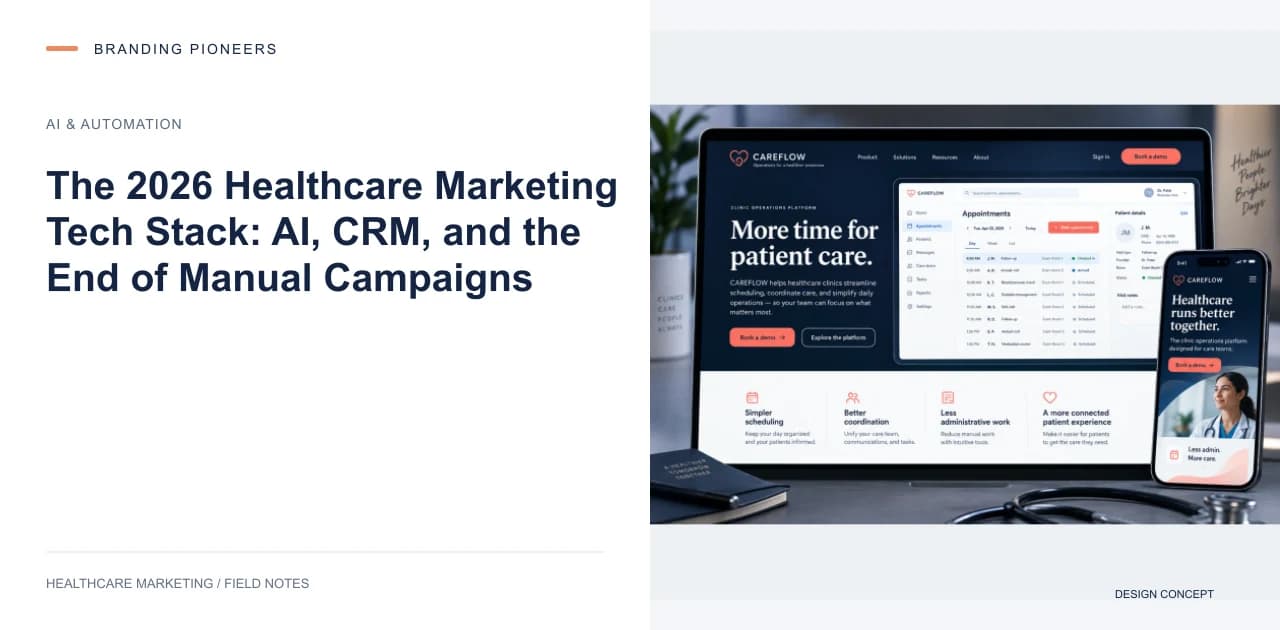
In 2026, the technology gap is a patient acquisition gap. Here is what the winning stack looks like.
Layer 1: Patient Communication and Lead Capture
WhatsApp Business API (Non-Negotiable)
The foundation layer. Every Indian hospital processing more than 50 patient inquiries per month needs a WhatsApp Business API integration. Not WhatsApp Business (the free app) — the API, which enables:
- Automated response to any WhatsApp message within seconds
- Broadcast campaigns to opted-in patient lists
- Chatbot flows for appointment booking, FAQ handling, department routing
- Integration with CRM to log all interactions
Recommended vendors for Indian healthcare: Interakt, Wati, Aisensy, Gupshup. Cost: ₹2,000 to ₹15,000/month depending on message volume and features.
What automation handles:
- "What are your consultation hours?" → instant automated response
- "I want to book an appointment with the cardiologist" → appointment booking flow
- "What does knee replacement cost?" → pricing information + appointment CTA
- "I had surgery there last year, who do I contact for follow-up?" → routing to patient relations
What human agents handle:
- Complex clinical questions requiring medical judgment
- Complaints and escalations
- Unresolved edge cases
Ratio at well-run facilities: 80 to 85 percent automated, 15 to 20 percent human. The human team handles the cases that actually need human judgment, rather than spending their day answering "what are your timing?" 40 times.
Website Chat and Lead Capture
WhatsApp covers patients who initiate on WhatsApp. A website chatbot covers patients who arrive on your website.
Tools: Freshchat, Tidio, Intercom (enterprise), or custom WhatsApp widget that opens a WhatsApp chat from the website.
Every form on your website (appointment booking, contact, callback request) should connect directly to your CRM with automatic lead creation, tagging by source and inquiry type, and automated response sequence trigger.
Layer 2: Customer Relationship Management (CRM)
The CRM is the central nervous system of the marketing stack. Everything feeds into it; campaigns go out of it.
Healthcare CRM options for Indian hospitals:
Salesforce Health Cloud: Enterprise-grade, HIPAA/DPDP-aware, integrates with most HMS systems. Cost: ₹3,000 to ₹10,000 per user per month. For hospital chains with complex operations.
HubSpot: Not healthcare-specific but highly customizable. Excellent marketing automation, good pipeline management, reasonable cost. Works well for mid-size hospitals and specialty chains. Cost: ₹2,500 to ₹8,000/month.
LeadSquared: Popular in Indian healthcare, has healthcare-specific CRM features, integrates with many HMS and diagnostic systems. Cost: ₹2,000 to ₹6,000/month.
Zoho CRM: Cost-effective for smaller practices, good automation capabilities, Indian support team. Cost: ₹1,400 to ₹4,000/month.
What your CRM must do for healthcare marketing:
- Lead source tracking: Every inquiry tagged with its source (Google Ads campaign, organic search, WhatsApp, referral, walk-in). This data drives budget allocation decisions.
- Patient lifecycle stages: Lead → Contacted → Appointment Scheduled → Appointment Completed → Post-Visit Follow-up → Loyal Patient. Automated campaigns trigger at each stage transition.
- Segmentation by condition/specialty: Patients who inquired about cardiology versus orthopedics versus fertility need different communication sequences. CRM segments should enable this automatically.
- Automated follow-up sequences: If a lead does not respond within 24 hours, automatic follow-up. After 3 days, different message. After 7 days, a different angle. Without CRM automation, these follow-ups depend on staff memory — which means they do not happen.
- Integration with appointment systems: Appointment confirmations, reminders, and post-visit surveys should flow from CRM integration, not from manual staff action.
Layer 3: Marketing Automation and Campaign Management
Email + SMS/WhatsApp Drip Campaigns
Automated patient communication sequences based on behavior and lifecycle stage:
Post-inquiry sequence (for leads who did not book):
- Day 1: "Thank you for your inquiry. Here is information about our [specialty]..." + booking link
- Day 3: "Questions patients often ask about [procedure]..." + doctor-led explainer video (no testimonials: in India, the NMC's 2026 guidelines bar them even with consent — see our NMC guide)
- Day 7: "What happens at your first consultation, and what it costs..." + factual fee information + booking link
- Day 14: "Is there anything we can help clarify?" + soft follow-up
Post-appointment sequence:
- 2 hours after appointment: "Thank you for visiting us..."
- 24 hours: "How was your experience?" + satisfaction survey
- 7 days: "We hope you are feeling well. Here is what to watch for..."
- 30 days: "Your follow-up appointment reminder"
Annual health check reminder:
- Patients who visited in January 2025 receive a campaign in November 2025: "Time for your annual check-up"
Preventive care campaigns:
- Patient segments with diabetes receive regular diabetes management tips and monitoring reminders
- Post-surgical patients receive rehabilitation milestone check-ins
These sequences are built once and run automatically for every patient who enters the relevant lifecycle stage.
AI-Powered Ad Optimization
Google's Performance Max and Meta's Advantage+ campaigns use machine learning to automatically optimize targeting, creative, and bidding. In 2026, manual keyword-by-keyword bidding is an inferior approach in most healthcare contexts.
The shift: from manual campaign management to AI-assisted campaign management where humans set the strategy (audiences, budgets, goals, creative inputs) and AI optimizes execution.
What this changes for healthcare: rather than a campaign manager spending most of their time adjusting bids and pausing underperforming keywords, they spend most of their time on creative strategy, audience definition, and campaign architecture — the parts that actually require human judgment.
Layer 4: Analytics and Attribution
Unified Reporting Dashboard
Data from Google Ads, Meta Ads, WhatsApp, CRM, and your website need to be visible in one place. Tools that enable this:
- Google Looker Studio (free): Connect to Google Ads, Analytics, Search Console. Good for SEO and Google Ads reporting.
- Supermetrics + Looker Studio: Adds Meta, LinkedIn, and other platform data.
- HubSpot Reports: If HubSpot is your CRM, its reporting hub aggregates cross-channel data well.
The one dashboard should answer: Where are patients coming from? What is the cost per appointment inquiry by channel? Which channels convert from inquiry to appointment at the highest rate? What is the monthly patient acquisition volume by source?
Call Tracking
A significant percentage of appointment bookings happen via phone, completely invisible to web analytics. Call tracking assigns unique phone numbers to different marketing channels, allowing you to attribute calls to their source.
Tools: CallTrackingMetrics, CallRail, WhatConverts. Cost: ₹3,000 to ₹8,000/month.
With call tracking, you discover that your Google My Business listing drives more appointment calls than your paid Google Ads campaign, or that your website's "Contact Us" page phone number generates more calls than your homepage. These insights redirect where you invest.
Layer 5: AI-Assisted Content and SEO
AI content assistance: Tools like Claude, ChatGPT, and Perplexity help draft initial content that physician-reviewers then edit for clinical accuracy and voice. The workflow: AI drafts, doctor refines, editor polishes. This is much faster than starting from scratch and produces content with accurate bones that humans make genuinely useful.
SEO monitoring: Ahrefs or Semrush for ranking tracking, competitor analysis, and backlink monitoring. Essential for understanding how organic visibility is changing and where opportunities exist.
AI-powered review response: Tools that draft responses to Google reviews, WhatsApp reviews, and Practo reviews using AI, requiring only a quick human review before posting. Reduces response time from hours to minutes.
The full stack at a mid-size hospital group or specialty chain costs ₹25,000 to ₹80,000 per month in technology subscriptions — less than one junior marketing employee's salary. It does the work that would otherwise take several additional marketing staff running manual campaigns.
Build Your Healthcare Marketing Tech Stack — Implementation Planning Available →
Filed underhealthcare marketing tech stackhospital marketing technology 2026healthcare CRMmarketing automation healthcareAI marketing hospital

About the author
Arush Thapar
Co-Founder & CTO · Gurugram, India
Arush builds the systems the rest of the company runs on — the patient-acquisition pipelines, the AI chatbots, the analytics that tie a single click to a booked appointment. If a campaign reports a number, it's because something his team built is tracking it.
Free guide · 17 pages
The Patient Acquisition Blueprint
A 90-day plan from first search to booked appointment.