If you practise in Australia and you have ever wondered why the marketing advice you read online does not seem to apply to you, this is why: Section 133 of the Health Practitioner Regulation National Law prohibits advertising a regulated health service in ways that most of the world considers standard. Testimonials. Outcome claims. Inducements without terms. The Australian regime is not a stricter version of the international norm — it is a different norm.
Practitioners get caught out not through bad intent but through inherited habit: an agency imports a playbook that works in the US or India, and the practice ends up with a compliance problem attached to its own name, because the obligation sits with the practitioner, not the agency.
This is a practitioner's summary written by marketers, not legal advice. Regulations change, and enforcement varies. Confirm the current text with your regulator or your own counsel before you publish.
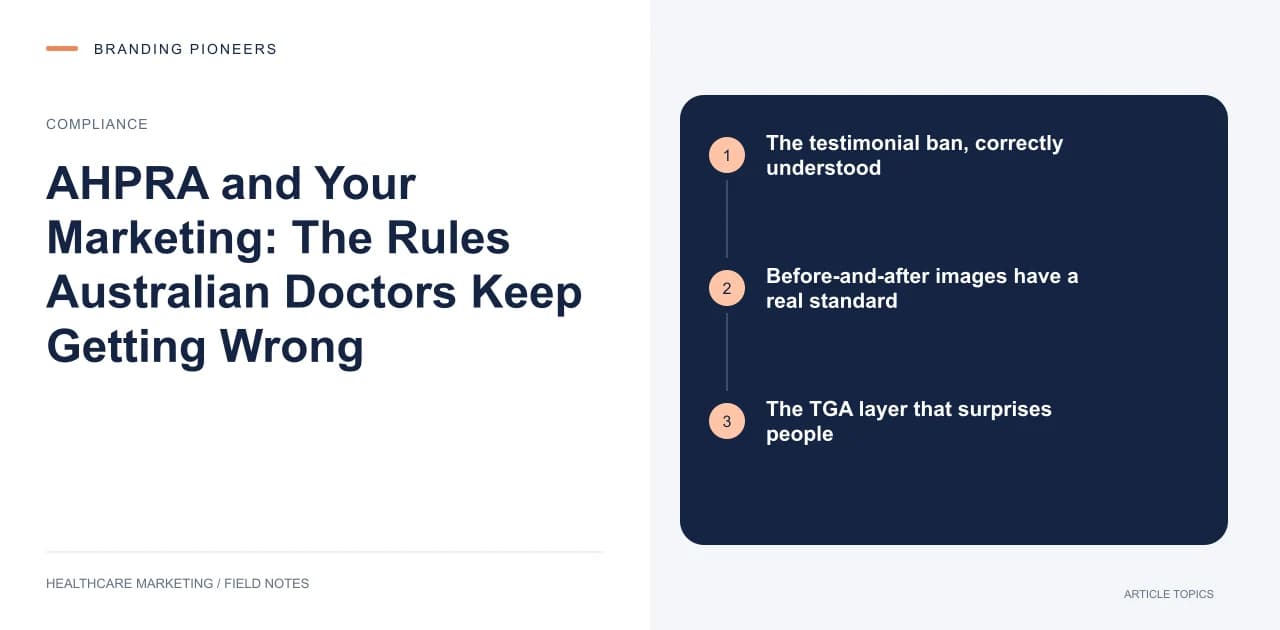
The testimonial ban, correctly understood
The National Law prohibits using testimonials about the clinical aspects of a regulated health service in advertising. This is the single most misunderstood rule in Australian healthcare marketing, and most of the confusion comes from collapsing three different situations into one.
Advertising you control. Your website, your social accounts, your ads, your printed material, your email. Testimonials about clinical care cannot appear here. That includes a review quoted onto your homepage, a screenshot of a five-star review posted to Instagram, and a video testimonial on your service page.
Reviews on platforms you do not control. Unsolicited reviews on Google, on a health directory, on social media pages you do not own are generally treated differently — a practitioner is not responsible for what a member of the public independently publishes on a third-party platform. But the moment you solicit, incentivise, curate or republish them, you have moved them into advertising you control.
Non-clinical comments. Feedback about parking, wait times, reception staff or how easy the booking system was is not about the clinical aspects of the service. This distinction is narrower than clinics would like, and it is not a workaround for outcome claims wearing a disguise.
The practical rule: never ask a patient for a review that mentions their treatment or result, never republish one, and train reception so they are not doing it informally at the front desk.
Before-and-after images have a real standard
Before-and-after photography is not banned, but it is held to a standard almost no clinic gallery actually meets. Images must be genuinely comparable — same lighting, same angle, same distance, same pose, comparable framing — and must not be enhanced, retouched, filtered, or selected to imply a typical result. Where a result is not typical, that must be clear rather than buried.
Since the cosmetic surgery advertising guidelines came into effect, the standard has tightened further. Idealised or sexualised imagery, imagery that trivialises a surgical procedure, and marketing that targets or appeals to people under eighteen are all specifically addressed. So is the use of influencers, and incentives such as discounts contingent on posting.
For most practices the honest answer is that the existing gallery has to go, and be replaced by something that works better anyway: procedure explanation, surgeon credentials, and a frank account of recovery and risk.
The TGA layer that surprises people
Separately from AHPRA, the Therapeutic Goods Administration restricts advertising prescription-only substances to the public. This is why Australian clinics write "anti-wrinkle injections" rather than naming the product, and why naming brands of injectable toxins or dermal filler prescription products in public-facing material is a problem regardless of how it is phrased.
The rule is not satisfied by disclaimers. If a member of the public can read it without a health professional intermediary, it is advertising to the public.