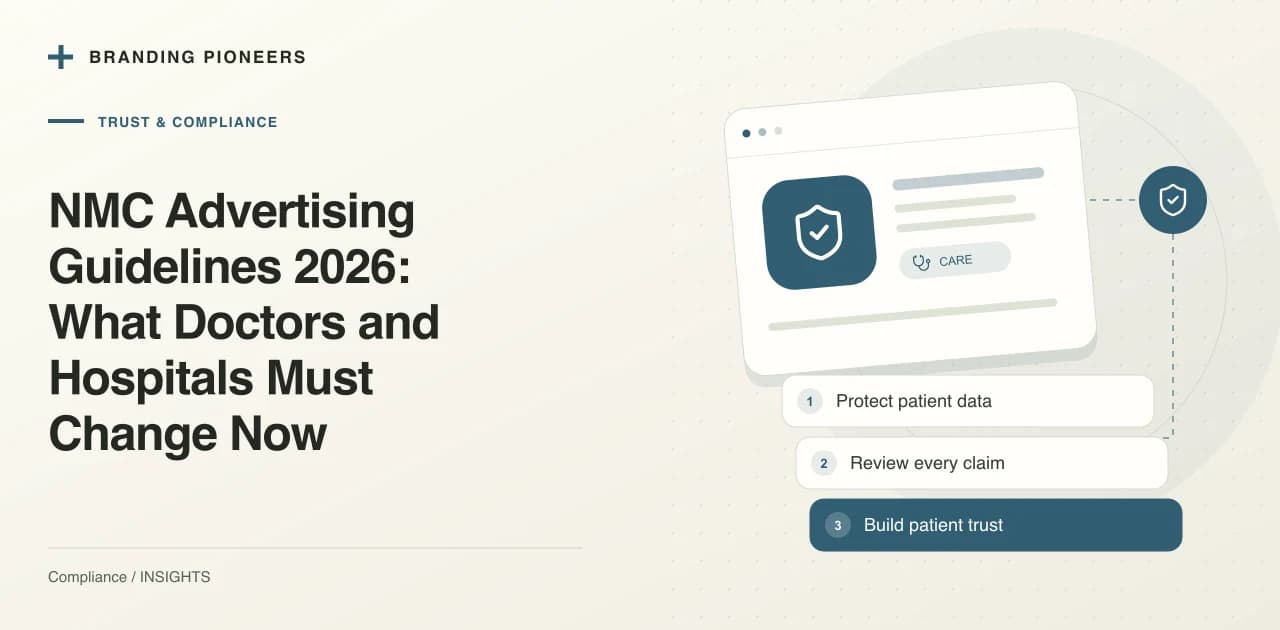
On 6 October 2026 the National Medical Commission published its "Guidelines on Ethical Advertising and Public Communication by Hospitals/Medical Institutions and Registered Medical Practitioners" (Public Notice R-13014/01/2024-Ethics). The notice says the guidelines "shall come into force with immediate effect". There is no transition window. A testimonial reel posted last month is judged by the new rules today.
This article is for doctors, clinic owners and hospital marketing teams in India. Paragraph numbers refer to the notice. For the full clause-by-clause reading, see our NMC guidelines hub.
A note before we start: we are a healthcare marketing team, not a law firm. This is a plain-language summary for planning, not legal advice. Read the official notice, and take advice from your legal adviser or State Medical Council on specific cases. These rules apply in India only. Clinics in the UAE, the UK, the US, Australia and elsewhere answer to their own regulators, which we cover on our compliance pages.
Why this notice matters more than earlier guidance
Until now, most doctors worked from the Indian Medical Council (Professional Conduct, Etiquette and Ethics) Regulations, 2002, framed under the former Medical Council of India. The NMC replaced that council under the NMC Act, 2019, and the 2002 Regulations still apply. They were written for newspapers and signboards, and said little about reels, search ads, WhatsApp broadcasts, influencers or AI video.
The 2026 guidelines close that gap. They are read with the 2002 Regulations and the NMC Act (para 4.2), and four things set them apart.
Digital is named as advertising. Para 3.2 defines an advertisement as any communication, in any medium, that directly or indirectly promotes the services, reputation, skills, qualifications, achievements or facilities of a doctor or hospital. It then lists digital, social-media, sponsored, targeted, influencer-led, search-engine, platform-based, audio-visual and AI-generated communications as advertising where the content or its distribution is promotional. Para 3.5 names websites, blogs, WhatsApp, Telegram, podcasts, sponsored posts and online healthcare platforms as media.
Hospitals are covered as well as doctors. The guidelines apply to hospitals and medical institutions, read with the Clinical Establishments Act or the relevant state act (para 4.3).
Agencies are not a shield. Para 4.4 says publishing through a digital platform, third party, advertising agency, influencer or intermediary does not absolve the doctor or institution of content they authorised, commissioned, sponsored, adopted or knowingly permitted. "The agency posted it" is not a defence.
Penalties are written down. Para 10.1 sets out a graded ladder, covered below.
What changed: the rules most practices are breaking today
Para 8.1 lists twelve restrictions for doctors. Several also apply to hospitals. These are the ones we see broken most often in Indian healthcare marketing.
Testimonials and reviews
Explanation V to para 3.2 says a doctor "shall not request or share patient testimonials, recommendations, endorsements or reviews for professional promotion on social media". Para 6.2 adds that consent does not, by itself, make a testimonial, endorsement, promotional patient story, before-and-after or success claim permissible. The same explanation bars any doctor or hospital from soliciting, buying, procuring or manipulating fake, paid or misleading reviews and ratings. Para 8.1(xii) extends this to fake followers, likes, comments and views, and to manipulating search rankings or algorithms to create a misleading impression of standing.
Reviews patients leave on their own are not prohibited. What changes is the doctor asking for them, resharing them as promotion, or anyone paying, incentivising or filtering for them.
Before-and-after, case posts and celebrity patients
Para 8.1(v) bars promotional case posts, surgical results, before-and-after photos, celebrity patients and personal success stories, unless they are published strictly for scientific or educational purposes with anonymised patient consent. In practice that means a journal or a CME setting, not an Instagram carousel.
Superlatives and success rates
Para 8.1(iii) names the phrases: "Guaranteed cures", "Best doctors", "No.1 Specialist", hundred-per-cent success claims, "painless treatment", "Miracle treatment" and "Exclusive cure". It also bars advertising success rates or the number of patients treated. Para 8.1(ix), which applies to hospitals too, bars "best", "leading", "most trusted", "top" and "unmatched" unless the claim is objectively verifiable through a transparent, independent method. Any award or ranking you cite must disclose the awarding body, the method and the date.
Discounts, offers and free procedures
Para 8.1(x), which also applies to hospitals, bars discounts, limited-period offers, contests, coupons, gifts, cashbacks, referral benefits and free procedures that encourage unnecessary consultations, tests or treatment, or that amount to solicitation. A "free consultation this week" banner or a refer-a-friend cashback is out. Factual, transparent disclosure of fees and packages is expressly allowed.
Third parties and agency fees
Para 8.1(ii) says a doctor shall not "engage any third party for marketing medical services", and shall not allow their name, image or voice to promote services or products. Para 8.1(xi) bars influencers, celebrities, patients, employees or any third party from promoting services through prohibited testimonials or endorsements, and bars using an intermediary to do indirectly what is prohibited directly.
Para 8.1(viii) deals with money. Engagements with advertising agencies, digital marketing agencies, influencers or platforms must not be structured so that payment is linked to the procurement or referral of individual patients. Para 8.1(vii) separately bars commissions, referral fees and lead-generation fees connected to patients. Pay-per-patient and pay-per-appointment deals need to be renegotiated.
AI
Para 7.2 states that an "AI Generated promotional campaign for furtherance of commercial interest is prohibited." AI-generated content that otherwise complies must carry a source mark stating that it is AI-generated. AI must not be used to create or manipulate a patient's image, testimonial, voice or clinical outcome, or a synthetic endorsement that appears to come from a real patient or doctor. Patient data used as AI input must comply with privacy and data-protection law. AI avatars of doctors and synthetic patient stories are therefore off the table.
The disclosure line
Explanation III to para 3.2 says a doctor publishing any electronic-media post should disclose their name, qualifications, registration status and State Medical Register or National Medical Register number. Explanation IV asks hospitals to disclose the same details for every doctor named in a post. Put the line on the post itself, not only in the bio:
Dr [Full Name] · MBBS, MD ([Specialty]) · Registered with [State] Medical Council · Reg. No. [Number]
What to take down this week
The guidelines took effect on the day they were issued, so start by removing and pausing. Keep a dated record of what you removed; if a complaint reaches the State Medical Council, it shows good faith.
- Patient testimonial videos, reshared patient stories and "thank you" posts, on every platform and on the website
- Before-and-after galleries and surgery-result reels
- Copy that says best, top, No.1, leading, most trusted, painless or guaranteed, or that quotes success rates or patient counts
- Offer, discount and free-consultation creatives, including WhatsApp forwards and festive banners
- Boosted posts and ads that promote an individual doctor's practice
- Review-request messages sent in a doctor's name, and any review incentive or filtering
- AI avatars, AI-voiced endorsements and synthetic patient content
- Any vendor or influencer deal paid per patient, per appointment or per lead
- Doctor photographs on hoardings, letterheads and signboards, which para 9.2 treats as unethical where they amount to self-advertisement
Do not forget offline material. Para 5.2 limits public hoardings to factual information about infrastructure and facilities.
What is still allowed
The guidelines are not a gag. They draw a line between informing the public and soliciting patients. Para 8.2 and Chapter IV list what stays open.
Public-health education. Para 5.1 allows awareness programmes, public-health campaigns and educational content that does not promote personal practice, solicit patients or get monetised through promotional marketing. Para 8.2(iii) allows talks on TV, radio and electronic media in your own name and designation, without promoting your employer. Condition explainers, myth-busters, prevention advice and "when to see a doctor" content all fit here. This is the core of compliant educational health content.
Formal announcements. Para 8.2(ii) and 9.3 allow factual, non-promotional notices about starting practice, changing practice type or address, temporary absence, resuming or succeeding to a practice, and a public declaration of charges.
Factual facility information. Explanation II to para 3.2 allows you to say that equipment, technology, diagnostics or services are available, without superiority, comparative or guaranteed-outcome claims.
Clinic leaflets, research and greetings. Health-education pamphlets for patients visiting the clinic (8.2(iv)), case studies in reputed medical journals (8.2(i)) and greetings on national or medical days without promotion (8.2(v)) remain open.
Government campaigns. Campaigns on Government of India and state government programmes in the larger public interest are exempt (para 7.3, Explanation).