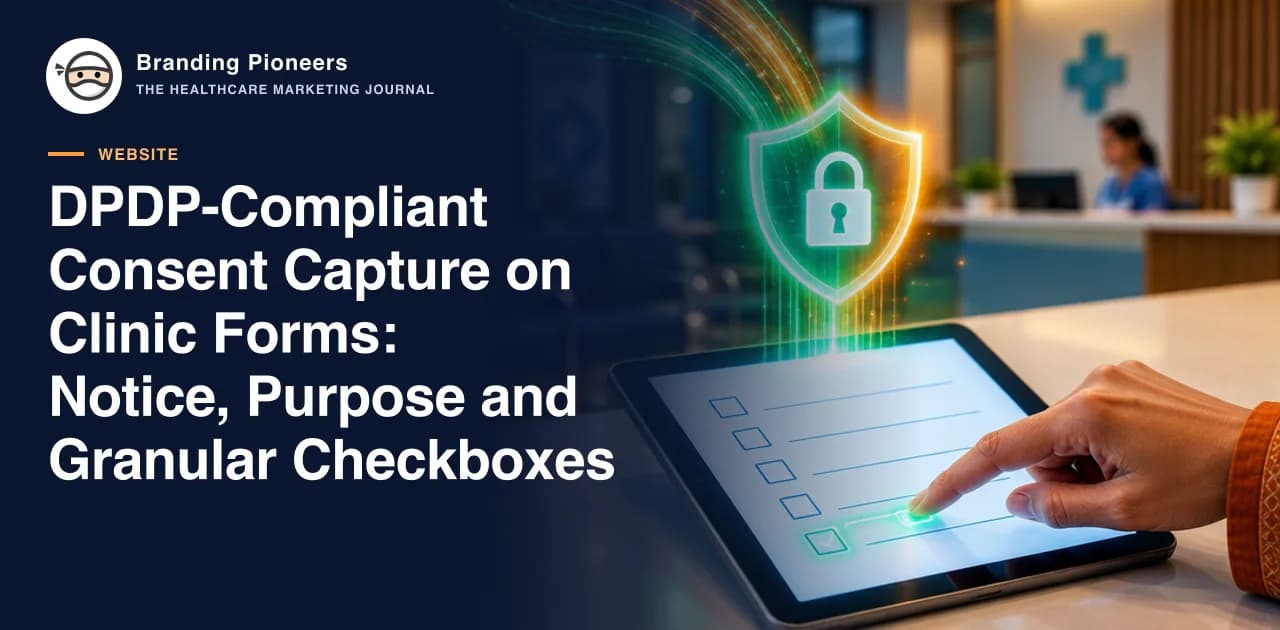
A clinic enquiry form collects a name, a phone number and a reason for the visit. That is enough to make it a personal data collection point under India's Digital Personal Data Protection Act, 2023, and the reason for visit is health information that deserves extra care even though the Act does not set a separate "sensitive" category. Most clinic forms today carry either a pre-ticked box that says "I agree to the privacy policy" or nothing at all.
This how-to is for clinic owners, practice managers and the developers or agencies who build their sites. It turns the Act and the DPDP Rules, 2025 into concrete form patterns: a separate notice, purpose-limited consent, granular checkboxes and a withdrawal route. It is not legal advice. The Rules are phased and parts remain subject to interpretation, so have your lawyer review the final wording.
We read the primary texts for this post: the DPDP Act, 2023 and the DPDP Rules, 2025. The PIB's explainer on the Rules summarises them in plain language.
What applies when
The Rules were notified on 14 November 2025. Under Rule 1, some rules apply immediately, Rule 4 (consent managers) one year after publication, and Rules 3 and 5 to 16 and others eighteen months after publication. Rule 3, which sets what a notice must contain, therefore falls in the later group. At the time of writing, in October 2026, that date has not arrived.
Do not read that as a reason to wait. Forms change slowly, consent records cannot be created retroactively, and the Act already sets the standard for what valid consent looks like. Building to it now means you will not have to re-collect later.
The elements a valid consent needs
Section 6 of the Act says consent must be free, specific, informed, unconditional and unambiguous, given by a clear affirmative action, for a specified purpose, and limited to the personal data necessary for that purpose. Four consequences for a clinic form:
- No pre-ticked boxes. A clear affirmative action means the patient ticks it, or presses a button that is clearly labelled as the consent action.
- No bundling. Consent to be contacted about an appointment is not consent to receive promotional messages. Section 6 calls for consent for a specified purpose, so separate purposes need separate choices.
- Data minimisation on the form itself. The Act's own illustration says that a telemedicine app that asks for the phone contact list, which is not necessary for telemedicine, cannot rely on consent for that. For a clinic, ask for the fields the purpose needs. A dental clinic taking a booking does not need an Aadhaar number.
- Language access. Requests for consent must be offered in English or any language in the Eighth Schedule to the Constitution, with the contact details of a Data Protection Officer or another authorised person.
Section 7(a) allows processing for the specified purpose for which the person voluntarily provided their data, as long as they have not indicated they do not consent. A patient who sends an enquiry asking to be called back is, in effect, asking for a callback. Whether that covers all uses you have in mind is the question for your lawyer. Marketing messages, remarketing and sharing data with a third party are different purposes and should not be assumed to fall under it.
Pattern 1: the notice is separate and understandable alone
Rule 3 says the notice must be presented and be understandable independently of any other information, give in clear and plain language the details necessary for specific and informed consent, include an itemised description of the personal data and the specified purposes with a specific description of goods or services enabled, and give the link and other means by which the patient can withdraw consent (with ease comparable to giving it), exercise rights and complain to the Board.
On a clinic form, that means a short notice panel, not a link to a 5,000-word privacy policy. A workable layout:
- A heading, "How we use the details you enter".
- An itemised list: name, mobile number, preferred time, reason for visit.
- A purposes list: to call or message you about this enquiry and to book your appointment.
- Who sees it: clinic reception and the treating doctor's team (add any processors, such as a messaging provider, in plain terms).
- How to withdraw, with a working link or number, and how to contact the person who handles your questions.
- Link to the full privacy policy, for the rest.
Keep the full policy at your privacy page as a second layer. The first layer has to carry the required content.
Pattern 2: purpose-limited checkboxes
Separate the form's job (get the enquiry to the clinic) from optional uses. A suggested structure:
| Item | Type | Default | Purpose label |
|---|---|---|---|
| Enquiry and appointment contact | Required to submit; stated as the form's purpose, not a checkbox | n/a | "To contact you about this enquiry and arrange your appointment" |
| Reminder messages | Checkbox | Unticked | "Send appointment reminders on WhatsApp or SMS" |
| Health tips and offers | Checkbox | Unticked | "Send occasional health information and updates" |
| Sharing with a named referral partner | Checkbox, only if real | Unticked | "Share my details with [named lab] to arrange a test I asked about" |
Words matter. A checkbox that reads "I agree to the terms" is not purpose-limited. A checkbox that names the channel, purpose and sender is. If you do not run promotional campaigns, do not add the box; an unused consent option is a risk, not a feature.
A separate point: consent is needed where it is the basis for processing, and not every message depends on it. Check with counsel whether a reminder to a patient with a confirmed appointment is covered by the booking purpose, and keep your opt-in practice consistent with the guidance in compliance and opt-in management.