Branding Pioneers · By the numbers2,000+Healthcare Clients350+Websites Built40+Specialties Served6Continents3,500Campaigns RunBranding Pioneers · By the numbers2,000+Healthcare Clients350+Websites Built40+Specialties Served6Continents3,500Campaigns Run
※THE PIONEERS BRIEF — weekly notes from inside healthcare growth→Subscribe · free
Branding PioneersBrandingPioneersAI-First Healthcare Growth · est. MMXVI
SolutionsWorkInsightsToolsFirmPricing
+91 98117 80937Book a strategy call →
Home›Blog›Strategy›First-Party Data Strategy for Healthcare Practices
Strategy

First-Party Data Strategy for Healthcare Practices

Third-party targeting is fading and health data carries the strictest handling rules of any category. Building your own patient data asset is now the durable advantage.

AT
Arush Thapar
July 20, 2026 · 5 min read
FILE · FIRST-PA
First-Party Data Strategy for Healthcare Practices

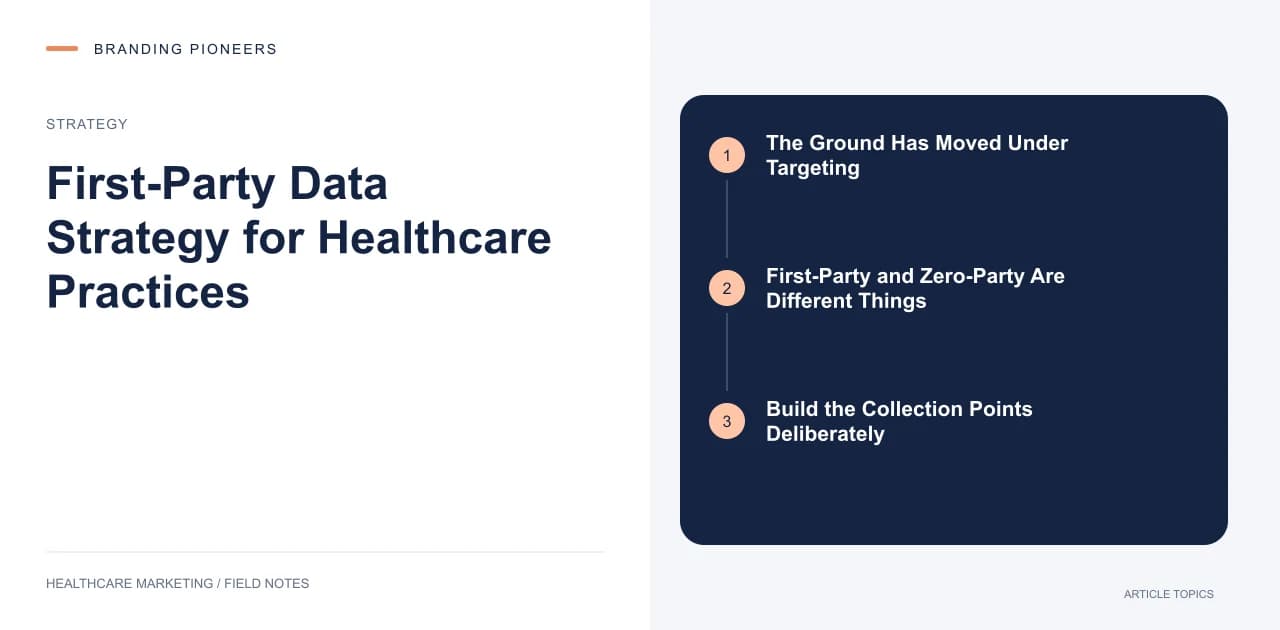
01The Ground Has Moved Under Targeting

For a decade, healthcare marketers rented audiences. You paid a platform to find people who resembled your patients, based on behavioural data collected across the web by someone else. That model is closing — through browser changes, platform restrictions, and, more decisively for healthcare, through regulation that treats health inference as a special category of data.

The practices that will be fine are the ones that own their relationships directly: a clean patient database, an email list people actually opted into, a WhatsApp audience that consented, and a CRM that knows which enquiry became which patient. The practices that will struggle are the ones whose entire growth engine is renting attention from platforms whose targeting keeps narrowing.

This is not a doom argument. First-party data is a better asset than rented targeting ever was, because you own it, competitors cannot buy it, and it improves every year you maintain it.

02First-Party and Zero-Party Are Different Things

Worth separating, because the second is more valuable and most practices ignore it.

First-party data is what you observe: appointments booked, pages visited, emails opened, forms submitted, procedures performed. It is behavioural and it accumulates automatically.

Zero-party data is what the patient deliberately tells you: which health topics they want to hear about, their preferred contact channel and time, whether they are researching for themselves or a parent, their language preference. It is volunteered, so it carries clearer consent, and it is usually more accurate than inference.

In healthcare, zero-party data is disproportionately useful because it lets you personalise without ever inferring a diagnosis from browsing behaviour. A patient who ticked a box saying send me content about managing diabetes has given you permission that no amount of page-visit tracking can substitute for. Ask, rather than deduce. It is both better marketing and a far safer legal position.

03Build the Collection Points Deliberately

Most practices have data leaking out of a dozen systems and consolidated in none. The first job is to design the collection points rather than let them happen.

Booking and enquiry forms. Every enquiry should land in one CRM with source, service interest, and location captured. Add one optional preference question — not five. Ask which channel they prefer to be contacted on. That single field will improve your follow-up response rate more than any copy change.

The front desk. This is the richest and most neglected source. If reception is not capturing how the patient heard about you and their contact preference at check-in, you are discarding the highest-quality attribution data available to you, daily. Make it two fields in the practice management system and make it mandatory.

Content downloads and tools. Pre-procedure checklists, recovery guides, cost estimator tools, and preparation instructions are all natural exchanges of genuinely useful material for an email address and a topic preference. Note the framing: you are collecting an interest, not a diagnosis.

WhatsApp opt-in. In India and much of the Gulf this is the highest-engagement channel available. Collect explicit, logged opt-in with a clear statement of what you will send and how to stop. Utility and appointment messages are welcome; unsolicited promotion will get your number blocked and your template approvals revoked.

Post-visit follow-up. Feedback requests and recovery check-ins are legitimate, useful touchpoints that also confirm and refresh contact details.

04Handle Health Data Like Health Data

This is the part where enthusiasm gets practices into trouble, so be explicit about the rules you will operate under.

Segment by expressed interest, never by inferred condition. A list of people who requested your knee replacement recovery guide is defensible. A list built from everyone who visited your oncology pages, tagged as cancer prospects, is not. The first is a stated preference; the second is a diagnosis you assigned to someone without asking.

Never upload condition-derived audiences to advertising platforms. Customer-match style uploads built from clinical data are prohibited by major ad platforms' own sensitive-category policies and are a serious regulatory exposure regardless. Keep clinical segmentation inside your own systems.

Keep marketing systems and clinical systems separate. Your CRM should hold enquiry and contact data. Your electronic medical record holds clinical data. Sync identifiers if you must, but do not let diagnoses flow into a marketing tool where dozens of people and several integrations can read them.

Consent must be specific, logged, and revocable. Record what was consented to, when, through which form, and with what wording. One unsubscribe action should stop all marketing, not just the list it came from.

Set retention limits. An enquiry that never converted and has had no engagement for two years is a liability, not an asset. Delete on a schedule and document the schedule.

Under India's Digital Personal Data Protection Act, the US health privacy framework, and GDPR alike, the safe pattern is the same: collect less, state clearly why, keep it separate, and make deletion easy.

05What to Actually Do With It

A database nobody uses is just risk. Four applications repay the effort.

Lifecycle communication. A patient who had a procedure has predictable needs afterwards — recovery milestones, follow-up scheduling, annual review reminders. These are useful, welcomed, and drive genuine repeat visits without any inference beyond what the patient already knows you know.

Reactivation. Patients who have not returned within their expected interval are your cheapest source of visits, and a simple reminder outperforms most acquisition spend for the effort involved.

Better measurement. When your CRM knows which enquiry became a patient, you can finally evaluate channels on patients rather than on clicks. This routinely changes budget decisions, because the channel producing the most enquiries is frequently not the one producing the most patients.

Modelled, non-sensitive audiences. You can still use first-party data for advertising responsibly — for example, suppressing existing patients from acquisition campaigns, or building lookalikes from a general newsletter list rather than a condition list.

06Where to Start

Do it in this order. Consolidate every enquiry into one CRM. Add the how-did-you-hear-about-us and preferred-channel fields at the front desk and on forms. Write a one-page data policy stating what you collect, why, where it lives, and when it is deleted. Build one genuinely useful content offer per major service line with a clear opt-in. Then, and only then, start building segments.

Six months of that discipline produces an asset that does not depend on any platform's policy changes — which is precisely the point.

FILED UNDERfirst-party data healthcarepatient data strategyhealthcare CRM datahealthcare marketing privacyzero-party data clinics
Stop reading. Start ranking.
Get a free strategy audit — we'll show you exactly what's missing.
Book audit →
AT
Author
Arush Thapar

Writing on healthcare growth, AI-powered patient acquisition, and the operational reality of marketing inside hospitals and clinics.

†Related guide: healthcare-marketing
The Patient Acquisition Blueprint (2026 Edition)
Free · 15 pages

The Patient Acquisition Blueprint (2026 Edition)

The exact 90-day patient-acquisition system, step by step.

We never share your details

FREE · 30 MIN
See your strategy opportunity gap.

Senior strategist, no boilerplate. Reply within 4 hours.

Book audit → Or call us directly
Keep going
7 Proven Ways to Reduce Patient Acquisition Cost→Medical Tourism Marketing: How to Attract International Patients→Strategy services & playbooks→13 healthcare case files→Pricing & engagement models→
The Pioneers Brief · weekly
One essay. Three benchmarks. One teardown.
Subscribe — free
Free for strategy readers

The Patient Acquisition Blueprint (2026 Edition)

The exact 90-day patient-acquisition system, step by step.

  • The 90-day patient acquisition operating system
  • Channel-by-channel budget allocation (₹50L–₹5Cr/yr)
  • 12 real, named client engagements walked through
  • ROI tracking spreadsheet (CAC, LTV, payback)
15 pages · Used by 2,000+ healthcare clients · Updated for AI search

We never share your details

Continue reading

More on strategy.

BROWSE ALL →
Strategy

7 Proven Ways to Reduce Patient Acquisition Cost

Most healthcare practices spend 2x to 5x more than necessary to acquire each new patient. Here are seven specific, teste…

February 3, 2026READ →
Strategy

Medical Tourism Marketing: How to Attract International Patients

India's medical tourism market is projected to reach $13 billion by 2026. Here is a comprehensive marketing strategy for…

March 10, 2026READ →
Strategy

Healthcare Marketing Budget: How Much Should You Spend?

The right marketing budget depends on your growth goals, market competition, and practice stage. Here are data-backed be…

August 10, 2025READ →
Why choose us

Why healthcare brands choose us.

Six reasons hospitals, clinics, and doctors pick a healthcare-only firm over a generalist agency.

  • Healthcare-only

    It's all we do. No retail, no fintech — the whole team thinks in patient journeys, clinical trust, and the way people actually choose a doctor.

  • AI-first systems

    Receptionists, WhatsApp triage, and attribution built in-house — we answer patients in seconds and tie every click to a booked appointment.

  • Compliance built-in

    HIPAA, ASCI, NABH and GDPR sign-off baked into every campaign — our standard, not an upcharge or an afterthought.

  • Senior on every account

    The senior who pitched you stays on the engagement. No bait-and-switch to juniors learning on your budget.

  • Measured to the appointment

    Patient-level attribution across calls, forms, and walk-ins. Monthly reports show booked patients — not just clicks and impressions.

  • Receipts, not promises

    We name our clients and show the work. Quarterly reviews with the numbers attached, every cycle.

The Branding Pioneers healthcare-marketing team at work
Healthcare-only · since 2016
An 80+ person team that does one thing well.
More from the brief

If this resonated, here’s what else lands.

Adjacent practices, the relevant tools, and the case files where we shipped this thinking against real patient-acquisition targets.

  • Service
    Google Search Ads (PPC)

    Inside Healthcare Performance Ads

    Read it
  • Service
    Google Display Ads

    Inside Healthcare Performance Ads

    Read it
  • Service
    Google Local Service Ads (LSA)

    Inside Healthcare Performance Ads

    Read it
  • Challenge
    Get More Patients

    Common issue in this segment

    Read it
  • Challenge
    Hospital Lead Generation

    Common issue in this segment

    Read it
  • Q & A
    Apollo Athenaa — Women's Cancer Centre launch

    Launch service launch plan · 9 mo

    Read it
  • Q & A
    Nova IVF — Doctor brand growth

    Doctor brand ivf growth programme · 6 mo

    Read it
  • Term
    ROAS (Return on Ad Spend)

    Revenue earned for every dollar of ad spend, calculated as Revenue ÷ Ad Spend. At 4x ROAS, each $1 brings back…

    Read it
  • Term
    CPA (Cost Per Acquisition)

    In healthcare, the price of turning marketing into one new patient. Benchmarks land around urgent care $15-25,…

    Read it
  • Guide
    Google Ads for Healthcare: The Definitive Guide

    Long-form playbook

    Read it
  • Q & A
    How to Get More Patients for My Clinic

    The most effective ways to get more patients are local SEO (ranking on Google Maps), Google Ads for immediate …

    Read it
  • Location
    Healthcare marketing in Mumbai

    Local SEO + media buying in Mumbai

    Read it
  • Location
    Healthcare marketing in Delhi

    Local SEO + media buying in Delhi

    Read it
  • Guide
    Clinic Growth
    Read it
  • Term
    Google Ads
    Read it
  • Term
    Google Lsa
    Read it
  • Term
    Patient Acquisition Cost
    Read it
  • Location
    Hospital Marketing Agency In Mumbai
    Read it
  • Location
    Hospital Marketing Agency In Delhi
    Read it
  • Guide
    Ivf Fertility Marketing
    Read it
THE PIONEERS BRIEF · WEEKLY

One essay,
three benchmarks,
one teardown.

Healthcare growth, every Thursday morning. No hype, no fluff.

Subscribe — free →Browse the archive
Branding PioneersBrandingPioneersAI-First Healthcare Growth · est. MMXVI

An AI-first MarTech firm engineered for healthcare. We build patient-acquisition systems for hospitals, clinics, and physicians worldwide.

official@brandingpioneers.com+91 98117 80937
The Pioneers Brief · Weekly

Healthcare growth notes, every Thursday.

Frameworks, tear-downs, and one strategy you can run on Monday. 12,000+ healthcare leaders read it.

No spam. Unsubscribe in one click.
Solutions
  • Branding
  • Healthcare SEO
  • Performance media
  • Social media
  • AI & automation
  • Direct marketing
  • Web & product
  • PR & influence
  • All solutions
Industries
  • Hospitals
  • IVF & fertility
  • Dental
  • Aesthetics
  • Mental health
  • Medical tourism
  • All industries
Work
  • Case studies
  • Results
  • Portfolio
  • Before / after
  • Awards
  • Reviews
  • Testimonials
Free guides
  • The Patient Acquisition Blueprint (2026 Edition)
  • The 147-Point Healthcare SEO Checklist
  • Healthcare Google Ads Playbook 2026
  • WhatsApp AI Chatbot for Hospitals (14-Day Deploy)
  • 365-Day Healthcare Social Media Calendar
  • Healthcare Website Conversion Toolkit
  • How to Rank on ChatGPT, Gemini & Claude (Healthcare AEO)
  • Medical Tourism Marketing Masterplan
  • The 4.9-Star Reputation System
  • How Much Should You Spend on Marketing?
  • Browse all 10 guides →
Resources
  • ROI calculators
  • Pricing & costs
  • Templates
  • Glossary
  • Benchmarks 2026
  • Free tools
  • Brand assets
Insights
  • Blog
  • Podcast
  • Webinars
  • Newsletter
  • Events
  • Academy
  • Research
Firm
  • About
  • Founder
  • Team
  • Careers
  • Process
  • Why healthcare-only
  • Contact
Headquarters
Gurugram, IN
Ground Floor, SupremeWork, Plot 84, Institutional Area, Sector 32, Gurugram 122001
+91 98117 80937
View on map
USA
La Mesa, US
8697 La Mesa Blvd, Suite C #495, La Mesa, CA 91942
View on map
Mental Health Partner
Tampa, US
700 S Harbour Island Blvd, Tampa, FL 33602
View on map
Healthcare marketing by location63 countries · explore →
India
  • Mumbai
  • Delhi
  • Bangalore
  • Hyderabad
  • Chennai
  • Kolkata
  • Pune
  • Ahmedabad
  • Jaipur
  • Gurugram
  • Noida
  • Vadodara
  • Hisar
  • Rohtak
  • Lucknow
  • Chandigarh
  • Kochi
  • Indore
  • Coimbatore
  • Goa
  • Bhopal
  • Visakhapatnam
  • Thiruvananthapuram
  • Nagpur
  • Surat
  • Patna
United States
  • New York
  • Los Angeles
  • Chicago
  • Houston
  • Miami
  • San Francisco
  • Dallas
  • Boston
  • Atlanta
  • Denver
  • Phoenix
  • Seattle
  • San Jose
  • Austin
  • Minneapolis
  • Detroit
  • Tampa
  • Orlando
  • Portland
  • Charlotte
  • Baltimore
  • Nashville
  • San Diego
  • Philadelphia
  • Washington DC
  • Raleigh
  • Salt Lake City
  • San Antonio
  • Pittsburgh
  • Cleveland
  • Rochester
  • New Haven
  • St. Louis
  • Kansas City
  • Indianapolis
  • Columbus
  • Jacksonville
  • Milwaukee
  • Louisville
  • Memphis
  • Oklahoma City
  • Albuquerque
  • Tucson
  • Las Vegas
  • Sacramento
  • Honolulu
  • Anchorage
  • Durham
  • Ann Arbor
  • Iowa City
  • Charlottesville
  • Chapel Hill
  • Madison
  • Birmingham
  • Omaha
  • Little Rock
  • Burlington
  • Scottsdale
  • Mesa
  • Fort Worth
  • Plano
  • Frisco
  • Arlington
  • El Paso
  • Corpus Christi
  • Boise
  • Colorado Springs
  • Fort Collins
  • Provo
  • Henderson
  • Stamford
  • Hackensack
  • Morristown
  • Bethesda
  • Naperville
  • Irvine
  • Pasadena
  • Savannah
  • Charleston
  • Greenville
  • Knoxville
  • Chattanooga
  • Lexington
  • Richmond
  • Virginia Beach
  • Winston-Salem
  • Greensboro
  • Wilmington
  • Des Moines
  • Wichita
  • Cincinnati
  • Dayton
  • Akron
  • Toledo
  • Grand Rapids
  • Lansing
  • Hartford
  • Providence
  • Worcester
  • Springfield
  • Albany
  • Syracuse
  • Buffalo
  • Rochester
  • Newark
  • Jersey City
  • Chandler
  • Gilbert
  • McAllen
  • Sugar Land
  • The Woodlands
  • Newport Beach
  • Fairfax
  • Tysons
  • White Plains
  • Garden City
  • Princeton
  • Schaumburg
  • Tulsa
  • Spokane
  • Jackson
  • Gainesville
  • New Orleans
  • Norfolk
  • Shreveport
  • Sioux Falls
  • Morgantown
  • Danville
United Kingdom
  • London
  • Manchester
  • Birmingham
  • Edinburgh
  • Leeds
  • Glasgow
  • Bristol
  • Liverpool
  • Newcastle
United Arab Emirates
  • Dubai
  • Abu Dhabi
  • Sharjah
  • Ajman
Canada
  • Toronto
  • Vancouver
  • Montreal
  • Calgary
  • Ottawa
  • Edmonton
  • Winnipeg
  • Halifax
  • Quebec City
Australia
  • Sydney
  • Melbourne
  • Brisbane
  • Perth
  • Adelaide
  • Gold Coast
  • Canberra
Singapore
  • Singapore
Saudi Arabia
  • Riyadh
  • Jeddah
  • Dammam
  • Medina
  • Makkah
Germany
  • Berlin
  • Munich
  • Hamburg
  • Frankfurt
France
  • Paris
  • Lyon
  • Marseille
Italy
  • Milan
  • Rome
  • Turin
  • Naples
Netherlands
  • Amsterdam
  • Rotterdam
Switzerland
  • Zurich
  • Geneva
Spain
  • Madrid
  • Barcelona
  • Valencia
  • Seville
Sweden
  • Stockholm
Ireland
  • Dublin
Qatar
  • Doha
Kuwait
  • Kuwait City
Bahrain
  • Manama
Oman
  • Muscat
Hong Kong
  • Hong Kong
Japan
  • Tokyo
  • Osaka
South Korea
  • Seoul
  • Busan
Thailand
  • Bangkok
  • Chiang Mai
Malaysia
  • Kuala Lumpur
  • Penang
New Zealand
  • Auckland
  • Wellington
  • Christchurch
Israel
  • Tel Aviv
Kenya
  • Nairobi
  • Mombasa
South Africa
  • Cape Town
  • Johannesburg
  • Durban
  • Pretoria
Nigeria
  • Lagos
  • Abuja
  • Port Harcourt
Ghana
  • Accra
Egypt
  • Cairo
  • Alexandria
Morocco
  • Casablanca
Mexico
  • Mexico City
  • Monterrey
Brazil
  • Sao Paulo
Colombia
  • Bogota
Argentina
  • Buenos Aires
Peru
  • Lima
Chile
  • Santiago
Portugal
  • Lisbon
Austria
  • Vienna
Czech Republic
  • Prague
Poland
  • Warsaw
Denmark
  • Copenhagen
Belgium
  • Brussels
Finland
  • Helsinki
Greece
  • Athens
Ethiopia
  • Addis Ababa
  • Dire Dawa
Tanzania
  • Dar es Salaam
  • Dodoma
  • Arusha
Uganda
  • Kampala
  • Entebbe
Rwanda
  • Kigali
Senegal
  • Dakar
Ivory Coast
  • Abidjan
Cameroon
  • Douala
  • Yaounde
Tunisia
  • Tunis
  • Sousse
Algeria
  • Algiers
  • Oran
Mozambique
  • Maputo
Zambia
  • Lusaka
Zimbabwe
  • Harare
Botswana
  • Gaborone
Mauritius
  • Port Louis
Namibia
  • Windhoek
Cambodia
  • Phnom Penh
Accreditations & partnerships
GooglePREMIER PARTNERMetaBUSINESS PARTNERLinkedInMARKETING PARTNERMicrosoft AdvertisingSELECT PARTNERHubSpotSOLUTIONS PARTNERISO 27001INFORMATION SECURITYCERTIFIED · 2024HHIPAA AwareUS HEALTH PRIVACYBAA-READY WORKFLOWSNABH-AlignedQUALITY COUNCIL · INDIAHOSPITAL STANDARDSMSME · IndiaUDYAM REGISTEREDGOI · MINISTRY OF MSME
© Branding Pioneers 2026 · est. MMXVI · All rights reserved.Privacy·Terms·Disclaimer·Refund·Sitemap·Compliance
Branding Pioneers · By the numbers2,000+Healthcare Clients350+Websites Built40+Specialties Served6Continents3,500Campaigns RunBranding Pioneers · By the numbers2,000+Healthcare Clients350+Websites Built40+Specialties Served6Continents3,500Campaigns Run