Two facts shape healthcare marketing in Mumbai more than anything else. First, the city's geography makes travel expensive in time, so patients choose within their own belt — South Mumbai, the western suburbs, the central line, Navi Mumbai, Thane — and rarely cross for an outpatient consultation. Second, broad search terms are dominated by large hospital brands with enormous accumulated authority.
Put together, they point to the same conclusion: a Mumbai practice competing on citywide terms is spending money to be seen by people who will never attend. The win is local, and it is available.
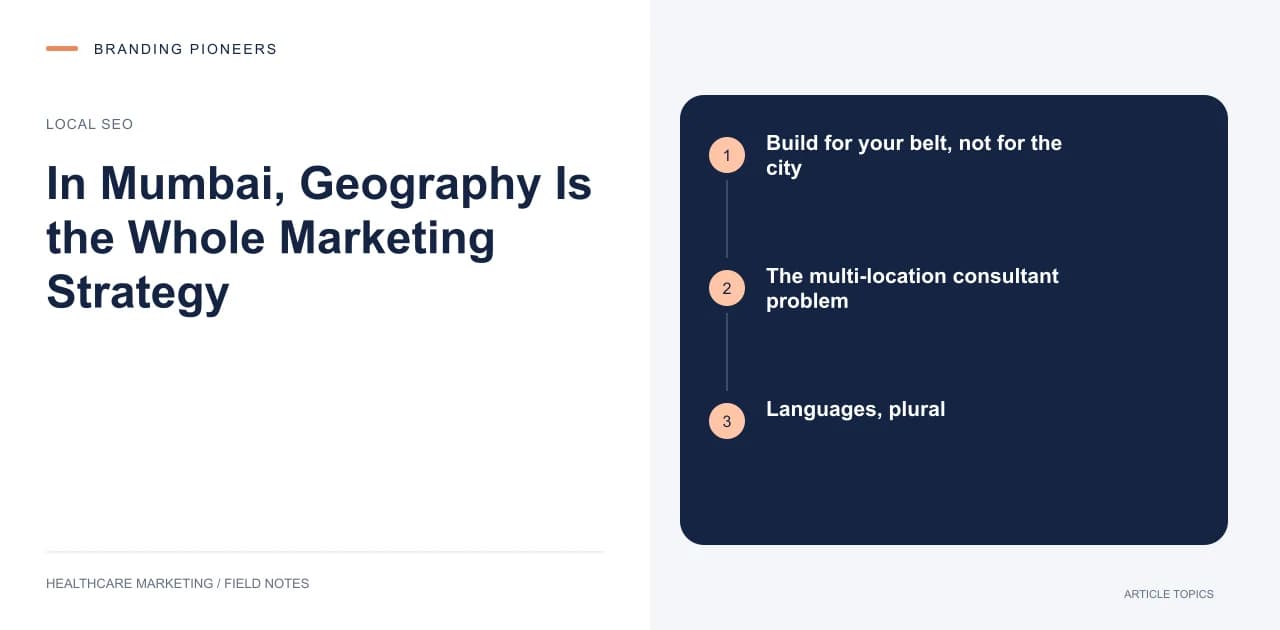
Build for your belt, not for the city
A dermatology clinic in Bandra and one in Chembur are not competitors. A patient in Borivali is not travelling to Colaba for a routine consultation, and one in Vashi is not crossing to the western suburbs. For high-acuity or surgical care patients absolutely will travel — but for the outpatient volume that sustains most practices, catchment is narrow.
So define the catchment honestly. Which suburbs do your patients actually come from? Which stations are they arriving at? Then make yourself unmistakable within that area:
- Google Business Profile as the primary asset, with correct category, accurate hours, real photography of the building and entrance, and directions written the way locals give them — nearest station, the landmark on the corner, where the parking actually is.
- Content that references the area naturally because that is how patients describe their own search, without manufacturing thin pages for every suburb in the city.
- Reviews from patients in your area, replied to briefly and factually, never confirming that anyone was a patient.
The multi-location consultant problem
Mumbai consultants commonly hold consulting hours at two or three addresses — an own clinic, a hospital attachment, a shared consulting facility. Handling this badly in local search is one of the most common and most damaging technical mistakes we see.
The failure modes are specific: creating multiple listings for the same practitioner at the same address, listing a practitioner at an address where they hold no scheduled hours, using an address without a real presence, or letting hours drift out of date across listings. These produce duplicate and suspended listings, and recovering a suspended profile is far harder than setting it up correctly.
The workable structure is a listing for each genuine practice location with its own accurate hours, plus a practitioner profile page on your own site that lists every location and when you are actually there. The website page carries the complexity; the listings each stay clean and true.
Languages, plural
Marathi, Hindi, Gujarati and English all describe the same conditions to different parts of this city, and the mix varies sharply by area. Practices do not need four full websites — they need to know which languages their catchment actually uses and make sure the front desk, the WhatsApp channel and the key service pages meet patients there.
The rule that holds everywhere: written, not machine-translated. Translated clinical content reads as foreign to native speakers and damages exactly the trust you were trying to build.
Where the hospital brands are weak
You will not outrank a large hospital group for a broad specialty term, and you should stop trying. What those brands do not do well:
Individual practitioner depth. A patient given your name by a friend or a referring GP searches that name. If the top result is a directory listing rather than your own profile, you have handed the relationship to an aggregator. A real profile — training, years in practice, hospital affiliations, conditions treated, procedures performed, languages, publications — should own your name.
Honest procedure detail. What the procedure involves, what preparation looks like, what recovery is genuinely like week by week, what determines cost. Hospital service pages are usually a paragraph. This is where a specialist practice wins.
Real questions, answered. Whether a condition needs surgery now or can wait, what a scan will and will not show, what a second opinion involves. These queries carry high intent and low competition.