Singapore is one of the few markets where the advertising rules for doctors are written plainly, published openly, and actually enforced. That combination is a gift. It means you can build a marketing programme once, confidently, instead of guessing at the boundary and quietly hoping nobody complains.
The catch is that the boundary sits in a different place than most international marketing playbooks assume — particularly on testimonials, before-and-after imagery, and outbound messaging.
This is a practitioner's summary written by marketers, not legal advice. Regulations change, and enforcement varies. Confirm the current text with your regulator or your own counsel before you publish.
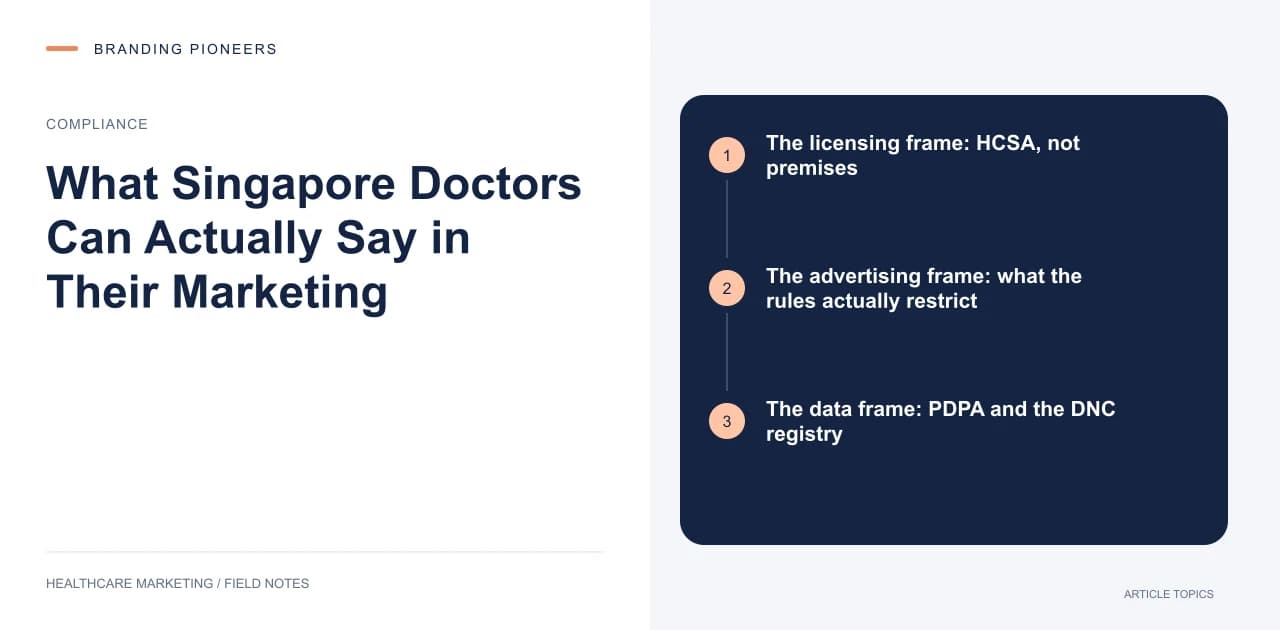
The licensing frame: HCSA, not premises
The Healthcare Services Act replaced the older Private Hospitals and Medical Clinics Act, and the shift matters more than it sounds. Licensing moved from premises-based to services-based: you are licensed for the services you provide rather than the room you provide them in. For marketing, that has a direct consequence — the services you advertise must map to services you are licensed to deliver, and telemedicine is a licensable service in its own right.
Practically: before a new service line goes on the website, confirm it sits inside your licence. "We now offer X" is an advertising claim and a licensing claim simultaneously.
The advertising frame: what the rules actually restrict
Read together, MOH's advertising requirements and the Singapore Medical Council's Ethical Code and Ethical Guidelines converge on a small number of prohibitions that catch most clinics:
- No claims of superiority. Comparative and superlative claims — best, leading, most advanced, number one — are out. So is implying that your equipment, technique or training is superior to a colleague's without objective substantiation.
- No creating unrealistic expectations. This is the clause that governs testimonials. A patient story that implies a typical outcome, or that promises a result, falls foul of it even when the story is true.
- No sensational or emotive appeal. Fear-based framing, urgency, and "limited slots" scarcity tactics are exactly the register the guidelines were written to exclude.
- No inducements. Discounts, package deals, free consultations and giveaways attached to medical services sit in restricted territory, especially for aesthetic procedures.
- Factual, verifiable information is permitted. Qualifications, registrable specialties, services offered, operating hours, languages, fees — all fine, and all under-used.
Aesthetics has its own layer
MOH's guidelines on aesthetic practices classify procedures and set out which are accepted practice, which require evidence, and what a doctor must have to perform them. Advertising in this space carries additional scrutiny: before-and-after imagery is heavily constrained, and imagery that has been retouched, taken under different lighting, or selected to flatter is treated as misleading. If your aesthetic marketing is built on transformation photography, it needs rebuilding around education and credentials.
The data frame: PDPA and the DNC registry
The Personal Data Protection Act governs consent, purpose limitation, access and correction for every enquiry form on your site. Two provisions catch clinics repeatedly:
The Do Not Call registry. Before sending a marketing message to a Singapore number, you must check the number against the DNC registers unless you have clear and unambiguous consent in evidentiary form. "The patient gave us their number when they booked" is not consent to market to it. This applies to SMS, to voice calls, and to messaging apps used for marketing. Appointment reminders and clinical follow-ups are a different category — but the moment a promotion rides along in the same message, it is a marketing message.
Purpose limitation. Data collected to deliver care cannot be repurposed for marketing without consent for that purpose. That includes uploading patient contact lists to advertising platforms to build audiences, which is a common and genuinely risky shortcut.
Add a distinct, separately-ticked marketing consent to your forms with the purpose stated in plain English, log it, and honour withdrawal quickly. It costs you a small percentage of opt-ins and removes an entire class of problem.