Diwali falls on 8 November 2026, with the festive run starting in mid-October at Navratri. Which means that by the third week of October, every hospital marketing team in India will be signing off the same creative: a diya, a rangoli border, a greeting, and the logo in the corner.
That post costs nothing and does nothing. It is also a strange thing to publish from an organisation whose emergency department is about to have one of the hardest weeks of its year.
There is a better way to run the festive season, and it starts with admitting that a hospital has two calendars, not one.
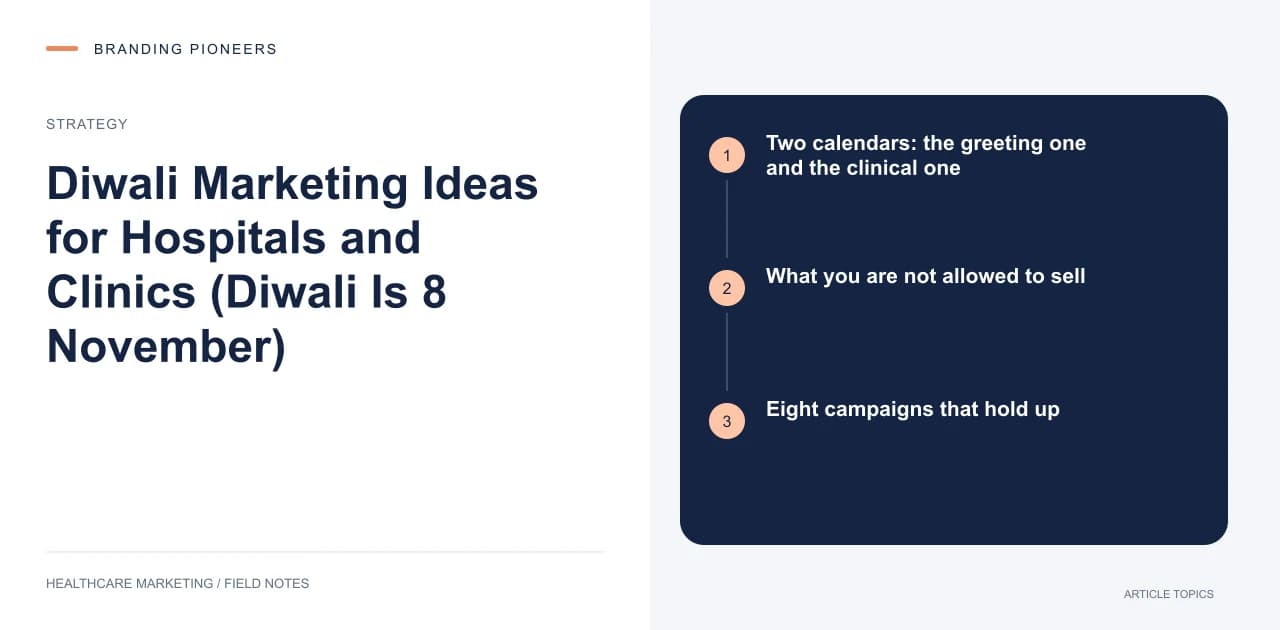
Two calendars: the greeting one and the clinical one
The greeting calendar is Navratri, Dhanteras, Diwali, Bhai Dooj. The clinical calendar, for most Indian hospitals, is burns, firecracker eye injuries, asthma and COPD flare-ups as air quality collapses, cardiac events after a week of heavy food and disturbed sleep, glycaemic swings in patients with diabetes, noise-related ear complaints, and road trauma.
Your clinical calendar is the content plan. It is useful, it is timely, it is unarguably within your competence, and it is the reason someone searches for you in November.
The greeting calendar is one post. Treat it that way.
What you are not allowed to sell
Before ideas, the boundary, because festive season is when healthcare advertising in India gets sloppy.
The National Medical Commission's ethical advertising guidelines of 6 October 2026, read with the 2002 conduct regulations, restrict how doctors and hospitals may advertise: no discounts, limited-period offers, coupons or free procedures as inducements (para 8.1(x)), no superlatives, and no testimonials or before-and-after posts. Our NMC guidelines hub summarises every clause. The Advertising Standards Council of India code applies to healthcare creative, including comparative claims, guarantees and before-and-after imagery. The Drugs and Magic Remedies (Objectionable Advertisements) Act 1954 prohibits advertising that claims to cure a list of named conditions, and it is still enforced.
In practice that rules out the three things agencies suggest every October: a discount on a surgical procedure, a countdown timer on a health package, and a festive offer framed as urgency around a diagnostic test. Preventive health packages can be promoted — accurately, with the inclusions stated and the price honest. They cannot be sold like a sofa.
Eight campaigns that hold up
1. The firecracker injury card, published before Dhanteras. What to do in the first ten minutes of a burn or an eye injury, written and signed off by your own burns and ophthalmology consultants. Cool running water, not ice, not toothpaste, not ghee. Do not rub the eye, do not wash it with whatever is nearby, come in. This is the single most shared piece of hospital content in India in November, and most hospitals publish it two days too late.
2. Open through Diwali. Hours for every department, the emergency entrance, pharmacy timing, which consultants are on call, whether the lab is running. Unglamorous and the most useful post you will publish all quarter. Put it on the website, on the Google Business Profile, and pin it.
3. Sweets without shaming. A diabetologist talking about portions, timing and insulin adjustment in the real world, where people are going to eat the mithai. Content that tells patients not to celebrate gets ignored; content that tells them how to celebrate gets saved.
4. The air quality post for respiratory patients. Inhaler and action-plan reminders, pinned for the fortnight around the festival, tied to your pulmonology pages. In north India this overlaps with smog season and should be planned as one campaign, not two.
5. The elderly-parent checklist. Written for the adult child who is visiting home for the festival and will notice, for the first time in a year, that something has changed. Medication review, a fall check at home, and what to ask the family doctor while you are there. This post reaches a diaspora audience that is impossible to target and easy to serve.
6. Your own staff. The team working the Diwali night shift. Shot properly, named, with their consent. It is the only festive content that is genuinely about celebration and it outperforms the diya every time.
7. The preventive health package, sold on evidence. Who the test is for, what it does and does not detect, what happens if something is found. Not a countdown. The hospital marketing pages go into how to structure these so they hold up commercially and ethically.
8. A corporate gifting alternative. Employers spend on Diwali gifting. A health check voucher, or an on-site camp booked for the new year, is a legitimate pitch to HR in exactly the weeks they are deciding. It also opens a B2B line that outlives the festival.
Fix the hours data before you write a single caption
The most common festive-season failure in Indian healthcare has nothing to do with creative. It is a Google Business Profile that still shows normal hours on a day the outpatient department is closed, or shows closed on a day the emergency entrance is running as usual.
Somebody arrives, finds a shut door or an empty reception, and writes the review that outlives the festival.
Set special hours on every profile — every location, every department that has its own listing, the pharmacy and the lab if they are listed separately. Do it in the third week of October, before the person who knows the roster goes on leave. Then check it again the day before, because roster changes late and nobody tells marketing.
Add the same information as a profile post, because the special-hours field is easy to miss on a phone. And make sure the phone number on the listing rings somewhere that is staffed during the festival, not at a desk that nobody is sitting at.
This takes under an hour and prevents the only festive marketing problem that produces a permanent public record.