Hospital executives rarely fail at LinkedIn because they have nothing to say. They fail because the posts happen in bursts, each one is approved by a different person in a different way, and by the third month nobody remembers what the plan was. A calendar fixes the rhythm. A review process fixes the risk.
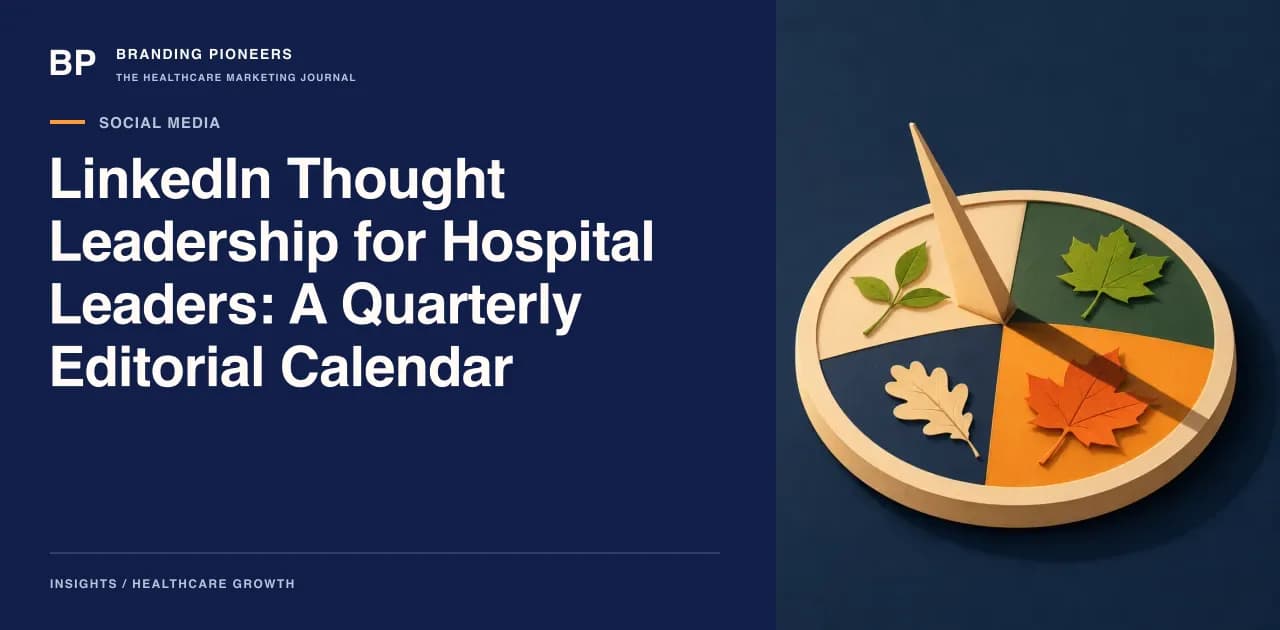
This article is for CEOs, medical directors, chief operating officers and the communications leads who support them, at hospitals in India and the Gulf. It sets out a quarterly editorial calendar built around four themes, a weekly rhythm that a busy leader can sustain, and the sign-off every post should pass before it goes live. For the reasoning on why a leader should be visible at all, and how it differs from the institutional page, see our earlier piece on building authority as a hospital leader. This one is the working plan.
One caution first. We do not have verified engagement benchmarks for hospital executives on LinkedIn, and numbers quoted without a method are not worth planning around. The calendar therefore comes with a way to set your own baseline in the first quarter.
Principles that shape the calendar
- One theme per quarter. Four themes across a year gives each time to develop and gives followers something to expect.
- One anchor piece per month. A long-form article, newsletter edition or recorded conversation that carries the substance. Everything else is a shorter derivative.
- Two to three posts a week from the leader, at most. More than that and review quality drops.
- Every post has a named reviewer before it exists. Decide who checks before the draft is written.
- Nothing that the hospital could not defend in front of a regulator. In India that means the National Medical Commission and the State Medical Council. In Dubai it means the Dubai Health Authority. Other emirates, Saudi Arabia and other markets have their own bodies and rules.
The four quarterly themes
Quarter 1: Quality and transparency (outcomes data, handled carefully)
"Outcomes data" is the theme hospital leaders most want to publish and the one with the most regulatory friction. Be exact about what this means.
In India, the NMC's October 2026 advertising and public communication guidelines, as reported by Medical Dialogues, bar before-and-after depictions and success stories except for scientific or educational use with anonymised consent, and allow hospitals to share factual, verifiable information. Our own reading is that this does not permit marketing-style success rates or patient counts, and you should confirm your approach with your legal adviser.
So Quarter 1 posts should be about how quality is measured, not a headline result:
- How the hospital tracks infection control, readmissions or patient safety incidents, and how the data is reviewed.
- What accreditation involves, and which bodies the hospital reports to. Name the accreditor and link to its listing where one exists.
- Clinical audit and morbidity-and-mortality reviews, described as a process.
- Where a hospital's outcomes are published in a journal or registry, link to that publication and say it is a scientific publication.
Avoid superlatives, rankings without disclosed method, and anything that identifies a patient.
Quarter 2: New technology and how it is adopted
Leaders like writing about new equipment and software. Posts that work are about decisions, not announcements: why the hospital chose a system, what it replaced, what staff training required, what it costs in time, what the clinical team said before it went live.
Rules for this quarter:
- Say the technology is available. Do not say it is better than alternatives, or that it improves outcomes, unless the claim can be supported by a published, independent source that you link.
- Do not post AI-generated promotional campaigns. The NMC's 2026 guidelines, as summarised by Medical Dialogues, prohibit them for commercial interest and require a source mark on permitted AI content.
- Ask the vendor's marketing team not to reshare your posts as endorsement. That is the vendor's promotion, not your thought leadership.
Quarter 3: Workforce
Nursing shortages, training pipelines, doctor retention, shift design and clinician wellbeing matter to both recruitment and reputation. These posts also suit leaders who prefer not to discuss clinical content at all.
Useful angles: what the hospital changed after staff feedback, how it trains new graduates, how it supports internationally recruited staff in the Gulf, how it handles rosters. Keep real people out unless they have agreed in writing to be named.
Quarter 4: Community, partnerships and regional health
Public-health education, screening drives, partnerships with schools or employers, and policy views. In India, educational content in the doctor's or institution's own name that does not promote personal practice or solicit patients sits more comfortably than promotional posts. For health awareness days, a calendar helps; our healthcare social media calendar planning guide lists how to build one.
A twelve-week template
Each quarter repeats this shape. The week numbers below are within a quarter.
| Week | Anchor activity | Leader posts |
|---|---|---|
| 1 | Plan the quarter: choose three sub-topics, assign reviewers | Post 1: the question this quarter will address |
| 2 | Draft the month-one anchor piece | Post 2 and 3: context and a process explanation |
| 3 | Review and publish the anchor piece | Post 4: short extract; Post 5: reply to comments |
| 4 | Collect audience questions | Post 6: answer one question in a short post |
| 5 | Draft month-two anchor piece | Post 7 and 8 |
| 6 | Review and publish | Post 9 and 10 |
| 7 | Collect questions | Post 11 |
| 8 | Draft month-three anchor piece | Post 12 and 13 |
| 9 | Review and publish | Post 14 and 15 |
| 10 | Prepare a quarterly summary | Post 16 |
| 11 | Review what worked, using the baseline method below | Post 17 |
| 12 | Plan the next quarter | Post 18: look back and look ahead |
The shape is deliberately light. It is more important to publish consistently for four quarters than to be ambitious for four weeks.
Choosing the anchor format
Any LinkedIn member can create a newsletter, and subscribers get push, in-app and email notifications on each new edition. A monthly newsletter fits the anchor role well: it has a subscriber list, it holds the themes together and it gives the shorter posts something to point to. Other anchor formats include an audio conversation, which we explore in the context of doctor-led podcasts, or a recorded panel from a conference the hospital hosted.
If you are working across India and the Gulf, decide the language policy early. English content works across both. Arabic posts for Gulf audiences should be written natively, not translated line by line, and reviewed by someone who knows the regulator's expectations.