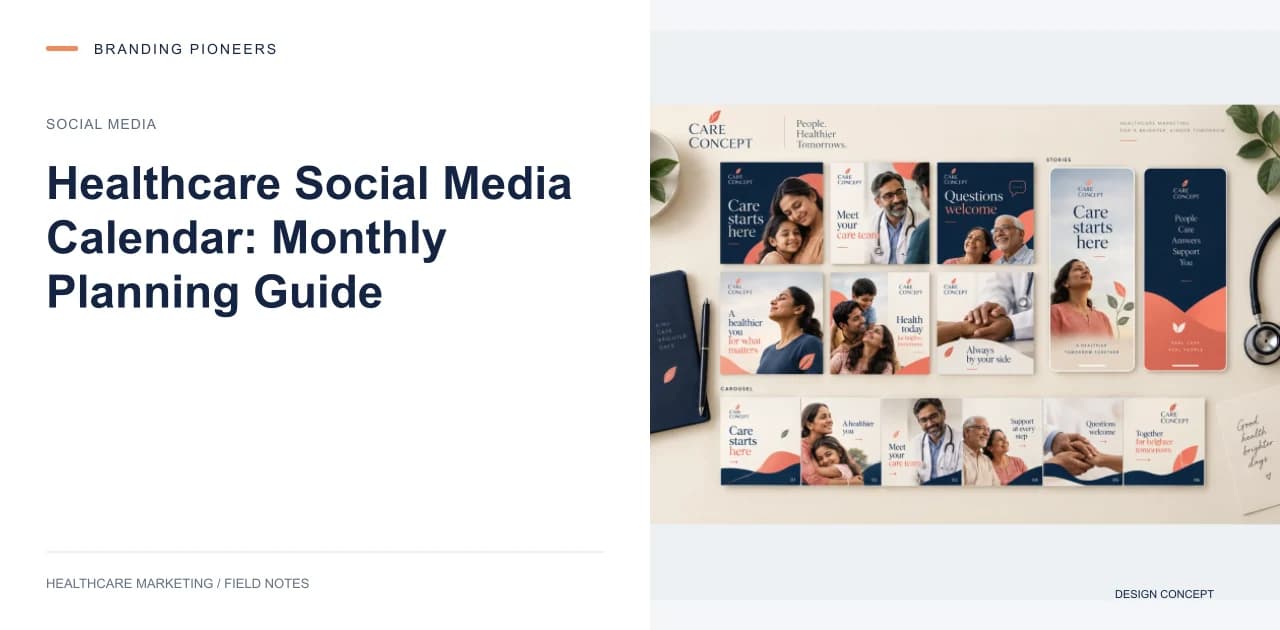
Healthcare Social Media Calendar: Monthly Planning Guide
A structured social media calendar eliminates the daily scramble of 'what should we post?' Here is a monthly framework designed for healthcare practices.
Sources & References
A structured social media calendar eliminates the daily scramble of 'what should we post?' Here is a monthly framework designed for healthcare practices.
The number one reason healthcare social media accounts go dormant is the daily question: "What should we post today?" Without a plan, posting becomes reactive and inconsistent. A content calendar transforms social media from a daily burden into a once-a-month planning session.
Consistent posting matters because social media algorithms reward regularity. An account that posts three times per week consistently will outperform one that posts daily for two weeks then goes silent for a month.
Instead of planning individual posts, assign a content theme to each day of the week. This creates variety while making planning efficient.
Share a health fact, tip, or myth-buster related to your specialty. "Did you know that 80 percent of back pain resolves without surgery? Here are 3 at-home exercises our physiotherapists recommend." Educational content establishes expertise and provides shareable value.
Show your team, your office, your technology, or your process. Tour a new exam room. Introduce a staff member. Show your morning huddle. Behind-the-scenes content humanizes your practice and builds familiarity.
Share a patient testimonial (with consent), a before-and-after photo (for relevant specialties), or a screenshot of a Google review with a thank-you message. Social proof is the most powerful conversion-driving content type.
Post to Instagram or Facebook Stories two to three times per week with informal, day-of content: quick tips, poll questions ("Would you rather: morning or evening appointments?"), or time-lapse videos of the office.
Overlay a monthly theme on your weekly framework to keep content cohesive and aligned with health awareness calendars.
January: New Year health goals, wellness resolutions, preventive care reminders. February: Heart health month, relationship between stress and health. March: Nutrition month, allergy season preparation. April: Oral health month (for dental), stress awareness month. May: Mental health awareness, skin cancer awareness, allergy season content. June: Men's health month, sun safety. July: UV protection, summer injury prevention, hydration. August: Back to school health (immunizations, vision checks, sports physicals). September: Healthy aging month, prostate awareness. October: Breast cancer awareness, flu season preparation. November: Diabetes awareness, lung cancer awareness. December: Year in review, holiday health tips, end-of-year insurance reminders.
Set aside two to three hours at the beginning of each month. Use this time to plan all content for the month, write captions, select or create visuals, and schedule everything using a tool like Later, Buffer, or Hootsuite.
Batch creation is dramatically more efficient than daily posting. When you sit down to create 12 posts at once, you enter a creative flow that produces better content in less total time.
Use real photos from your practice whenever possible. Stock photos are obvious and generic. Even a phone photo of your actual waiting room is more authentic than a stock image of a model in a lab coat.
Take 10 to 15 photos per month during regular practice operations: your team at work, the office looking welcoming, equipment being used, community events.
Write conversational captions that open with a hook. "Most patients wait three months before seeing a doctor about knee pain. Here is why that delay matters." Then deliver the educational content. Close with a question or call to action.
Keep captions under 150 words for feed posts. Longer-form content works for LinkedIn and carousel posts.
Use 5 to 10 relevant hashtags per post. Mix broad hashtags (healthcare, medical, health) with specific ones (dermatology, skincare, acne treatment) and local ones (GurgaonDoctors, DelhiHealthcare). Avoid trending hashtags that have nothing to do with your content.
Never post patient photos without explicit written consent. Never share patient health information in any form. Avoid controversial political content unrelated to healthcare. Do not post content that contradicts established medical guidelines. Avoid promotional content more than 20 percent of the time — the 80-20 rule (80 percent value, 20 percent promotion) works well for healthcare.
Track followers growth, engagement rate (likes plus comments plus shares divided by followers), website clicks from social profiles, and appointment bookings attributed to social media. Review these metrics monthly and adjust your content mix based on what performs best.
Writing on healthcare growth, AI-powered patient acquisition, and the operational reality of marketing inside hospitals and clinics.
Never run out of content ideas — a full year, mapped.
Running out of things to post? Here are 30 proven Instagram content ideas specifically designed for healthcare practices…
Instagram is the number one patient acquisition channel for cosmetic surgery practices. Here is how to build a content s…
TikTok's algorithm gives healthcare professionals massive organic reach. But is it right for your practice? Here is an h…
Six reasons hospitals, clinics, and doctors pick a healthcare-only firm over a generalist agency.
It's all we do. No retail, no fintech — the whole team thinks in patient journeys, clinical trust, and the way people actually choose a doctor.
Receptionists, WhatsApp triage, and attribution built in-house — we answer patients in seconds and tie every click to a booked appointment.
HIPAA, ASCI, NABH and GDPR sign-off baked into every campaign — our standard, not an upcharge or an afterthought.
The senior who pitched you stays on the engagement. No bait-and-switch to juniors learning on your budget.
Patient-level attribution across calls, forms, and walk-ins. Monthly reports show booked patients — not just clicks and impressions.
We name our clients and show the work. Quarterly reviews with the numbers attached, every cycle.
Adjacent practices, the relevant tools, and the case files where we shipped this thinking against real patient-acquisition targets.