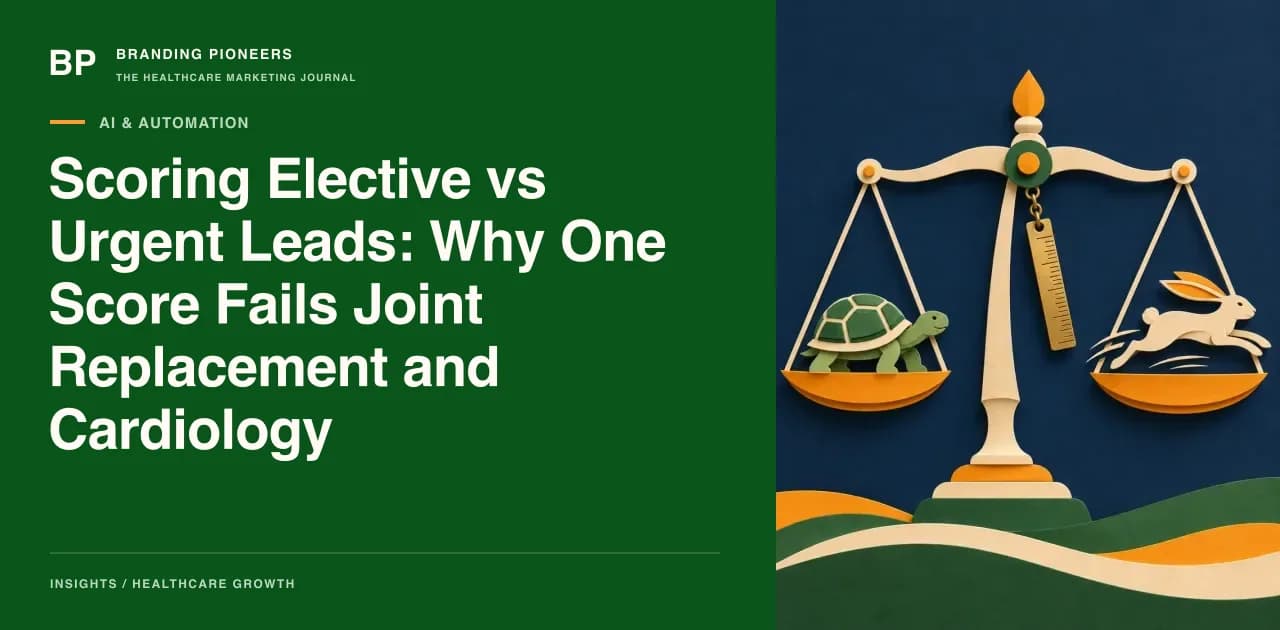
A lead score is a promise about the future: this enquiry is more likely to become a patient than that one. The promise only holds if the enquiries are comparable. An orthopaedic practice receiving a call from someone whose chest pain began an hour ago and an email from someone comparing knee-replacement surgeons for next spring is not looking at two leads of different quality. It is looking at two different problems.
This article is for orthopaedic and cardiology practices, and for the marketing and operations teams who run their enquiry desks. It argues that a single score across elective and urgent demand fails in predictable ways, and sets out a sample design with separate logic, separate response targets and a safe route for anything that sounds urgent. The scoring rules below are examples to adapt, not benchmarks, and clinicians must define what counts as urgent.
If you are new to scoring, read our introduction to prioritising patient enquiries with AI first. This post goes narrower: what changes when the same inbox holds both a 12-week decision and a same-day need.
Why one score fails
A single model or rule set learns from past conversions. Past conversions in a joint-replacement practice are overwhelmingly elective: long research, several touchpoints, repeated questions about recovery and cost. The patterns that predict conversion are slow ones: multiple visits to a procedure page, a reply to a nurture message, a request for a second opinion.
Urgent enquiries have the opposite signature. They arrive once, in plain words, often at night, with no browsing history. A model trained on elective behaviour will mark them low: no repeat visits, no email engagement, no downloaded guide. The person who most needs a fast reply gets the lowest priority.
The reverse happens too. A rule that boosts anything containing "pain" or "emergency" will push a stream of elective enquiries, which mention pain as background, above the genuinely urgent. And a high-score bonus for "ready to book now" can put a keen but non-urgent patient ahead of someone whose symptoms need clinical triage.
Three things differ between the classes:
- The decision cycle. Elective surgery decisions often take weeks or months. Urgent decisions take hours.
- The cost of delay. Replying to an elective lead in four hours instead of one is a missed marketing opportunity. Replying slowly to an urgent one can be a clinical problem.
- Who should respond. Elective leads suit a counsellor. Urgent ones need a clinician-approved triage path.
Step 1: Classify before you score
Add a routing step that assigns each enquiry to a class. Scoring happens inside the class, never across classes.
| Class | Example signals | Handled by |
|---|---|---|
| Possible urgent | Symptoms described as sudden or severe, chest pain, breathlessness, inability to bear weight after a fall, "emergency", "tonight" | Clinician-approved triage script; human on duty |
| Time-sensitive elective | Known diagnosis, surgeon recommended a date, insurance pre-authorisation pending, travelling soon | Senior counsellor |
| High-consideration elective | Research phase, comparing surgeons, cost and recovery questions | Counsellor with nurture sequence |
| Information only | Careers, billing queries, reports, wrong number | Relevant desk |
The signals list for "possible urgent" must be written and signed off by your clinical leads, not by marketing or an algorithm. Make it conservative. A false alarm costs a short call. A missed one can cost far more. For cardiology in particular, the safe public message for symptoms such as chest pain is to seek emergency care immediately rather than wait for a clinic reply, and your forms, auto-replies and chatbot should say so in clinician-approved words. In India the unified emergency number is 112.
NMC's October 2026 advertising guidelines also warn against promotion that induces unnecessary investigations or procedures through discounts or inducements. That bears on scoring too. A lead score should rank by likely fit and timing, never by how much a patient can be nudged into an unneeded procedure. Ask your compliance lead to review what the score is allowed to trigger.
Step 2: Score the elective classes separately
High-consideration surgery (joint replacement, spine, bariatric)
Here, intent builds up across weeks, so a behavioural score is meaningful. A sample rule set, with invented weights to show the structure:
| Signal | Points |
|---|---|
| Asked about a specific procedure by name | +15 |
| Viewed surgeon profile page | +10 |
| Viewed cost or insurance page | +15 |
| Uploaded or mentioned a recent scan | +20 |
| Returned within seven days | +10 |
| Asked about timing ("when can I be operated") | +15 |
| Located within travel distance | +10 |
| Generic "price list" request, no clinical context | +0 |
| Only downloaded a general guide | +5 |
| No reply to two follow-ups | -15 |
Cap the score at 100 and band it: 70 or more is "ready", 40 to 69 is "warming", under 40 is "nurture". These weights are placeholders. The next step in a real project is to fit or adjust them against your own arrivals data, and to check them as described in our post on validating a lead score.
Time-sensitive elective
These are patients with a recommendation and a deadline. Score on practical blockers rather than interest: insurance status, referral present, surgeon availability, travel dates. The question is not "how interested?" but "what stands between this person and a date?" A checklist of blockers with an owner for each beats a numeric score here.
Step 3: Treat urgent as a pathway, not a score
Do not rank urgent enquiries against others. Route them. The logic is a rule, not a model:
- Any enquiry flagged as possibly urgent bypasses the queue.
- The first response is the clinician-approved message advising emergency care where appropriate, delivered immediately, even outside working hours.
- A human on duty sees the item within a defined time, and the CRM records who acted and when.
- Nothing about the enquiry enters a marketing nurture flow.
Marketing automation should never message a possible-urgent contact with promotional content. Suppress them from campaigns until a clinician or senior staff member clears the flag.