A UK consultant building private practice sits under four separate regimes at once, none of which reference the others. The General Medical Council governs professional conduct. The Care Quality Commission governs the regulated activity. The Advertising Standards Authority, through the CAP Code, governs what your marketing says. The Information Commissioner's Office, through UK GDPR and PECR, governs the data behind it.
Most practices know about the first two and get caught by the third.
This is a practitioner's summary written by marketers, not legal advice. Regulations change, and enforcement varies. Confirm the current text with your regulator or your own counsel before you publish.
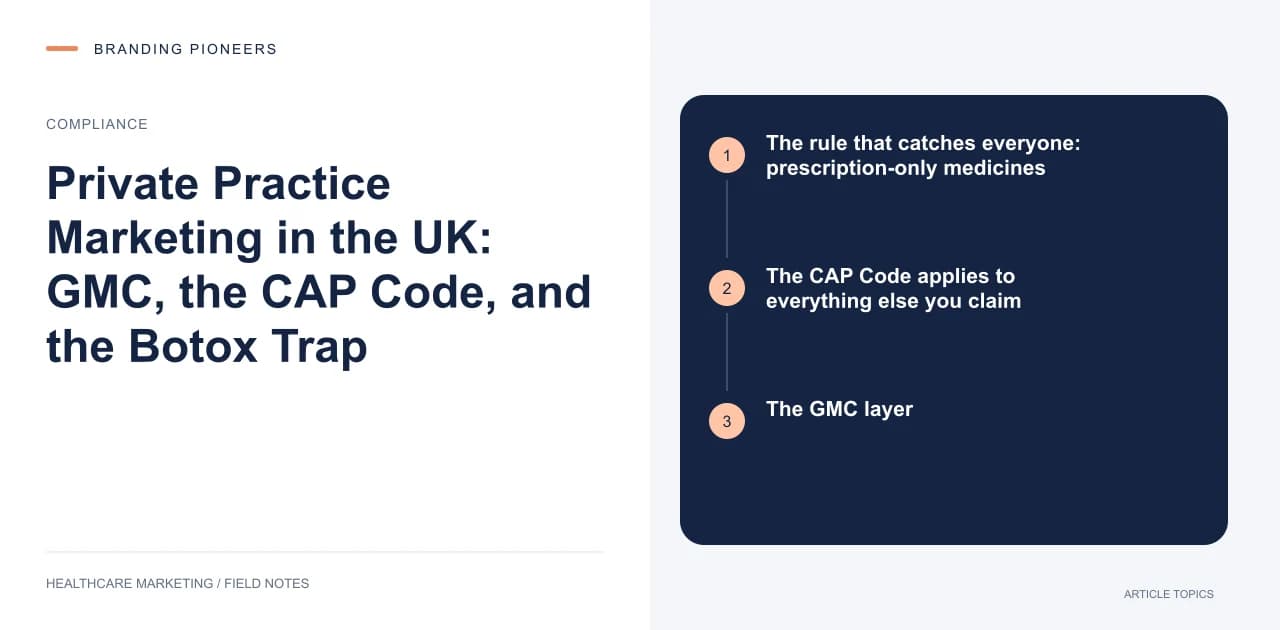
The rule that catches everyone: prescription-only medicines
Advertising prescription-only medicines to the public is prohibited under UK medicines legislation. It is not a guidance point or a professional courtesy — it is the single most frequently enforced rule in UK healthcare advertising, and it is why the aesthetics sector generates a steady stream of ASA rulings.
In practice this means botulinum toxin products cannot be advertised to the public, by brand name or in any way that promotes the prescription medicine itself. Clinics work around it by referring to the treatment category rather than the product — but the workaround only holds if the copy genuinely does not promote the medicine. Naming the brand, using its logo, offering it at a price, or building a landing page around it are all promotional.
The enforcement surface is wider than a website. The ASA treats a clinic's own social media posts as advertising. So a compliant website plus an Instagram grid full of product names is not a compliant marketing programme, and social is where most of the rulings originate.
The CAP Code applies to everything else you claim
Beyond medicines, the CAP Code requires that claims be capable of substantiation, that health claims not discourage essential treatment, and that marketing not exploit anxiety about appearance or health. Practical consequences:
- Efficacy claims need evidence of a standard the ASA will accept, held before publication rather than assembled after a complaint.
- Testimonials cannot carry claims you could not make yourself. A patient saying a treatment cured them does not launder an unsubstantiated efficacy claim.
- Before-and-after imagery must be genuine, comparable, and unretouched, and must not exaggerate.
- Pressure tactics — countdown offers, limited slots, discounting on invasive procedures — sit in the territory the Code was written to constrain, particularly where body image is involved.
- Influencer and affiliate content is advertising and must be labelled as such, and the advertiser carries responsibility for it.
The GMC layer
Good Medical Practice requires that information you publish about your services is factual, verifiable, and does not exploit patients' vulnerability or lack of medical knowledge. In private practice this bites hardest on two things: fee transparency and the framing of elective work.
Publish your fees, or at least the structure and what drives variation. Patients expect it, the competition regulator's work on private healthcare pushed the sector toward it, and the practices that do it consistently report better-qualified enquiries. Separately, consultants practising privately are expected to submit activity and outcome data to the sector's information programme; being visible and accurate there is both an obligation and, quietly, a marketing asset.
The CQC layer
If you carry out a regulated activity you must be registered, and your rating is public. Displaying it is a requirement, not a choice, and the ratings page is frequently the second thing a prospective private patient looks at after your profile. A practice that presents its rating clearly, with context about what has changed since the inspection, controls that narrative rather than letting a directory site frame it.
Data: UK GDPR plus PECR
UK GDPR governs your lawful basis for processing enquiry data; PECR governs electronic marketing. The two interact in a way that is routinely misapplied.
The soft opt-in permits marketing similar services to people who gave you their details in the course of a sale or negotiation, provided you offered a refusal at the point of collection and in every message. Whether it applies cleanly to a healthcare context is arguable, and health data carries special category status under UK GDPR regardless. The defensible position for a clinic is straightforward opt-in consent for marketing, recorded, with the wording the patient saw.
Cookies and similar technologies need consent before they are set, which means marketing and analytics tags must be gated. A banner that loads after the tags is not compliance. And as elsewhere, condition-specific browsing behaviour flowing to advertising platforms is a risk worth designing out rather than arguing about.
What performs in the UK once you take the shortcuts away
- Consultant profiles that a referring GP would respect. Training, fellowships, NHS appointment, subspecialty interest, research, professional memberships, and how to refer.
- Genuine procedure information, including conservative options and honest recovery timelines. UK patients researching private care are frequently comparing against an NHS pathway and want to understand the trade-off, not be sold.
- Fee clarity, including what is and is not included, and how insurers are handled. Insurer recognition status is a decisive filter for a large share of private patients.
- Local visibility. Google Business Profile for each consulting location, accurate hours, and factual review replies that never confirm a patient relationship.
- Speed of response. Private patients are paying for access. An enquiry answered in hours converts; one answered in days does not.
Five things to check today
- Search your website and every social account for prescription product names.
- Check every efficacy claim against the evidence you actually hold.
- Review before-and-after images for comparability and retouching.
- Confirm marketing tags are gated behind consent and fire only after it.
- Confirm your CQC rating is displayed and your fee information is current.
Our compliance hub covers the landscape in summary form, and our market notes cover London and Manchester. If your marketing was built before you read any of this, we will audit it.
Filed underhealthcare marketing UKprivate practice marketingGMC advertising rulesASA CAP code healthcareaesthetic clinic advertising UK

About the author
Nishu Sharma
Founder & CEO · Gurugram, India
Nishu founded Branding Pioneers in 2016 with one rule that hasn't changed since: healthcare only. She'd run digital strategy at a top-10 Indian agency and watched generalist marketing underserve medical clients who needed something built for how patients actually search and decide. So she left to build the specialist instead. It's now an 80-person team working with healthcare brands worldwide.
Free guide · 17 pages
The Patient Acquisition Blueprint
A 90-day plan from first search to booked appointment.