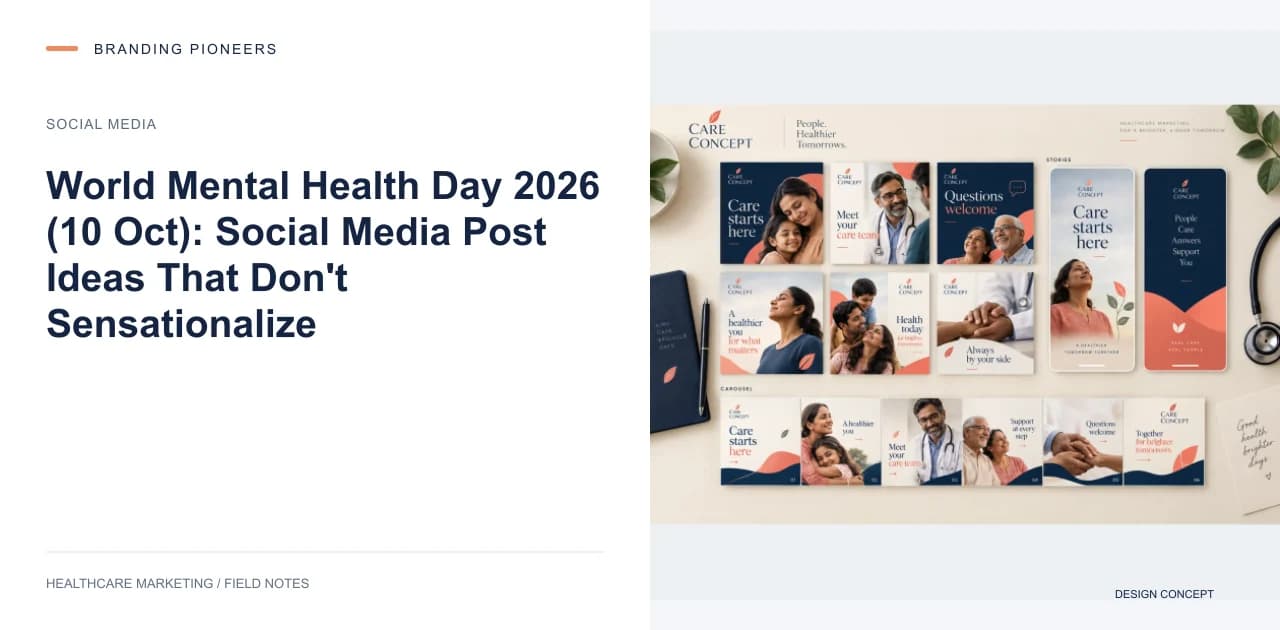
World Mental Health Day falls on 10 October 2026, and by the end of that day most clinics will have published the same thing: a green ribbon, a soft gradient, and the words you are not alone.
Nobody is harmed by that post. Nobody is helped by it either. The posts that do cause harm are usually the ambitious ones — a patient's recovery story shared with good intentions, a suicide statistic pulled off a slide deck with no source, a reel that describes what someone went through in enough detail to be a template.
Mental health is the one specialty where a content mistake has a clinical consequence. That is the reason to plan this day properly rather than hand it to whoever runs the account.
Start from the safe-messaging rules, not from the content calendar
The World Health Organization publishes Preventing suicide: a resource for media professionals. It is short, free, and written for exactly this situation. Read it before you brief anyone.
The parts that apply to a clinic's social account:
- Do not describe method or location. Ever, in any format, including a patient's own words.
- Do not present suicide as a solution to a problem, or as a response to a specific event.
- Do not use the phrase committed suicide. Died by suicide is the accepted wording.
- Do not use dramatic imagery, countdowns, or sensational headlines.
- Do not repeat and re-share distress content — prominence and repetition are themselves a risk factor in the guidance.
- Do include help-seeking information every single time the subject comes up.
That last point is the one most often skipped. In India, the number to publish is Tele-MANAS on 14416, the national mental health helpline, which runs in multiple languages. Put it in the image, the caption and the pinned comment — not only in the bio, where nobody in distress will go looking.
For any other market you serve, publish that country's national line rather than an Indian one. A helpline a reader cannot call is decoration.
Look the theme up. Do not guess it.
The World Federation for Mental Health sets the annual theme for the day, and WHO marks it. The theme changes each year and is usually confirmed well before October.
Check it at source in early September and build the creative around it. A campaign that invents a theme, or recycles last year's, reads as exactly what it is.
Nine posts that survive the safe-messaging test
1. What a first appointment actually looks like. The room. How long it takes. The questions you will be asked. Whether anything is written down. Who can see the notes. What it costs. This single post removes more friction than the rest of the campaign combined.
2. Who does what. Psychiatrist, clinical psychologist, counsellor, psychiatric social worker. In India, note which of these are registered with the Rehabilitation Council of India and which prescribe. Most people asking for help do not know who to ask.
3. Is this worth bringing to a doctor? Written as a threshold question, not a diagnostic quiz. Duration, function, and whether it is getting worse — not a symptom checklist that invites self-diagnosis.
4. Medication questions, answered by a psychiatrist. Will I be on this forever. Will it change my personality. Is it addictive. What happens if I stop. These are asked constantly and answered almost nowhere.
5. A post for managers and HR. What a manager may ask, what they may not, and what a reasonable adjustment looks like. This is the post that gets shared internally at companies, which is how a practice reaches people who would never follow a clinic.
6. A post for families. What to say to someone who has just told you they are struggling, and what not to say. Concrete sentences work better than principles.
7. One clinician, one question, ninety seconds. No production. The point is that a viewer sees the face of the person they would have to say this to.
8. A local resources card. Your city's actual services, including the free and government ones. Listing services you do not provide is the strongest trust signal on the account.
9. How to help without diagnosing. For the friend who is worried and about to say the wrong thing.
Route each of these to a real page rather than a link in bio. Our mental health practice marketing pages and the psychiatry marketing pages are built around that structure — awareness content earns attention, the page does the explaining.
Four things to cut from the plan
The unsourced statistic carousel. If you cannot name the study, the year and the population, do not publish the number. An invented or misremembered figure on a mental health post is the fastest way to lose a clinician's credibility.
The gradient with no next step. You are not alone is not a call to action. If a person in difficulty reads the post, what do they do in the next sixty seconds? If the answer is nothing, the post is for your brand, not for them.
The recovery-story reel. Sometimes appropriate, usually not, and never as a quick festive-week asset. See below.
The awareness-day discount. A discounted first consultation attached to a mental health awareness day converts the day into a sale. In India it is also barred outright: the NMC's ethical advertising guidelines of 6 October 2026 prohibit discounts, limited-period offers and similar inducements (para 8.1(x)).
If you publish a patient story, publish it properly
In India, start from the NMC position: consent does not make a promotional patient story permissible (para 6.2), and personal success stories are barred unless they are strictly educational and anonymised (para 8.1(v)). Our NMC guidelines hub covers the detail. So a story told to promote the practice is out. A person with lived experience choosing to speak for awareness, framed as public-health education rather than a result your clinic produced, is the only version worth considering. It has conditions.
Written consent, specific to the channel and the format, obtained when the person is well and not in active crisis. No method, no means, no detail that could function as instruction. No implied outcome — recovery is not a product you sell. A clinician reviews the final cut before it goes out. The person keeps the right to withdraw at any point, and you actually honour it, which means keeping the source files and knowing where the post lives.
In India, health data is personal data under the Digital Personal Data Protection Act 2023 and the DPDP Rules 2025, enforced by the Data Protection Board of India. Consent has to be specific, informed and withdrawable, and a signed release from three years ago for a different campaign is not consent for this one. For a US practice, the equivalent is a HIPAA authorization under 45 CFR 164.508. In the UK, the GMC's guidance on confidentiality and the CAP and ASA codes both apply to a clinician's promotional content.
Our ethical mental health marketing post goes further into consent mechanics if you are building this into a repeatable process.
The comment section is the campaign
This is the part nobody staffs, and it is the part that matters on 10 October.
Decide before you publish who is watching comments and direct messages, during what hours, and what they are allowed to say. The answer is almost always: acknowledge, do not advise, give a route.
Have three things ready. A pinned first comment carrying the helpline number. A short reply template that offers an appointment path without attempting clinical judgement over a message thread. An out-of-hours auto-reply that names Tele-MANAS 14416 and says plainly that the account is not monitored overnight.
Nobody in your team should be diagnosing in a direct message. Write that down and tell them.
What the ad platforms will not let you do
Google's personalized advertising policy treats mental health as a sensitive category and restricts targeting built on it. Meta's health and wellness restrictions limit both targeting and the event data you can send back from a mental health page. Neither Google nor Meta will sign a business associate agreement, so no patient-identifying data should reach either of them — which constrains your tracking before it constrains your creative.
The practical shape of this: run the awareness content organically, and keep paid media on service-level, non-inferring copy that points at a page rather than at a condition. If you want the detail on building that out, the social media services page covers how the organic and paid sides divide, and marketing a mental health practice covers the funnel underneath.
Measure something other than reach
Reach on an awareness day is a vanity number, because half of it is other clinics.
The numbers worth watching: saves, which indicate someone came back to the post. Direct messages that ask about booking. Taps on the helpline card. Whether the what a first appointment looks like page was actually read, and for how long.
One caution. Do not A/B test distress content. The variant that performs better on engagement may be the one that performs worse on safety, and you will not be able to see that in the dashboard.
A workable week
Publish the first-appointment post and the who-does-what post in the week before the day. Run the clinician video and the family post on the day itself. Follow with the manager and HR post the week after, when corporate accounts are looking for something to circulate. Keep the local resources card pinned all month.
That sequence gives you five useful assets instead of one ribbon, and every one of them still works on 11 October.
---
If you want a read on how your mental health pages currently perform — what they rank for, where the consent and helpline gaps are, and which questions you are not answering — get a free audit and we will send the findings whether or not you work with us. Or book a strategy call to plan the campaign with a clinician in the room.
If you are in distress in India, call Tele-MANAS on 14416. It is free, confidential, and available in multiple languages.
Filed underworld mental health day social media post ideasideas for world mental health dayworld mental health day 2026 topicworld mental health day events

About the author
Nishu Sharma
Founder & CEO · Gurugram, India
Nishu founded Branding Pioneers in 2016 with one rule that hasn't changed since: healthcare only. She'd run digital strategy at a top-10 Indian agency and watched generalist marketing underserve medical clients who needed something built for how patients actually search and decide. So she left to build the specialist instead. It's now an 80-person team working with healthcare brands worldwide.
Free guide · 15 pages
12-Month Healthcare Social Media Calendar
Never run out of content ideas — a full year, mapped.