Most Arabic clinic websites in the Gulf were built the same way. An English site was finished, a translation vendor was sent the copy, and the result was published under an /ar/ folder.
It ranks for almost nothing, and the reason is simple: the translator produced correct Arabic for the English sentences they were given. Nobody asked what a patient in Dubai or Riyadh actually types into a phone at eleven at night.
Those are different questions, and only the second one is SEO.
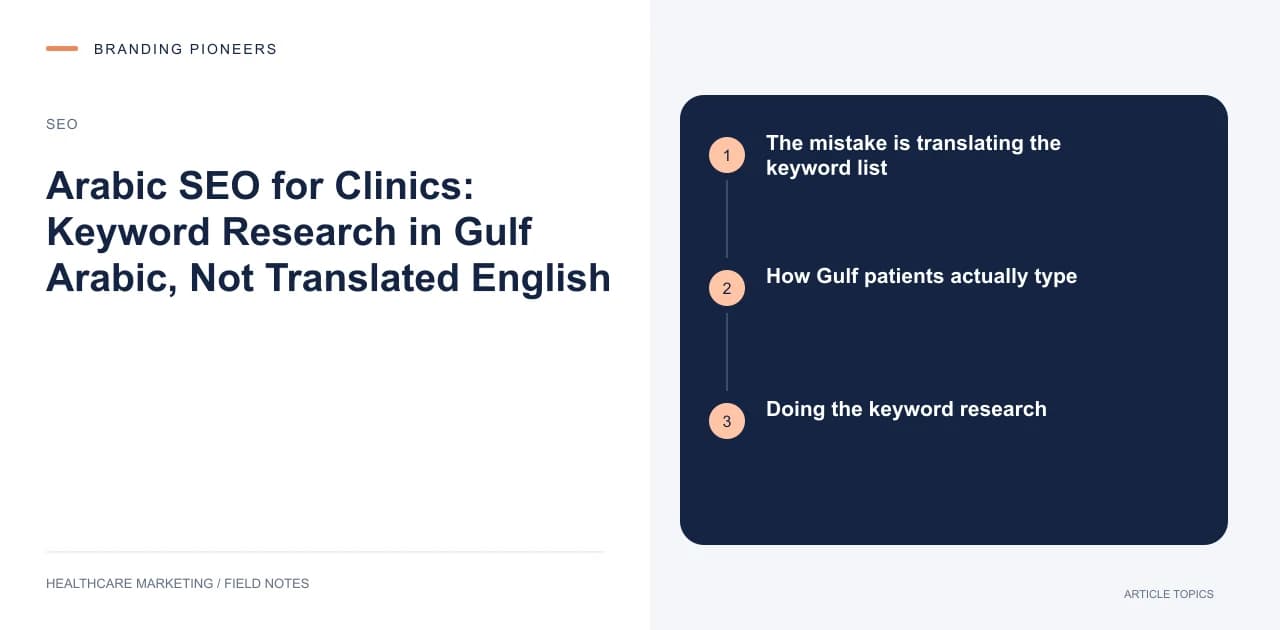
The mistake is translating the keyword list
An English keyword list translated into Arabic gives you the Modern Standard Arabic term for each concept. MSA is the language of news broadcasts, official documents, and formal writing. It is understood everywhere and it is not, for the most part, how people type a search about a toothache.
Gulf search is a mix. Some queries come in MSA because that is what people write. Many come in dialect. A large share come in English, particularly from the expatriate majority in the UAE. And some come in Latin script — Arabic words typed with English letters, which people in the region use constantly in messaging and sometimes in search.
A serious Arabic keyword project treats those as four separate inputs rather than one translated output.
How Gulf patients actually type
Several habits change the shape of the keyword list, and none of them show up in a translation brief.
Dialect terms sit next to formal ones. Both طبيب and دكتور mean doctor, and patients use both, with دكتور far more common in casual search. The same duplication runs through most clinical vocabulary, and the two forms have to be researched separately.
Diacritics are not typed. Arabic script marks short vowels with diacritics, and almost nobody types them in a search box. Content written with full diacritics is correct and matches badly. Write for the way people type.
Letters vary. The alef forms أ, إ and ا get used interchangeably. Ta marbuta ة is frequently typed as ه. Ya ي and alef maqsura ى are swapped constantly. The same query arrives in three spellings, and your internal site search will treat them as three different queries unless it normalises them.
Latin-script Arabic exists. "Afdal doctor asnan Dubai" is a real search pattern, not a curiosity. It rarely justifies its own page, but it belongs in the research, and it explains query data that would otherwise look like noise.
English and Arabic mix in one query. "Best دكتور اسنان in Dubai" is normal. Insisting the page be purely one language or the other misses how people write.
Doing the keyword research
Set Google Keyword Planner to the country and the Arabic language and work in Arabic, not in an English list with a translate column. Then treat the tool output as a starting point, because Arabic volumes are under-reported relative to real usage and the tool merges spelling variants inconsistently.
Use in-country autocomplete. A VPN and a browser set to Arabic in the UAE or Saudi Arabia tells you more in twenty minutes about phrasing than any keyword tool, because autocomplete reflects what people actually type. Do it per country: Emirati, Saudi, Kuwaiti and Egyptian phrasing are not interchangeable, and an Egyptian expatriate in Dubai searches differently from an Emirati national.
Read the SERP itself. The competing Arabic pages that rank tell you which register Google is currently rewarding for that query — formal MSA for clinical topics, colloquial for consumer ones.
Ask your own staff. The receptionist who takes fifty calls a day in Arabic knows the words patients use for their conditions, and those words are free to collect.
Then check Search Console once you have Arabic pages live, filtered by country and by page path. Real queries beat estimated volumes every time.
The technical side is small but unforgiving
Arabic SEO does not need an exotic stack. It needs a handful of things done correctly and consistently.
Serve Arabic pages on their own URLs — a subfolder such as /ar/ is the usual choice and the one we use for our own Arabic location pages. Set lang="ar" and dir="rtl" on the document, not on a wrapper div, so browsers and assistive technology get it right.
Implement hreflang properly and reciprocally. A UAE clinic serving both languages needs ar-AE and en-AE pointing at each other, plus an x-default. A group operating across the Gulf needs ar-SA distinct from ar-AE, because the pages should not be identical either.
Decide URL structure and stick to it. Arabic slugs work and are percent-encoded in the wild, which makes them ugly to share; transliterated Latin slugs are cleaner but lose the keyword. Either is defensible. Mixing both across a site is not.
Check the small things that break RTL layouts: forms, phone-number fields, date pickers, breadcrumbs, and icons that point the wrong way. Choose a typeface with a real Arabic cut rather than a fallback. Decide between Arabic-Indic and Western digits and use one consistently, including in phone numbers.
We cover the build side on our multilingual website page, and the search side under multilingual SEO.
Write it, do not translate it
The single change that moves Arabic rankings more than any technical fix: commission Arabic content as original content.
An Arabic-speaking medical writer, briefed on the keyword research, writing for a Gulf patient, reviewed by a clinician who practises in that market. The result is different from a translation in structure as well as vocabulary — different questions answered, different objections handled, different assumptions about insurance and family involvement.
Then treat the Arabic page as a first-class page. It needs its own reviewer byline in Arabic, its own date, its own schema, and its own internal links. An Arabic page with an English author box tells both the reader and the search engine that it is a secondary artefact.
This is the same E-E-A-T expectation applied to every health page, in a language most quality processes were never set up for, and it is where the opportunity is — because a well-made Arabic health page still faces less competition than its English equivalent.