Specialty Marketing

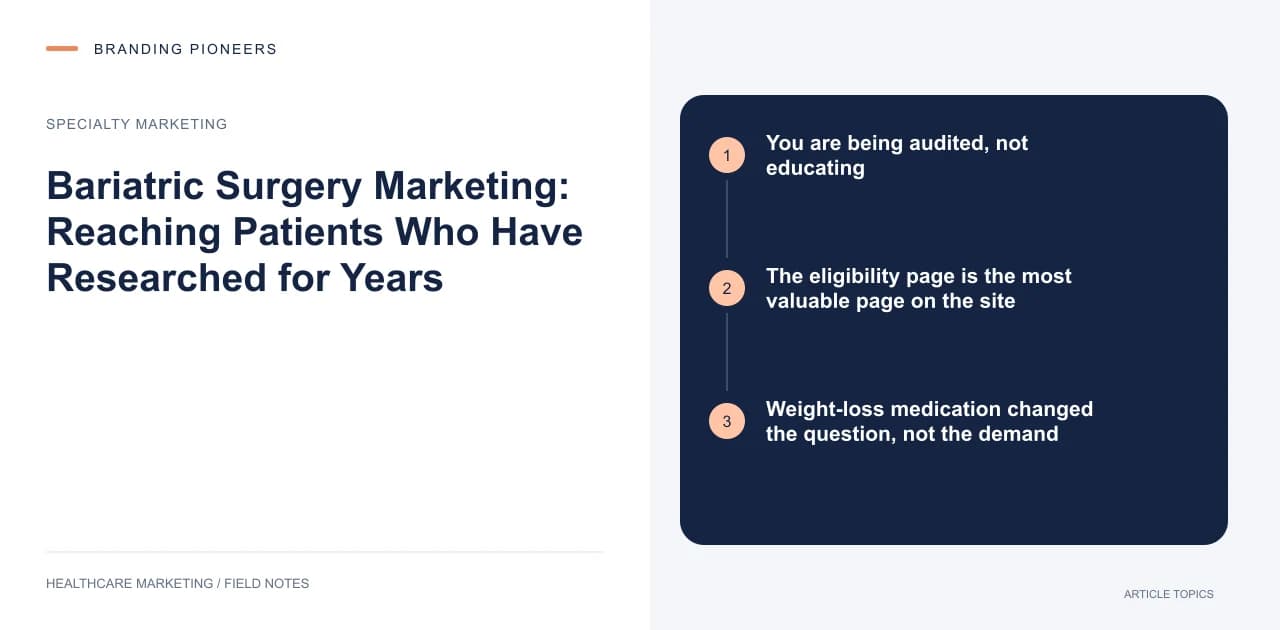
Bariatric Surgery Marketing: Reaching Patients Who Have Researched for Years

The bariatric patient is usually the most informed person in the building. You are not educating them. You are being audited, and most clinic websites fail the audit in the first minute.

NS
Founder & CEO · September 28, 2026 · 7 min read
FILE · BARIATRI
Bariatric Surgery Marketing: Reaching Patients Who Have Researched for Years

Most surgical specialties market to people who have just started thinking about a procedure. Bariatric surgery markets to people who have been thinking about it for years.

They have read the forums. They know the difference between a sleeve and a bypass and can argue about it. They have watched surgery videos, tracked other people's progress, priced it in three cities, and talked themselves out of it at least twice. Some have already tried a weight-loss medication.

So the site is not educating them. It is being audited. They are checking whether this clinic sounds like it understands the years behind the enquiry, or whether it is going to talk to them the way everyone else has talked to them about their weight.

That is the whole game, and it is mostly a tone problem before it is a channel problem.

You are being audited, not educating

An audit has a checklist. The bariatric patient's checklist is roughly: is this surgeon experienced, will I be judged, what happens if it goes wrong, what does the follow-up look like, how much of this will I have to fight for, and what will it cost me in total.

Pages that answer those questions win. Pages that open with a definition of obesity and a diagram of the stomach lose, because the reader already knows the diagram and has now learned that this clinic thinks they do not.

Build the site around the checklist. Surgeon experience stated plainly. Complications discussed rather than buried. The follow-up programme described in detail. The eligibility criteria written out. The full cost structure explained. Our bariatric surgery marketing pages are built on that order because it matches the order the questions arrive in.

The eligibility page is the most valuable page on the site

"Am I eligible for bariatric surgery" is the question that stops more people than cost does, and most clinic sites answer it in one line lifted from a guideline.

Write it properly. What the assessment involves. Who is assessed by whom — surgeon, physician, dietitian, psychologist. What comorbidities change the picture. What disqualifies somebody, temporarily or permanently. What happens if the answer is no, and what the clinic offers instead.

That last part is the one that builds trust, because a clinic willing to say "surgery is not right for everybody, and here is what we do for the people it is not right for" is a clinic that is not selling an operation to whoever walks in.

Weight-loss medication changed the question, not the demand

The arrival of GLP-1 receptor agonists reset the conversation. It did not remove surgical demand; it added a new decision point in front of it, and a lot of new searches that look like surgical intent and are not.

Marketing that pretends medication does not exist reads as either uninformed or defensive. Marketing that attacks it reads worse. What works is a clinic that can explain, without contempt in either direction, where each option fits, what happens when medication is stopped, what the evidence supports, and how a patient on medication is assessed if they later consider surgery.

If your clinic also runs a medical weight-management programme, that is a separate service with separate search demand and it should have its own pages — see weight loss clinic marketing for how the non-surgical side is structured, and GLP-1 weight loss clinic marketing for the advertising constraints specific to it.

Weight-loss advertising has its own rulebook

This category is policed harder than almost any other in healthcare, and the rules are checkable, so check them instead of guessing.

Meta's advertising standards restrict before-and-after images and images implying unexpected or unlikely results, and restrict weight-loss ads to adult audiences. That rule catches almost every creative a bariatric clinic instinctively wants to run. Google's policies restrict certain weight-loss claims and require certification for advertising prescription drugs, which differs by country.

In India, the Drugs and Magic Remedies (Objectionable Advertisements) Act, 1954 prohibits advertising drugs and remedies as treatments for the conditions listed in its Schedule, and the Drugs and Cosmetics rules prohibit advertising prescription medicines to the public — which is the constraint that matters if you are tempted to market a weight-loss injection by name. The NMC's professional conduct rules govern what a registered practitioner may claim, and the ASCI code covers the advertising itself. In the United States, the FTC governs substantiation of weight-loss claims and has a long record of enforcement in this category; if the practice is a covered entity, HIPAA also governs what patient data may reach an ad platform, and neither Google nor Meta will sign a business associate agreement. HIPAA has no application to an Indian or Gulf clinic, but the platform policies apply everywhere.

Practical version: no typical-result claims, no numbers on creatives, consent documented for any patient image, and no targeting that implies you know someone's health status.

The site has to be usable by the body it is written for

This is the detail that separates bariatric clinics that understand their patients from clinics that do not, and it is almost never treated as a marketing question.

A patient with severe obesity has spent years in medical settings that did not accommodate them — chairs with arms they do not fit in, gowns that do not close, blood pressure cuffs that do not go round, scanners with weight limits nobody mentioned until the appointment. They are checking whether yours will be another one.

So say it on the site. What seating the waiting area has. What the imaging weight limits are and what you do when a patient exceeds them. What operating table and equipment capacity you have. Whether the ward beds are bariatric. Whether staff are trained in how to talk about weight.

No competitor is publishing this, and to the patient reading it, nothing else on the page carries the same weight. It converts because it is the first evidence they have seen that the clinic thought about them before they arrived.
Insurance and the part patients have to fight for

In most markets, a large share of bariatric cases run through an insurer, and the approval process is the most demoralising part of the journey.

Whatever your market, the clinic that explains the process clearly — what documentation is needed, what the insurer typically asks for, how long approvals take, who in the clinic handles it, what happens after a rejection — removes the biggest practical barrier between an enquiry and a surgery date.

In India, publish how the cashless process works at your hospital and which insurers you deal with regularly. In the United States, explain the prior authorisation requirements you commonly see and the supervised-programme documentation insurers request. In the Gulf, explain which policies typically cover metabolic surgery and which do not.

Almost every clinic handles this competently in the back office and says nothing about it publicly. Saying it publicly is free and it moves cases.

Information sessions still work, and they work better online

The in-person seminar was the backbone of bariatric marketing for years, and the reason it worked was never the room. It was that a patient could watch a surgeon answer difficult questions without having to identify themselves.

Online, that is easier, not harder. A recorded session, a live question-and-answer, a series of short videos where the surgeon answers one question each — what the first week after surgery is like, whether the weight comes back, what happens to loose skin, how it affects pregnancy, what it does to relationships.

These convert because they let a private person get close without exposure. They also give you honest content, which is in short supply in this category.

The follow-through is the marketing

Bariatric outcomes depend on what happens after the operation, and informed patients know this. A clinic with a described, structured follow-up programme — dietetic review, supplementation, psychological support, long-term monitoring — is selling something materially different from a clinic that sells an operation.

So describe the programme in detail on the site, including how long it runs and who delivers it. This is the strongest available differentiator and almost nobody publishes it.

Ads and a consideration cycle measured in years

Bariatric paid media produces enquiries quickly and conversions slowly, and campaigns get cancelled in between.

Two adjustments fix most of that. Judge the channel over a window long enough to contain the decision, not over a month. And treat remarketing to previous visitors as a primary channel rather than a leftover, within the platform rules above — the patient who visited in February and booked in September is normal, not an anomaly.

Search intent worth paying for: named procedures, "bariatric surgeon" plus a city, "weight loss surgery cost", "bariatric surgery eligibility". Broad weight-loss terms belong to content.

What to measure

Enquiry counts will mislead you here more than in any other specialty. The numbers that matter are enquiry to consultation, consultation to workup, workup to surgery, and how long each step takes.

If you can see those four, you can tell the difference between a channel that produces curious readers and a channel that produces patients, and you will usually find they are not the channels you assumed.

Where to start

  1. The eligibility page, written properly.
  2. Full cost structure, with no headline price.
  3. The follow-up programme described in detail.
  4. Surgeon-led video answering the questions patients will not ask out loud.
  5. A medication page that treats the option honestly.
  6. Paid media last, judged over a long enough window.

---

If you want to know how your bariatric pages read to someone who has been researching for three years — and where the enquiry path loses them — get a free audit. Or book a strategy call and we will walk through it together.

FILED UNDERbariatric surgery marketingweight loss clinic marketingweight loss clinic marketing agency
Stop reading. Start ranking.
Get a free specialty marketing audit — we'll show you exactly what's missing.
Book audit →
Author
Founder & CEO · Gurugram, India

Nishu founded Branding Pioneers in 2016 with one rule that hasn't changed since: healthcare only. She'd run digital strategy at a top-10 Indian agency and watched generalist marketing underserve medical clients who needed something built for how patients actually search and decide. So she left to build the specialist instead. It's now an 80-person team working with healthcare brands worldwide.

The Patient Acquisition Blueprint (2026 Edition) — guide cover
Free · 15 pages

The Patient Acquisition Blueprint (2026 Edition)

The exact 90-day patient-acquisition system, step by step.

We never share your details

FREE · 30 MIN
See your specialty marketing opportunity gap.

Senior strategist, no boilerplate. Reply within 4 hours.

Book audit → Or call us directly
The Pioneers Brief · weekly
One essay. Three benchmarks. One teardown.
Subscribe — free
The Patient Acquisition Blueprint (2026 Edition) — guide cover
Free for specialty marketing readers

The Patient Acquisition Blueprint (2026 Edition)

The exact 90-day patient-acquisition system, step by step.

  • The 90-day patient acquisition operating system
  • Channel-by-channel budget allocation (₹50L–₹5Cr/yr)
  • 12 real, named client engagements walked through
  • ROI tracking spreadsheet (CAC, LTV, payback)
15 pages · Used by 350+ healthcare clients · Updated for AI search

We never share your details

Continue reading

More on specialty marketing.

BROWSE ALL →
From the studio

This thinking, applied.

Multi-clinic social media design system
Social · System
Social design system across clinics
Technology empowerment for healthcare brands
MarTech
Technology for healthcare teams
Specialty clinic clients
Clients
Specialty clinics
Branding Pioneers — the studio
The studio
Branding Pioneers
Healthcare event videography
Video · Event
Event films and coverage
Why choose us

Why healthcare brands choose us.

Six reasons hospitals, clinics, and doctors pick a healthcare-only firm over a generalist agency.

  • Healthcare-only

    It's all we do. No retail, no fintech — the whole team thinks in patient journeys, clinical trust, and the way people actually choose a doctor.

  • AI-first systems

    Receptionists, WhatsApp triage, and attribution built in-house — we answer patients in seconds and tie every click to a booked appointment.

  • Compliance built-in

    HIPAA-aware handling, ASCI-reviewed creative, and GDPR/DPDP sign-off on every campaign — our standard, not an upcharge or an afterthought.

  • Senior on every account

    The senior who pitched you stays on the engagement. No bait-and-switch to juniors learning on your budget.

  • Measured to the appointment

    Patient-level attribution across calls, forms, and walk-ins. Monthly reports show booked patients — not just clicks and impressions.

  • Receipts, not promises

    We name our clients and show the work. Quarterly reviews with the numbers attached, every cycle.

The Branding Pioneers healthcare-marketing team at work
Healthcare-only · since 2016
A team that does one thing well.
More from the brief

If this resonated, here’s what else lands.

Adjacent practices, the relevant tools, and the case files where we shipped this thinking against real patient-acquisition targets.

THE PIONEERS BRIEF · WEEKLY

One essay,
three benchmarks,
one teardown.

Healthcare growth, every Thursday morning. No hype, no fluff.