In almost every other part of healthcare, the person who searches is the person who will be treated. Home healthcare is the exception, and nearly every marketing mistake in the category comes from forgetting it.
The patient is an eighty-one-year-old man three days post-discharge after a hip replacement. The person typing "24 hour nursing attendant at home" into a phone at eleven at night is his daughter, who lives in another city, has taken two days off work, and needs this decided by Friday.
Write for her. Everything else follows.
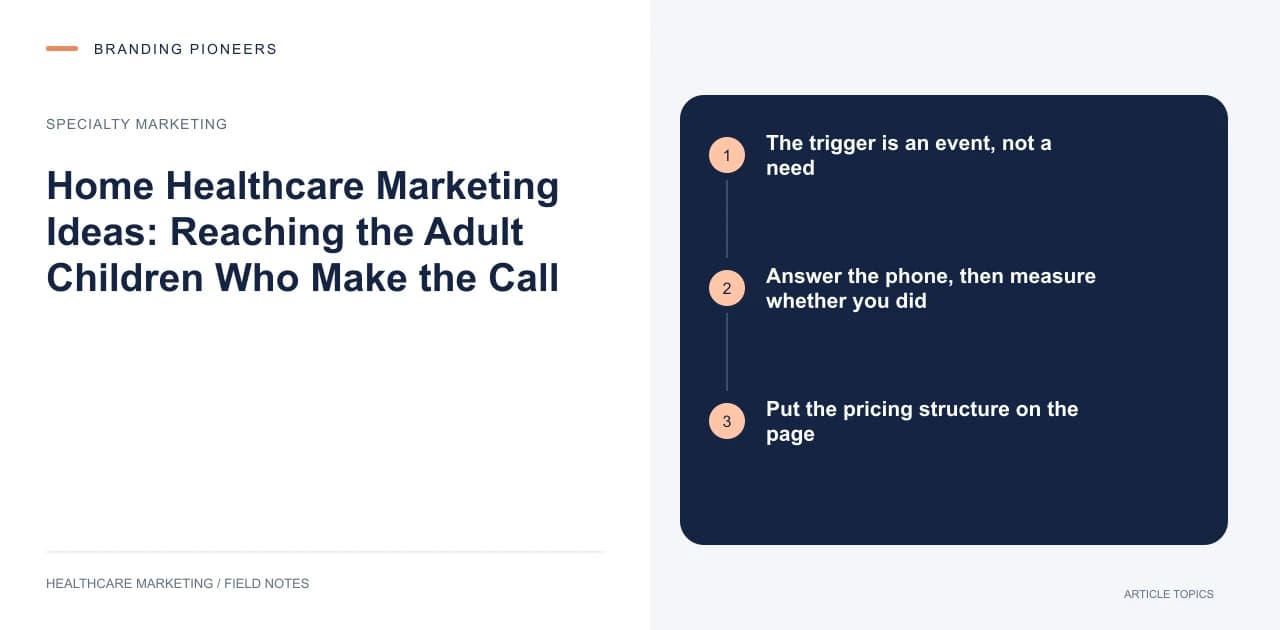
The trigger is an event, not a need
Nobody researches home care in advance. Demand is created by a discharge summary, a fall, a stroke, a cancer diagnosis, or a caregiver who has finally run out of capacity.
That compresses the decision to somewhere between a day and a week. It has three consequences that matter more than anything you put in an ad.
Response time beats every other variable. A family comparing three providers will very often go with whoever picked up first and could start on Monday. Not the cheapest, not the best reviewed — the one that answered.
Second, the search happens outside business hours, because that is when the family is free to worry. An enquiry line that stops at six in the evening is a line that misses the majority of first contacts.
Third, the decision is made under guilt. The adult child is usually choosing this because they cannot do it themselves. Copy that leans on "you can't be there" is both cruel and counterproductive. Copy that describes competence — who comes, what they do, who supervises them — sells.
Answer the phone, then measure whether you did
Before anything else in this article, check how many calls your enquiry line missed last month, and how many of those came in after hours or while another call was in progress.
Most home healthcare operators cannot answer that question, which means they are spending on demand generation while losing demand they already have. Call tracking, a second line, an after-hours answering path and a same-evening callback rule will usually return more than a new campaign. It is the same failure we describe in clinics that are not getting calls, except the stakes are higher because the family is deciding this week.
Put the pricing structure on the page
In India, the highest-intent searches in this category are price searches: nursing attendant charges per day, 24 hour home nursing cost, ICU setup at home cost. In the US, they are "how much does home care cost per hour" and questions about what Medicare covers.
Most provider websites refuse to answer, on the theory that a phone conversation converts better. It does — for the families who call. It loses everyone who closes the tab and opens the competitor who published a structure.
You do not have to publish a single number. Publish the shape of the pricing: the difference between a trained attendant and a qualified nurse, the difference between a twelve-hour and a twenty-four-hour shift, what a monthly engagement typically includes, what equipment is charged separately, and what changes the price. Then explain how a quote is produced. A family that understands the structure will call to get the number.
Local SEO for a service-area business is a different job
Home healthcare has no waiting room, and that changes the local setup.
Google Business Profile supports service-area businesses that visit customers rather than receiving them. If you do not operate a clinic that patients walk into, the address should be hidden and the service areas defined as the localities you actually staff — not the whole city, and certainly not the whole state, because coverage you cannot deliver produces enquiries you have to refuse.
Then build a page per area you genuinely serve, and make each one specific: the hospitals you discharge from in that area, typical travel time, whether you have night staff available there. A page that is the same text with the locality swapped is worth nothing to a reader and very little to Google. Our home health care pages are structured this way for exactly that reason.
The referral side is where the volume is
Consumer search gets you the families who go looking. The larger share of home healthcare volume comes from the people standing next to the patient at the moment of discharge.
In India, that is the discharge coordinator, the ward sister, the physiotherapist and the treating consultant. In the US, it is the hospital case manager and the discharge planner, and for Medicare-certified home health it is a physician order.
Supporting that channel is unglamorous and it works: a single phone number that reaches a coordinator rather than a queue, a one-page capability sheet that says what you can and cannot take, honest same-day availability, and feedback to the referrer after the first week. The mechanics are the same ones we set out for building a patient referral system, applied to a discharge desk instead of a GP.
The thing that loses this channel is not price. It is one case that went badly and was never followed up.
The overseas-family segment, for Indian providers
A large share of Indian home care enquiries come from adult children working abroad, arranging care for a parent in Chennai, Kochi, Hyderabad or Lucknow. They are buying from six thousand kilometres away, usually without having met anyone.
What they need is different from what a local family needs: proof of who the caregiver is, a reporting rhythm they can see, a way to pay from another country, and someone who will answer a WhatsApp message at an inconvenient hour.
Almost nobody markets to this explicitly. A page that names the concern directly — arranging care for a parent in India while you are overseas — plus a daily written update as a standard part of the service, will do more than a month of generic advertising. The home healthcare solution page goes into how we build that funnel.
Publish the answers to the fear questions
Families do not worry about your brand. They worry about specific, practical failures, and the provider that addresses them in writing wins.
Who is the caregiver, and how were their credentials verified? What happens if they do not turn up? Is there a nurse or supervisor the family can call at three in the morning? How is the caregiver replaced if the fit is wrong, and how quickly? What is the process when the patient deteriorates? What are the caregiver's rest hours, and who covers them?
Put these on the site as a plainly worded page. It reads as unpromotional and converts better than anything promotional you could write instead.
Know which rulebook you are under
The US and India are not the same business and should not share copy.
In the US, Medicare-certified home health agencies and private-duty home care are distinct categories with different payers, referral routes and marketing constraints, and CMS publishes agency-level information on Care Compare that families do read. HIPAA applies to US operations, which limits what can be said in a testimonial and what patient data may reach an ad platform — note that neither Google nor Meta will sign a business associate agreement, so no patient-identifying data should reach them at all.
In India, HIPAA is irrelevant. What applies is the Digital Personal Data Protection Act, 2023 and the Digital Personal Data Protection Rules, 2025, enforced by the Data Protection Board of India. Enquiry data collected to arrange care cannot be quietly rolled into a marketing list; consent has to be obtained for that purpose and has to be as easy to withdraw as it was to give.
Family testimonials are the norm in this category in many markets and are genuinely persuasive — but take written consent, name the person who gave it, and do not imply a clinical outcome. Check the market first: in India, if the service is run by doctors or registered as a clinical establishment, the NMC's 2026 guidelines say consent does not make a promotional testimonial permissible (para 6.2; see our NMC guide); in Australia, AHPRA bans testimonials about clinical aspects of care.
What to actually advertise on
Paid search in this category is unusually clean, because the intent is written into the query. Terms that name the service and the city convert. Terms that name the equipment or the condition — hospital bed on rent, dementia care at home, palliative care at home — convert when the page matches them exactly and waste money when they all land on a homepage.
Two habits fix most of the waste. Build one landing page per service line rather than sending everything to the same page, and put the phone number above the fold with a click-to-call that works, because a family in this state phones rather than fills in a form.
On social, the targeting that works is geographic and age-based, aimed at the adult child rather than the patient. Do not attempt to target by health condition: Meta removed detailed health-related targeting options, and inferring a condition about an audience is against its policy in every market.
Creative should show the caregiver and the home, not a stock photograph of a smiling elderly couple on a beach. Families are trying to picture a stranger in their parent's bedroom. Show them one.
Measure the three numbers that decide the business
Not impressions. These:
Time to first response, measured from enquiry to a human speaking to the family. Enquiry-to-start conversion, split by source. And average engagement length, because home care economics are decided by retention, not acquisition — a client who stays four months is worth several who stay three weeks.
What to do first
- Fix the phone. After-hours path, second line, call tracking, same-evening callback rule.
- Publish the pricing structure, even without a single number.
- Set up the Google Business Profile correctly as a service-area business, with areas you actually staff.
- Write the fear-questions page.
- Give the discharge desks at your three nearest hospitals a direct line and a capability sheet.
- Only then spend on ads.
---
If you want to know which of those six is costing you the most right now, get a free audit — we will look at the phone path, the local setup and the pages, and send you the findings whether or not you work with us. Or book a strategy call to talk it through.
Filed underhome healthcare marketing ideashome healthcare marketing strategieshome care marketing ideashome health care advertising exampleshome nursing marketing india

About the author
Nishu Sharma
Founder & CEO · Gurugram, India
Nishu founded Branding Pioneers in 2016 with one rule that hasn't changed since: healthcare only. She'd run digital strategy at a top-10 Indian agency and watched generalist marketing underserve medical clients who needed something built for how patients actually search and decide. So she left to build the specialist instead. It's now an 80-person team working with healthcare brands worldwide.
Free guide · 17 pages
The Patient Acquisition Blueprint
A 90-day plan from first search to booked appointment.