Specialty Marketing

Ayurveda Marketing Ideas: Growing an AYUSH Clinic Online Within India's Advertising Rules

Most Ayurveda marketing in India fails on one word. Work out what you are allowed to say first — the 1954 Act, the state of Rule 170, NCISM and ASCI — then find the version that still persuades.

NS
Founder & CEO · October 14, 2026 · 8 min read
FILE · AYURVEDA
Ayurveda Marketing Ideas: Growing an AYUSH Clinic Online Within India's Advertising Rules

Most Ayurveda marketing in India fails on a single word, and the word is "cure".

Not because patients dislike it. Because the sentence a clinic most wants to write is, in a large number of cases, prohibited by a law passed in 1954 and still enforced. Every plan that starts with the claim and works backwards to the rules ends up rewriting itself, usually after a notice.

Start the other way round. Work out what you are allowed to say, then find the version of that which is still persuasive. There is more room than clinic owners assume — it just is not where they look first.

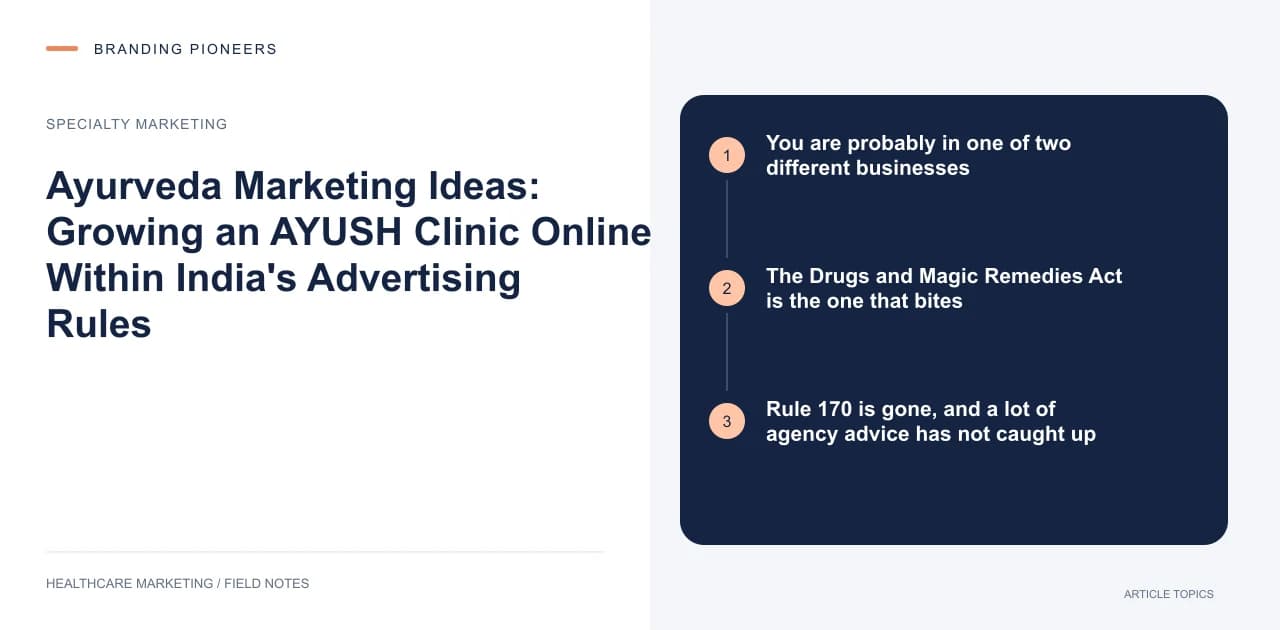
You are probably in one of two different businesses

The rules diverge sharply depending on what you sell, and a lot of confusion comes from mixing them.

If you manufacture or sell an Ayurvedic, Siddha or Unani medicine, you are regulated as a drug: licensing under the Drugs and Cosmetics Act, 1940 and its Rules, and a separate set of requirements around advertising those products.

If you run a clinic — consultations, panchakarma, therapy programmes — you are selling a professional service. Your constraints come from the practitioner conduct rules, the advertising statute below, and the general consumer-protection machinery.

Most Ayurveda businesses do both, and then write one set of copy for both. That is where the trouble starts.

The Drugs and Magic Remedies Act is the one that bites

The Drugs and Magic Remedies (Objectionable Advertisements) Act, 1954 prohibits advertising any drug or remedy as a treatment, prevention or cure for a schedule of specified conditions. The Schedule covers exactly the things clinics most want to advertise: cancer, diabetes, tuberculosis, heart disease, epilepsy, paralysis, leprosy, sexual impotence, female sterility, disorders of menstrual flow, cataract, glaucoma, deafness, goitre and a long list besides.

The Act also prohibits advertisements that are misleading in a material particular, that make a false impression about a remedy's nature, or that suggest a therapeutic effect it does not have. It applies to advertisements in any medium, which includes your website, your Instagram grid and your Google Ads copy.

Read the Schedule before you write anything. Not a summary of it — the actual list, from the bare Act. It is short, it is public, and it will settle most of your copy arguments in ten minutes.

Rule 170 is gone, and a lot of agency advice has not caught up

Rule 170 of the Drugs and Cosmetics Rules, 1945 was inserted by the Drugs and Cosmetics (Fifth Amendment) Rules, 2018. It required advertisements for Ayurveda, Siddha and Unani drugs to carry a unique identification number issued by the state licensing authority, with the advertisement approved in advance.

It no longer applies. The Ministry of AYUSH omitted the rule by the Drugs (Fourth Amendment) Rules, 2024, notified on 1 July 2024. The Supreme Court stayed that omission on 27 August 2024 in the proceedings in Indian Medical Association v. Union of India, the matter arising out of the misleading-advertisement case. On 11 August 2025 the Court vacated the stay and disposed of the petition, holding that the reliefs sought had substantially been achieved. Rule 170 stands omitted.

Two things follow. First, if a proposal or a compliance checklist you have been given still requires a Rule 170 approval number, it was written before August 2025 and you should ask what else in it is out of date.

Second — and this is the part people get wrong — the removal of an approval mechanism is not the removal of the underlying prohibition. The 1954 Act still applies in full. So does the consumer-protection machinery. What has gone is a pre-clearance step, not the rule about what you may claim. If anything, the absence of a stamp means there is nobody between you and a complaint.

Clinic service advertising — a consultation, a therapy programme — is a different question from product advertising in any case, and conflating the two is the most common mistake we see in AYUSH accounts.

Who regulates the practitioner

Ayurveda practitioners in India register under the National Commission for Indian System of Medicine, established by the NCISM Act, 2020, which replaced the Central Council of Indian Medicine. Their conduct is governed by the National Commission for Indian System of Medicine (Ethics and Registration) Regulations, 2023, notified on 29 December 2023, which superseded the 1982 conduct regulations for practitioners of Indian medicine.

Modern-medicine practitioners come under the National Medical Commission and, for conduct, the Medical Council of India's Code of Ethics Regulations, 2002 — still operative, because the NMC's 2023 conduct regulations were withdrawn and remain on hold.

That distinction matters if you employ both. The general principle across both systems is the same: you may state facts about the practitioner — name, qualifications, registration, specialisation, address, timings — and you may not solicit, self-praise, or claim superiority over others.

Then there is the Advertising Standards Council of India. ASCI is self-regulatory but its decisions carry weight with platforms and broadcasters, and its chapters on misleading advertising and on healthcare apply directly to this category. Our summary of ASCI compliance for healthcare advertising covers what gets flagged in practice. On top of that sits the Central Consumer Protection Authority, whose guidelines on misleading advertisements and endorsements give a regulator with real teeth a route into the same conduct.
What you can say instead

Here is the shift that makes this workable. Stop marketing the outcome. Market the process, the practitioner and the specificity.

Describe the therapy accurately. What panchakarma actually involves, day by day. How long a programme runs. What a patient eats during it. What it feels like. What the preparation period requires. Nobody publishes this and every prospective patient wants it.

Describe the practitioner. BAMS, MD in a specific stream, years in practice, the conditions they see most, where they trained, what they have published. Credentials are facts, and facts are permitted.

Describe the assessment. A prakriti assessment or a detailed first consultation is a real differentiator against a spa selling an "ayurvedic massage", and describing it truthfully does not claim anything about a disease.

Describe the boundaries. Saying plainly that you will not stop a patient's prescribed medication, that you coordinate with their treating physician, and that you refer out when a case needs modern medicine, buys more trust from an educated patient than any claim you are not allowed to make.

The unifying rule: verbs like "manage", "support" and "relieve" attached to symptoms are safer ground than verbs like "cure" and "reverse" attached to diseases — and no verb at all, attached to a scheduled condition, is safest of all.

Classical texts are context, not evidence

Citing Charaka or Sushruta is legitimate as background. It is not substantiation for an advertising claim under Indian law, and a regulator asking for evidence of a therapeutic claim will not accept it as such.

If you want to make a claim that goes beyond description, the substantiation has to be of the kind a regulator recognises, and it has to be on file before the advertisement runs, not assembled after a complaint.

The local search problem nobody fixes

Ayurveda clinics have a category problem in local search. A search for "ayurvedic doctor near me" returns a mixture of qualified clinics, wellness spas, massage centres and product retailers, and Google frequently cannot tell which is which — partly because clinics choose the wrong primary category on their own Google Business Profile.

Fix that first. Primary category should reflect the clinic, not the therapy menu. Then list services in the words patients use, including the Hindi and Hinglish forms they actually type — panchakarma, vaman, basti, nasya, garbhini paricharya — and make sure the practitioner's qualification is visible in the profile and on the site.

The rest is the standard local SEO set, and it is worth doing properly rather than in parallel with a paid push: complete profile, accurate hours, real photographs of the clinic rather than stock images of herbs, citations that match, and a review flow that runs by message rather than by asking at the counter. Our Ayurveda marketing pages set out the full structure.

Content, reviews and paid media

Content is where this specialty wins, because the search demand is enormous and the published material is mostly product marketing. Practitioner-led video answering one question at a time, in Hindi as well as English, does more here than any other format. So do process explainers, diet and daily-routine content, and honest "who is this not suitable for" pages.

Reviews need care. A patient testimonial that describes a disease being cured carries the same claim the Act prohibits, restated in someone else's voice, and ASCI treats testimonials presented as typical results as a flag in their own right. Ask for reviews about the experience — the consultation, the staff, the clarity of the plan — not about outcomes.

Paid media has its own filter on top of Indian law. Google's healthcare and medicines policy restricts a range of treatment advertising and restricts personalised advertising based on health conditions. Meta removed detailed health-condition targeting options and prohibits implying knowledge of a person's condition in creative. Neither platform signs a business associate agreement, and in any case HIPAA is an American statute that has no application to an Indian clinic — what applies to your patient data here is the Digital Personal Data Protection Act, 2023 and the Digital Personal Data Protection Rules, 2025.

What to do first

  1. Read the Schedule to the 1954 Act and audit every page and ad against it.
  2. Separate your product copy from your clinic copy, permanently.
  3. Delete any Rule 170 step still sitting in your compliance process, and check what else in that document predates August 2025.
  4. Fix the Google Business Profile category and the services list.
  5. Publish the process, the practitioner and the assessment. Not the outcome.
  6. Rewrite your review request so it asks about the experience.

---

If you want a compliance-aware read of your current Ayurveda pages and ads — what would be flagged, what is simply invisible, and what you could say instead — get a free audit and we will send the findings whether or not you work with us. Or book a strategy call to talk it through.

FILED UNDERayurveda marketing ideasayush advertising guidelines indiaayush regulationsayurveda marketing agencypanchakarma clinic marketing
Stop reading. Start ranking.
Get a free specialty marketing audit — we'll show you exactly what's missing.
Book audit →
Author
Founder & CEO · Gurugram, India

Nishu founded Branding Pioneers in 2016 with one rule that hasn't changed since: healthcare only. She'd run digital strategy at a top-10 Indian agency and watched generalist marketing underserve medical clients who needed something built for how patients actually search and decide. So she left to build the specialist instead. It's now an 80-person team working with healthcare brands worldwide.

The Patient Acquisition Blueprint (2026 Edition) — guide cover
Free · 15 pages

The Patient Acquisition Blueprint (2026 Edition)

The exact 90-day patient-acquisition system, step by step.

We never share your details

FREE · 30 MIN
See your specialty marketing opportunity gap.

Senior strategist, no boilerplate. Reply within 4 hours.

Book audit → Or call us directly
The Pioneers Brief · weekly
One essay. Three benchmarks. One teardown.
Subscribe — free
The Patient Acquisition Blueprint (2026 Edition) — guide cover
Free for specialty marketing readers

The Patient Acquisition Blueprint (2026 Edition)

The exact 90-day patient-acquisition system, step by step.

  • The 90-day patient acquisition operating system
  • Channel-by-channel budget allocation (₹50L–₹5Cr/yr)
  • 12 real, named client engagements walked through
  • ROI tracking spreadsheet (CAC, LTV, payback)
15 pages · Used by 350+ healthcare clients · Updated for AI search

We never share your details

Continue reading

More on specialty marketing.

BROWSE ALL →
From the studio

This thinking, applied.

Video production and video SEO for healthcare brands
Video · SEO
Video built to rank and convert
Healthcare digital ad creative set
Performance
Search and social ad creative
Specialty clinic clients
Clients
Specialty clinics
The Branding Pioneers team — 80+ healthcare-only specialists
The team
80+ specialists, healthcare only
Vizer — investor and go-to-market deck design system
Deck · Diagnostics
Vizer — investor and go-to-market deck
Why choose us

Why healthcare brands choose us.

Six reasons hospitals, clinics, and doctors pick a healthcare-only firm over a generalist agency.

  • Healthcare-only

    It's all we do. No retail, no fintech — the whole team thinks in patient journeys, clinical trust, and the way people actually choose a doctor.

  • AI-first systems

    Receptionists, WhatsApp triage, and attribution built in-house — we answer patients in seconds and tie every click to a booked appointment.

  • Compliance built-in

    HIPAA-aware handling, ASCI-reviewed creative, and GDPR/DPDP sign-off on every campaign — our standard, not an upcharge or an afterthought.

  • Senior on every account

    The senior who pitched you stays on the engagement. No bait-and-switch to juniors learning on your budget.

  • Measured to the appointment

    Patient-level attribution across calls, forms, and walk-ins. Monthly reports show booked patients — not just clicks and impressions.

  • Receipts, not promises

    We name our clients and show the work. Quarterly reviews with the numbers attached, every cycle.

The Branding Pioneers healthcare-marketing team at work
Healthcare-only · since 2016
A team that does one thing well.
More from the brief

If this resonated, here’s what else lands.

Adjacent practices, the relevant tools, and the case files where we shipped this thinking against real patient-acquisition targets.

THE PIONEERS BRIEF · WEEKLY

One essay,
three benchmarks,
one teardown.

Healthcare growth, every Thursday morning. No hype, no fluff.