The Advertising Standards Council of India enforces the ASCI Code on healthcare advertising. Common flags:
Before/after images without disclosure
"Guaranteed" outcome language
Drug brand names in non-Rx-targeted ads
Comparative claims without evidence
Testimonials presented as typical results
Doctors and hospitals: the NMC rules are stricter
ASCI is self-regulatory and applies to every advertiser. For doctors and hospitals, the NMC's Guidelines on Ethical Advertising (6 Oct 2026) go further: no patient testimonials, no promotional before-and-after images, no success rates or "best" and "No.1" claims unless independently verifiable, and no discounts or free procedures as inducements. Where the two differ, follow the NMC guidelines. Our NMC Guidelines 2026 guide has the detail.
What survives review
Factual service descriptions, with risks and side effects disclosed
Doctor names, qualifications and SMR/NMR registration numbers
Accreditation status, departments, facilities and factual fees
Public-health education that does not promote a practice
Claims you can substantiate from a document you can produce today
What we ship
Pre-launch review of all creative against the ASCI Code and the NMC guidelines
Disclaimer and risk copy written for every ad
A substantiation file maintained per campaign
Annual review of ASCI complaint trends
From the studio
This, applied to real practices.
OOH
Out-of-home billboard execution
MarTech
Technology for healthcare teams
Clients
Clinics across specialties
Print
Hospital brochure system
SEO
Rank tracking across treatment keywords
Founders
Arush Thapar and Nishu Sharma
Free executive download
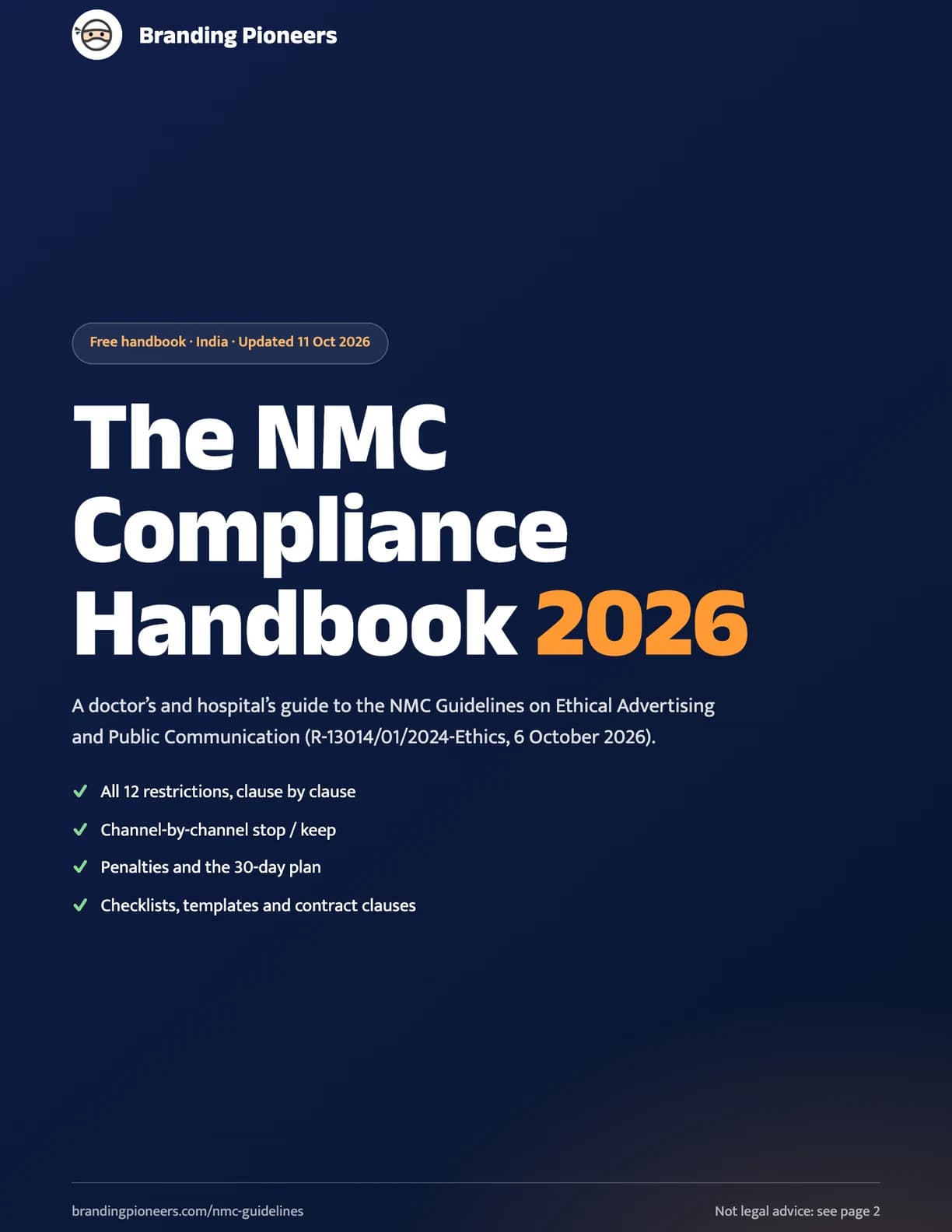
The NMC Compliance Handbook 2026
Every clause of NMC's 6 Oct 2026 advertising guidelines, with checklists and templates.
All 12 restrictions in para 8.1, clause by clause
The disclosure line every post needs, with templates
Channel-by-channel stop / keep guide
Penalty ladder and what happens after a complaint
20 pages · In force since 6 Oct 2026: penalties go up to removal from the register
Free · 30 min · no commitment
Want it for your practice?
Free 30-min audit. We map your situation against this guide and ship a 90-day plan.
ASCI's code sits alongside the rules for doctors: the NMC advertising guidelines and the NMC compliance handbook cover what individual doctors may publish, and NABH marketing rules cover accredited hospitals.
Published by Branding Pioneers · Published page information and practical marketing guidance
A practical reference for this page
01
Start hereASCI Compliance for Healthcare Advertising
02
Establish contextUse the published scope and relevant source material
03
Choose the next stepFollow the linked resource and assign an owner
Putting ASCI Compliance for Healthcare Advertising into practice
Use the ASCI resource to review how an advertising claim is worded and supported. Keep the final creative, the underlying evidence and the approval record together. A changed headline or image can alter the meaning of an approved message, so review the released version as well as the original brief.
Choose the resource that matches your next decision
Begin with the question you need to answer, then choose the most appropriate destination in this collection. A guide explains a method, a checklist supports a repeatable review, a calculator explores assumptions and a case file documents a particular engagement. Reading them as interchangeable resources can create confusion. If you need to brief a supplier, start with the relevant service or framework. If you need to assess evidence, start with the source reports and the limits stated alongside the example.
Use the collection to narrow the investigation rather than adding every possible task to a marketing plan. Identify the stage where progress is blocked: discovery, understanding the service, making contact, arranging an appointment or following up. Choose a resource that addresses that stage and keep a short note of the evidence you need. A focused review is easier to act on than a long list of unrelated recommendations, particularly when clinical approvals and operational changes involve different people.
Apply the material to your own practice
Document the local conditions before adopting an example. Include the service mix, available clinicians, languages, appointment process and existing digital assets. A method used by a hospital network may need to be simplified for a solo practice; a single-clinic process may need explicit location ownership when used by a chain. Keep those adaptations visible in the brief. The resource provides a way to organise the work, while your own records establish whether its assumptions fit.
Assign a person to each next action and define how completion will be checked. Editorial tasks need content and approval ownership, technical tasks need a release review and measurement tasks need a named source account. Keep evidence attached to the relevant decision instead of relying on a general claim that the programme is performing well. Revisit the plan when the service, market or operational capacity changes. The related links on this page let you move from an overview into the detail needed for that next action.