Specialty Marketing

Gastroenterology Digital Marketing: Reaching Endoscopy, Liver and Gut Health Patients Online

Gastroenterology has three demand streams that barely overlap. Most departments answer all three with one page called Gastroenterology, and lose the two that are worth the most.

NS
Founder & CEO · October 7, 2026 · 7 min read
FILE · GASTROEN
Gastroenterology Digital Marketing: Reaching Endoscopy, Liver and Gut Health Patients Online

Gastroenterology gets three completely different kinds of patient, and they have almost nothing in common.

There is the symptom patient — acidity, bloating, irregular bowels, a stomach that has been wrong for months. There is the screening patient, who feels fine and is being asked to undergo a procedure for a problem they do not have. And there is the urgent patient, who has seen blood, or turned yellow, or is in enough pain to search at two in the morning.

Different search terms, different anxieties, different economics, different conversion paths. Most hospital sites answer all three with a single department page and a list of consultants.

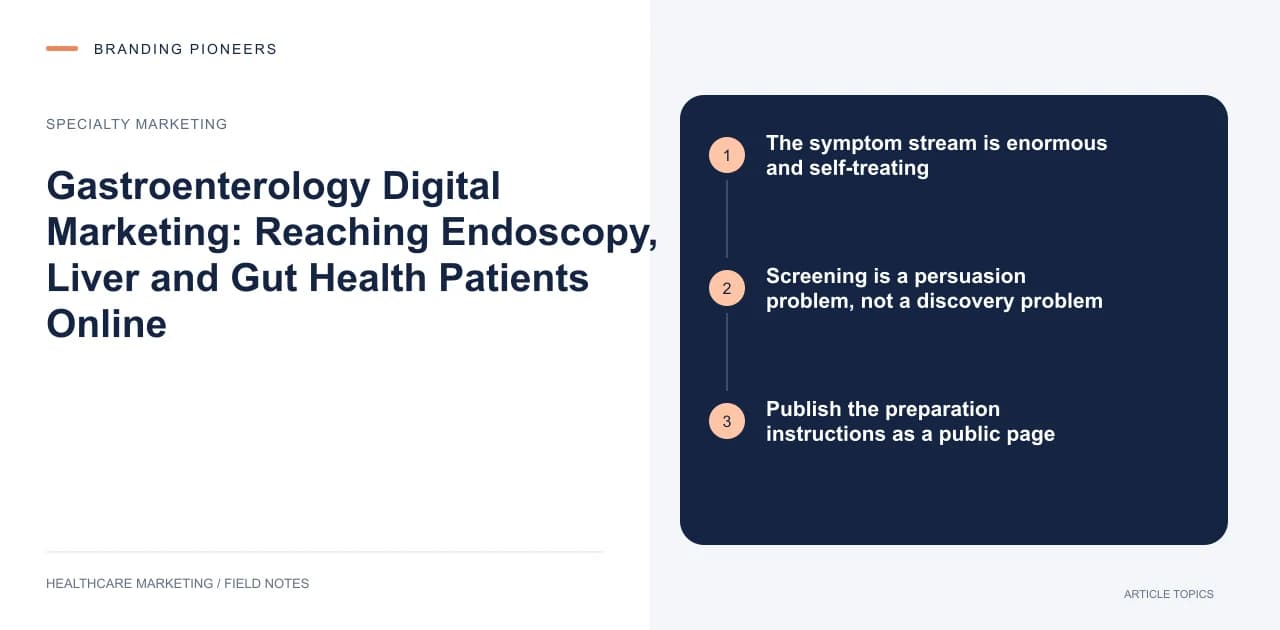
The symptom stream is enormous and self-treating

More people search stomach symptoms than search almost any other medical category, and the overwhelming majority of them self-treat. They take an antacid, change their diet, wait.

That is not a failure of your marketing; it is appropriate behaviour, and trying to convert it wholesale is how gastroenterology paid search wastes money. What the symptom stream is actually good for is authority. A department that answers these questions properly — what acidity is, when reflux stops being ordinary, why bloating happens, what IBS is and is not, when a change in bowel habit matters — earns the visibility that pays off when the same reader escalates.

Write it as one page per symptom, in the words patients use, with a clear line about when to stop self-treating and see someone. That line is the conversion mechanism, and it should be specific rather than a generic "consult your doctor". Our gastroenterology marketing pages are organised this way because the symptom layer feeds the procedure layer and nothing else does.

Screening is a persuasion problem, not a discovery problem

Colonoscopy demand behaves unlike anything else in the department. The patient is well. They have been told to have a procedure they find undignified and frightening, involving a preparation they have heard bad things about, and nothing is forcing them.

They do not need to discover you. They need to be talked out of postponing.

The content that does that is unusually specific: what the preparation actually involves and how people manage it, whether they will be sedated and what sedation feels like, how long the whole day takes, whether they can drive home, who will be in the room, what happens if something is found, and how long results take.

The reference points are real and worth citing accurately. In the United States, the US Preventive Services Task Force recommends colorectal cancer screening beginning at age forty-five for average-risk adults. In India there is no organised national colorectal screening programme, which makes this an opportunistic, awareness-led market where a hospital that explains risk clearly has more room than it would in a screened population. State the guidance you are relying on and where it comes from, rather than implying a universal rule.

Publish the preparation instructions as a public page

This sounds like an operational document and it is one of the highest-value pages a gastroenterology department can own.

Patients search bowel preparation instructions constantly — before the procedure, during it, at midnight when something is not going as described. Publishing yours, clearly, with the timings and the diet and the common problems, does three things: it ranks, it reduces cancelled and failed procedures, and it signals a department that treats patients as capable of following instructions.

The same applies to endoscopy fasting instructions and to post-procedure advice.

The cost page you do not want to write is the one they search for

Endoscopy and colonoscopy cost searches are high-volume and high-intent, and most hospitals refuse to engage with them.

You do not have to publish a price to own the query. Explain the structure: what a diagnostic procedure includes, what changes when a biopsy or a polypectomy is needed, what sedation adds, what is covered by insurance and what usually is not, what a day-care admission means for the bill. A page that explains why the number varies will out-perform a competitor's number, because the patient reading it learns something they can use.

Procedure cost page SEO covers how to build these without creating a price-comparison trap.

Liver is the quiet growth area

Fatty liver is now found incidentally on abdominal ultrasounds constantly, and the person holding that report has no idea what to do with it. They search. Almost nobody has written them a good answer.

A department that owns fatty liver content — what the grades mean, whether it is reversible, what actually changes it, when it needs a specialist, what fibrosis assessment involves — picks up a stream of well-qualified patients that competitors are not contesting. The same is true for hepatitis B and C in markets where prevalence is meaningful, and for alcohol-related liver disease, which is searched privately and written about badly.

Bariatric and metabolic services sit adjacent to this, and the overlap is real; if your hospital runs both, link them properly rather than keeping them in separate silos — see bariatric surgery marketing for how that demand behaves.
Local search and the endoscopy unit

Much of this demand resolves locally: "gastroenterologist near me", "endoscopy centre" plus a city, "colonoscopy near me".

The Google Business Profile carries that, and it is usually incomplete. Right primary category. Procedures named as services, in patient language. Photographs of the actual endoscopy suite and recovery area, which reassures more than any copy. True hours, including when procedures are done rather than only when the clinic runs. A booking route that works on a phone.

The account should bid where the decision is: a named procedure plus a city, "gastroenterologist appointment", "liver specialist" plus a location, "endoscopy cost". Symptom terms belong to organic content, where they cost nothing per click and serve a reader who is not ready anyway.

Platform policy is the same everywhere. Google's personalised advertising policy restricts audience building around sensitive health conditions, so remarketing lists assembled from condition pages are a problem. Meta's health and wellness policy restricts targeting and optimisation based on inferred health conditions. Neither will sign a business associate agreement, so for a US practice subject to HIPAA no patient-identifying data may reach them. In India, the Digital Personal Data Protection Act, 2023 and the DPDP Rules, 2025 set the obligations for notice, consent and storage, with the Data Protection Board of India as regulator; HIPAA has no application there.

The urgent stream needs a page that behaves like an emergency

Blood in the stool. Vomiting blood. Jaundice appearing over a weekend. Severe abdominal pain that has not settled. These searches happen at night, on a phone, by somebody frightened.

They are not served by a department page. They need a page that says, in the first two lines, what needs attention now and what can wait until morning — then gives a route: a number that is answered at that hour, the emergency department address, and what to bring.

This content is difficult to write because it sits close to giving advice. Write it with a named gastroenterologist, keep the qualifier inside the sentence rather than in a paragraph underneath it, and be specific about when to go to hospital. A hedged page helps nobody and gets skipped; a clear one earns the patient and, often, the admission.

It is also the content most likely to be summarised by an AI assistant, which is another reason the safety qualifier has to be in the same sentence as the reassurance. A summary that keeps "most causes are not serious" and drops "but any visible blood needs assessing" is a failure your page caused.

Trust signals for a procedure nobody can see

An endoscopy patient is being asked to be unconscious while a stranger does something to them. The trust signals that matter are correspondingly specific.

Who performs the procedure — the consultant or a trainee. How scopes are reprocessed. What sedation is used and who monitors it. What the complication rate discussion sounds like. Whether a family member can be present until sedation. What happens if they need to be admitted.

Departments leave this out because it feels clinical rather than promotional. It is the most persuasive content available, because it is the only content addressing what the patient is actually afraid of.

Where to start

  1. Symptom pages for the presentations you see most, in patient language.
  2. The preparation instructions published as a public page.
  3. A cost page that explains the structure rather than quoting a number.
  4. Fatty liver content, because almost nobody is contesting it.
  5. The Google Business Profile completed, with procedures named as services.
  6. Paid search last, on procedure intent only.

What to measure

Symptom-page traffic is not the goal and should not be reported as one. The chain worth measuring is: symptom content to consultation booked, consultation to procedure scheduled, procedure scheduled to procedure completed. The gap between the last two is where preparation instructions and pre-procedure communication earn their keep.

---

If you want an outside read on your gastroenterology visibility — which symptoms you are absent from, and where the procedure pathway loses people — get a free audit. Or book a strategy call.

FILED UNDERgastroenterology digital marketinggastroenterology marketinggastro marketing agency
Stop reading. Start ranking.
Get a free specialty marketing audit — we'll show you exactly what's missing.
Book audit →
Author
Founder & CEO · Gurugram, India

Nishu founded Branding Pioneers in 2016 with one rule that hasn't changed since: healthcare only. She'd run digital strategy at a top-10 Indian agency and watched generalist marketing underserve medical clients who needed something built for how patients actually search and decide. So she left to build the specialist instead. It's now an 80-person team working with healthcare brands worldwide.

The Patient Acquisition Blueprint (2026 Edition) — guide cover
Free · 15 pages

The Patient Acquisition Blueprint (2026 Edition)

The exact 90-day patient-acquisition system, step by step.

We never share your details

FREE · 30 MIN
See your specialty marketing opportunity gap.

Senior strategist, no boilerplate. Reply within 4 hours.

Book audit → Or call us directly
The Pioneers Brief · weekly
One essay. Three benchmarks. One teardown.
Subscribe — free
The Patient Acquisition Blueprint (2026 Edition) — guide cover
Free for specialty marketing readers

The Patient Acquisition Blueprint (2026 Edition)

The exact 90-day patient-acquisition system, step by step.

  • The 90-day patient acquisition operating system
  • Channel-by-channel budget allocation (₹50L–₹5Cr/yr)
  • 12 real, named client engagements walked through
  • ROI tracking spreadsheet (CAC, LTV, payback)
15 pages · Used by 350+ healthcare clients · Updated for AI search

We never share your details

Continue reading

More on specialty marketing.

BROWSE ALL →
From the studio

This thinking, applied.

Apollo Hospitals — doctor-led video library
Video · Library
Apollo — the doctor-led video library
Healthcare digital ad creative set
Performance
Search and social ad creative
Medical tourism — healthcare marketing by Branding Pioneers
Vertical
Medical tourism
Founders co-presenting at a business training
Craft
Founders presenting to the team
Healthcare event videography
Video · Event
Event films and coverage
Why choose us

Why healthcare brands choose us.

Six reasons hospitals, clinics, and doctors pick a healthcare-only firm over a generalist agency.

  • Healthcare-only

    It's all we do. No retail, no fintech — the whole team thinks in patient journeys, clinical trust, and the way people actually choose a doctor.

  • AI-first systems

    Receptionists, WhatsApp triage, and attribution built in-house — we answer patients in seconds and tie every click to a booked appointment.

  • Compliance built-in

    HIPAA-aware handling, ASCI-reviewed creative, and GDPR/DPDP sign-off on every campaign — our standard, not an upcharge or an afterthought.

  • Senior on every account

    The senior who pitched you stays on the engagement. No bait-and-switch to juniors learning on your budget.

  • Measured to the appointment

    Patient-level attribution across calls, forms, and walk-ins. Monthly reports show booked patients — not just clicks and impressions.

  • Receipts, not promises

    We name our clients and show the work. Quarterly reviews with the numbers attached, every cycle.

The Branding Pioneers healthcare-marketing team at work
Healthcare-only · since 2016
A team that does one thing well.
More from the brief

If this resonated, here’s what else lands.

Adjacent practices, the relevant tools, and the case files where we shipped this thinking against real patient-acquisition targets.

THE PIONEERS BRIEF · WEEKLY

One essay,
three benchmarks,
one teardown.

Healthcare growth, every Thursday morning. No hype, no fluff.