Most aesthetic clinics in Dubai do not have a creative problem. They have a queue problem.
The campaign is designed, the before-and-afters are shot, the media plan is booked — and then the whole thing sits waiting for an advertising permit that nobody costed into the timeline. By the time it clears, the offer has moved on, the season has turned, and the media is running against a different brief.
Dubai rewards clinics that plan backwards from the approval. Everything else in this market is downstream of that.
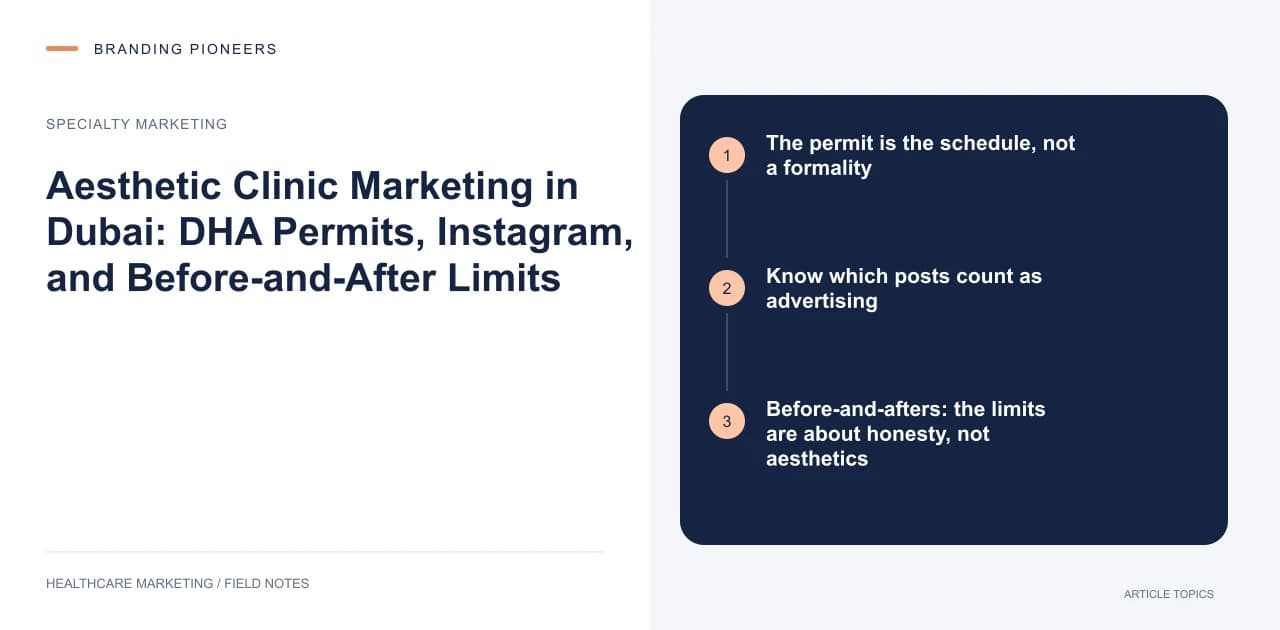
The permit is the schedule, not a formality
Health-related advertising in Dubai needs clearance from the Dubai Health Authority before it is published. Abu Dhabi sits under the Department of Health — Abu Dhabi (the body that used to be HAAD), and the northern emirates under MOHAP. Three regulators, three processes, one country.
The practical consequence is that "when does this go live" is not a question your media team can answer. It is a question the submission queue answers.
So build the calendar around it. Decide the quarter's offers early, submit as a batch rather than one asset at a time, and keep a standing library of pre-cleared assets you can fall back on when something is rejected. Clinics that run continuously in this market are not faster at approvals — they are just never dependent on a single pending one.
Our UAE market page covers how the three emirate-level regulators differ, and the existing walkthrough of how healthcare advertising approval actually works in Dubai and the Emirates goes through the submission itself step by step rather than repeating it here.
Know which posts count as advertising
The grey area that costs clinics the most time is the assumption that organic social is outside the rules because no money is behind it.
Treat the test as promotional intent, not spend. A post that explains what a treatment does, in general terms, reads as education. A post that names a price, announces a package, promises an outcome, or pushes a booking link is promoting a licensed medical service — and that is the category the regulator is interested in, whether or not it is boosted.
The workable internal rule: two content streams. An education stream your team can publish without a queue, and a promotional stream that only ever uses cleared assets. Most clinics discover they can keep publishing daily once the two are separated.
Before-and-afters: the limits are about honesty, not aesthetics
Before-and-after imagery is the single most persuasive asset an aesthetic clinic owns and the single most common reason a submission comes back.
What survives review tends to share the same characteristics. Written, specific, documented consent from the patient for marketing use — not a line buried in a treatment form. The same lighting, the same angle, the same distance, the same expression, no makeup change between the two frames. No retouching of any kind on either image. A stated timeframe. And no language that converts an individual result into a promise: "results vary" is not a disclaimer you add at the end, it is a fact the caption has to carry.
What gets pulled: composite images, stock comparisons, filtered skin, cropping that flatters, and any claim of permanence for something that is not permanent.
Two more habits worth building in. Keep the consent record and the raw originals filed with the campaign, because the question "can you show us the source of this image" arrives long after the person who shot it has left. And re-confirm consent before reusing an image in a new campaign years later — the patient agreed to one use, not to a permanent licence.
Instagram is the decision surface; search is the shortlist
In the UAE the shortlist usually forms on Instagram and the verification happens on Google. Clinics that treat those as the same job do both badly.
Instagram carries the aesthetic judgement — the clinic's room, the practitioner's hands, the tone of the captions, whether the account looks like a medical practice or a filter. Search carries the trust check: the licence, the reviews, the address, the practitioner's name and where they trained.
Two audiences move through that differently. A resident is comparing three clinics within a few kilometres and will read your Google Business Profile carefully. A visitor is comparing Dubai against home and is looking for price clarity, timelines and whether the follow-up is handled if they fly out two days later. Write for both, but do not blend them into one page.
Area-level search matters more in Dubai than in most cities, because residents think in neighbourhoods rather than in the city. Jumeirah, Al Barsha, Business Bay, Dubai Marina and JLT are separate search markets even for the same clinic brand, and separate location pages are worth building if you genuinely operate in more than one.
Arabic is not an afterthought either. A meaningful share of the resident audience searches in Arabic and is served translated English that reads like translated English. That is a content decision, not a plugin setting.
Reviews behave differently in a transient city
Dubai's resident population turns over constantly, and that changes what a review is worth.
Recency matters more here than almost anywhere. A page of enthusiastic reviews from three years ago describes a clinic staffed by people who have since moved to another country, and patients read it that way. A steady trickle of recent reviews beats a large historic pile.
Language matters too. A profile with reviews only in English tells an Arabic-speaking resident something about who the clinic is for, whether or not that was intended. Ask in the language the patient used with you.
And the rule that holds everywhere: do not incentivise. Offering anything of value in exchange for a review breaches Google's policies regardless of local law, and in an aesthetics market where the reviews are the product, a removed review set is an expensive lesson. Ask every eligible patient, ask by message rather than at the desk, and ask after a completed course rather than after the first appointment.