The mistake international clinics make in the UAE is treating advertising approval as a formality that happens after the creative is finished. It is not. It is the constraint the entire programme is built around, and clinics that understand this run smoother, cheaper campaigns than those that keep resubmitting rejected work.
The second mistake is assuming the UAE is one jurisdiction for this purpose. It is not that either.
This is a practitioner's summary written by marketers, not legal advice. Regulations change, and enforcement varies. Confirm the current text with your regulator or your own counsel before you publish.
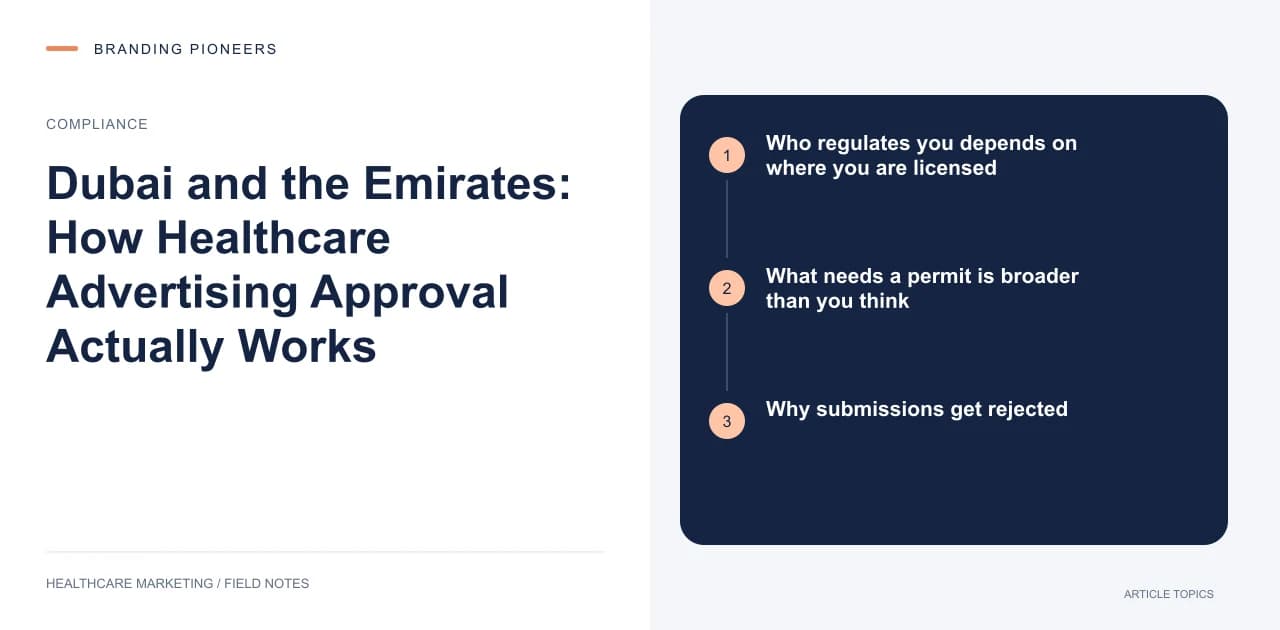
Who regulates you depends on where you are licensed
Health advertising oversight is split by emirate. The Dubai Health Authority covers Dubai. The Department of Health covers Abu Dhabi. The Ministry of Health and Prevention covers the northern emirates. And Dubai Healthcare City operates as a free zone with its own regulatory authority and its own requirements — a clinic inside DHCC does not simply follow Dubai's mainland process.
If you operate branches across emirates, you are dealing with multiple approval processes for what is, from your side, one campaign. Plan the creative so that a single concept can be adapted rather than rebuilt, and expect the timelines to differ.
What needs a permit is broader than you think
Practices often assume approval applies to outdoor and print advertising. In practice the scope generally extends to promotional health content published to the public — which pulls in website service pages, social media posts, offers and packages, video content, and material published on your behalf by an influencer or partner.
The influencer point deserves emphasis. Content creators promoting commercially in the UAE need appropriate media licensing, and health content adds a further layer. An arrangement where a creator posts about a procedure at your clinic is your advertising, with your regulatory exposure attached.
Why submissions get rejected
The pattern is consistent enough to write down:
- Superlatives. Best, number one, leading, most advanced, the only clinic. If it cannot be objectively substantiated, it will not clear.
- Guarantees and outcome promises. Including softer versions — permanent results, guaranteed success, pain-free.
- Discounts and offers on medical procedures. Price promotion in healthcare is treated very differently here than in retail.
- Before-and-after imagery, particularly in aesthetics and dentistry.
- Title and scope mismatches. Using consultant or specialist when the practitioner's licence category says otherwise, or advertising a service the licence does not cover.
- Unsubstantiated technology claims. Naming a device or technique and attaching performance claims to it without evidence.
- Missing or poor Arabic. Requirements vary by emirate and medium, but Arabic is expected and machine-translated Arabic reads as exactly that.
Planning around approval, not against it
The practices that do this well change their operating rhythm in three ways.
They build an approved asset library. Rather than commissioning campaign-specific creative each time, they get a core set of messages, images and service descriptions approved, then assemble campaigns from approved components. The first quarter is slower; every quarter after is dramatically faster.
They separate education from promotion. A great deal of high-performing healthcare content is not promotional in character — explaining a condition, describing what a procedure involves, answering the questions people actually ask. Understanding where your regulator draws the line between education and advertisement lets you keep a content engine running continuously while promotional pushes go through approval.
They plan seasonally, in advance. Ramadan shifts consultation timing and content tone considerably. Summer sees a large share of the resident population travel. The National Day period, back-to-school health checks, and insurance renewal cycles are all predictable. Approval lead times mean these are planned quarters ahead, not weeks.