World Diabetes Day is Saturday 14 November 2026. In the United States it sits inside Diabetes Awareness Month, which runs the whole of November.
Here is what happens at most clinics on that Saturday. A screening camp is set up, a queue forms, several hundred finger-prick tests get done, a number of people are told their reading is high, everyone is thanked, the photographs go up on Monday — and almost nobody comes back.
The campaign was not wrong. It just ended on the day it was supposed to start. Diabetes is the one awareness day where the value is entirely in the follow-up, because the thing you are screening for is chronic, silent and managed over years rather than treated in an afternoon.
If you are planning this, you have four weeks. Spend most of them on what happens after the fourteenth.
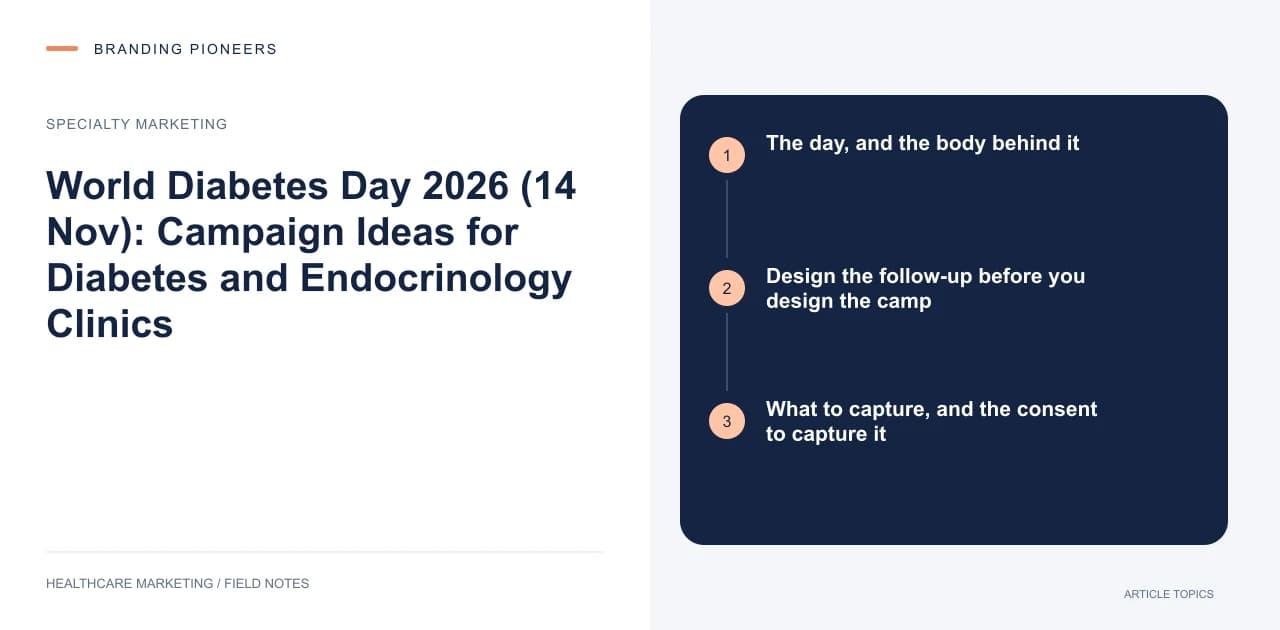
The day, and the body behind it
World Diabetes Day is marked on 14 November by the International Diabetes Federation with the World Health Organization. The date is Frederick Banting's birthday — the co-discoverer of insulin — and the campaign's symbol is the blue circle.
The IDF sets the campaign theme, and it has run themes across multi-year cycles rather than changing them annually. Check idf.org for the current one before you brief creative rather than assuming, because a campaign built on last cycle's theme is visibly out of date to anyone in the field.
One scheduling note for Indian clinics: Diwali falls on 8 November 2026, six days before. Camp attendance in the week after Diwali is unpredictable and staff availability is worse. Decide early whether you run on the fourteenth itself or shift the camp into the following week and keep the fourteenth for content.
Design the follow-up before you design the camp
Work backwards. Before you book a tent, answer these:
Who calls the people with high readings, and on which day? What do they say? What does the person get in writing, and does it go to them or only into a file? If they book, who confirms the appointment the day before? If they do not book, when does someone try again, and how many times?
A camp that screens a hundred people with no answer to those questions is a data-collection exercise. A camp that screens forty with all of them answered will produce more managed patients.
Also decide in advance what you will not do. In India, the camp is public-health screening, not an inducement: the NMC's ethical advertising guidelines of 6 October 2026 bar free procedures, discounts and similar offers used to draw patients in (para 8.1(x)), so no free-consultation vouchers on the slip. You are not diagnosing at a camp, you are identifying people who should be tested properly. Say that out loud to every attendee, print it on the slip, and train the volunteers to say it the same way. A random blood glucose reading at a stall is a prompt, not a diagnosis, and treating it as one creates both clinical risk and a trust problem when the confirmatory test disagrees.
What to capture, and the consent to capture it
The failure that wastes the most camps is a paper register nobody can follow up from.
Capture the minimum that lets you call: name, phone number, reading, and whether they already have a diagnosis. Capture it digitally at the table — a tablet or a phone form, not a sheet that gets typed up next week, because it never gets typed up next week.
And take consent for the follow-up call at the point of capture, in plain words, recorded against the entry. In India that is what the DPDP Act 2023 and the DPDP Rules 2025 require, with the Data Protection Board of India as the regulator. If any part of your operation is US-facing, HIPAA applies to that part. Either way, a camp list is patient data from the moment the first reading is written down, and it should never sit on a volunteer's personal phone.
Content the whole hospital can use
Diabetes is the one condition that connects almost every department, which makes November the easiest month of the year to produce content that is not a repost of the same infographic.
Build a complications series and have each department own one piece: the eye clinic on retinal screening and why it happens before symptoms, nephrology on kidney function and what an annual test is for, cardiology on why blood pressure and lipids are part of diabetes care, podiatry on foot checks, dentistry on gum disease. Each one is a short video and a page, each one links to a real service line, and together they make the point that diabetes care is not one appointment with one doctor.
Link them into your specialty pages rather than leaving them on social: endocrinology, ophthalmology, nephrology and cardiology all have a legitimate stake in this month, and the content will keep earning after November.
Language rules that are also good marketing
The reflex in diabetes campaigns is fear and food policing. It performs badly and it is clinically unhelpful.
Some plain rules worth putting in the brief. Say "person with diabetes", not "diabetic" — the condition is not the person. Say "manage" rather than "cure", because type 2 diabetes management is not a cure and saying otherwise is both false and, in India, a specific legal problem. Avoid framing food as good or bad, and avoid any image that implies the person caused it. Do not use a scale, and do not use a photograph of someone's body as a warning.
The regulatory line here is worth knowing precisely. The Drugs and Magic Remedies (Objectionable Advertisements) Act, 1954 prohibits advertising that claims to cure or remedy a list of conditions, and diabetes is on that list. ASCI's code applies to the rest of the claim. If anyone in your marketing chain proposes "reverse your diabetes" as a headline, that is the reason it does not run.