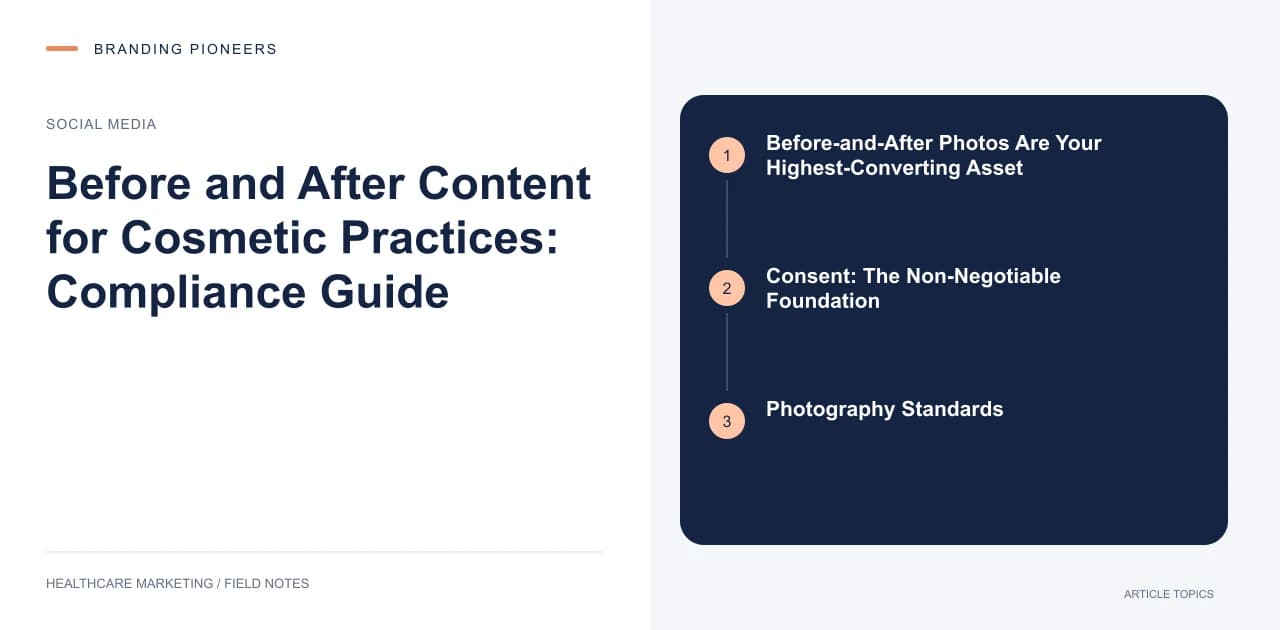
Before and After Content for Cosmetic Practices: Compliance Guide
Before-and-after photos are the most powerful marketing tool for cosmetic practices, but regulatory compliance is non-negotiable. Here is how to do it right.
For cosmetic surgery practices, medspas, and aesthetic dermatology clinics, before-and-after (B&A) photos are not just marketing content — they are the primary decision-making tool for prospective patients. When someone is considering rhinoplasty, Botox, or laser skin resurfacing, they want to see real results from real patients.
Practices with robust B&A galleries consistently report two to three times higher conversion rates on their service pages compared to pages with stock photos or text descriptions alone. On social media, B&A content generates five to eight times more engagement than other post types.
But B&A content in healthcare exists at the intersection of marketing and regulation. Getting compliance wrong can result in disciplinary action from medical boards, advertising violations, and patient lawsuits.
Every B&A photo requires a specific media consent form — separate from surgical consent and HIPAA authorization. The consent form must specify that photos will be used for marketing and advertising purposes, list every platform where photos may appear (website, social media, print materials, third-party sites), state whether the patient's face will be shown or obscured, include the patient's right to revoke consent at any time, and be signed before photos are taken.
Best practice: have patients review and sign the consent form at a pre-operative appointment, not on the day of treatment when they may feel rushed or anxious.
Inconsistent photography undermines credibility and can even create compliance issues if it appears that results are exaggerated through different lighting, angles, or editing.
Use the same camera, lens, and settings for before and after photos. Shoot in the same location with the same lighting setup. Use consistent patient positioning — same distance from camera, same angle, same expression.
Many practices build a dedicated photo station with fixed lighting and markings on the floor for patient positioning. This ensures every B&A pair is shot under identical conditions.
Take the "before" photo at the pre-operative or pre-treatment appointment. Take "after" photos at defined intervals — two weeks post for injectables, three months post for surgical procedures, and six to twelve months for final results.
Document the time elapsed between photos. "Three months post-rhinoplasty" gives context that makes the results meaningful.
Crop, color-correct for consistent white balance, and adjust exposure to match between photos. Nothing more. Do not retouch skin, adjust proportions, or apply filters. Digitally altered B&A photos are both ethically wrong and legally risky. Several state medical boards explicitly prohibit enhanced B&A photos.
Include a disclaimer near your gallery: "Results may vary. These photos represent individual outcomes and do not guarantee similar results." Link to or display the specific procedure, the patient's age and gender, and the time elapsed between photos.
These platforms have specific policies about B&A content. They prohibit content that implies negative self-perception — "Don't you wish you looked like this?" framing is not allowed. Present B&A content positively: celebrate the patient's result rather than criticizing the "before."
Use carousel posts to show the progression. Include the procedure name, time elapsed, and a results-may-vary disclaimer in the caption.
Video B&A content must follow the same consent and accuracy rules as photos. Do not use filters or effects that alter the appearance of results. Include verbal or on-screen disclaimers about individual variation.
Medical boards and advertising regulators specifically look for guaranteed outcomes language (never promise a specific result), cherry-picked results (showing only the best outcomes creates a misleading impression — show a representative range), misleading photography (different lighting, angles, or editing between before and after), missing context (failing to state the procedure, recovery time, or potential risks), and pressure or exploitation (using B&A content to create anxiety or body shame).
Create a standard operating procedure that your entire team follows. Train staff on proper consent processes. Invest in a simple but consistent photography setup. Store consent forms securely and linked to corresponding photos. Review your B&A content quarterly for compliance.
A strong B&A gallery built with proper consent, standardized photography, and honest representation is the most powerful marketing asset a cosmetic practice can own. It builds trust, demonstrates skill, and converts prospective patients — all within regulatory boundaries.
Nishu founded Branding Pioneers in 2016 with one rule that hasn't changed since: healthcare only. She'd run digital strategy at a top-10 Indian agency and watched generalist marketing underserve medical clients who needed something built for how patients actually search and decide. So she left to build the specialist instead. It's now an 80-person team working with healthcare brands worldwide.

Never run out of content ideas — a full year, mapped.
Senior strategist, no boilerplate. Reply within 4 hours.
Book audit → Or call us directlyThe post that does harm on 10 October is almost never the cynical one. It is the well-meaning one — a personal recovery …
A YouTube channel is the highest long-term ROI media asset a doctor can build. Here is how to build one from scratch, wh…
One wrong post can cost $50,000. But being too cautious means missing the most powerful marketing channel. Here is the c…
Six reasons hospitals, clinics, and doctors pick a healthcare-only firm over a generalist agency.
It's all we do. No retail, no fintech — the whole team thinks in patient journeys, clinical trust, and the way people actually choose a doctor.
Receptionists, WhatsApp triage, and attribution built in-house — we answer patients in seconds and tie every click to a booked appointment.
HIPAA-aware handling, ASCI-reviewed creative, and GDPR/DPDP sign-off on every campaign — our standard, not an upcharge or an afterthought.
The senior who pitched you stays on the engagement. No bait-and-switch to juniors learning on your budget.
Patient-level attribution across calls, forms, and walk-ins. Monthly reports show booked patients — not just clicks and impressions.
We name our clients and show the work. Quarterly reviews with the numbers attached, every cycle.
Adjacent practices, the relevant tools, and the case files where we shipped this thinking against real patient-acquisition targets.
Inside Healthcare Social Media
Read itInside Healthcare Social Media
Read itCommon issue in this segment
Read itLaunch service launch plan · 9 mo
Read itDoctor brand ivf growth programme · 6 mo
Read itHow many people see your posts without any ad spend behind them. On Instagram and Facebook that figure has sli…
Read itOf your followers, the share who actually interact — liking, commenting, sharing, or saving a post. Healthcare…
Read itLong-form playbook
Read itHigh-performing Instagram content for doctors: (1) Before/after transformations (with consent), (2) Quick educ…
Read itLocal SEO + media buying in Mumbai
Read itLocal SEO + media buying in Delhi
Read itbefore after content cosmetic practices compliance · Portfolio