Almost every Indian hospital with a diagnostic arm sells corporate health checkups, and almost all of them sell it the same way: a tiered package list, a per-employee price, and a PDF that arrives attached to a cold email.
The reason it converts poorly is not the price. It is that the document answers the wrong question. An HR head is not comparing test panels. They are trying to work out whether running this will cost them three weeks of their own time, whether the results will land them in a data problem, and whether anyone will actually turn up on the day.
Answer those three questions and the package list becomes a formality.
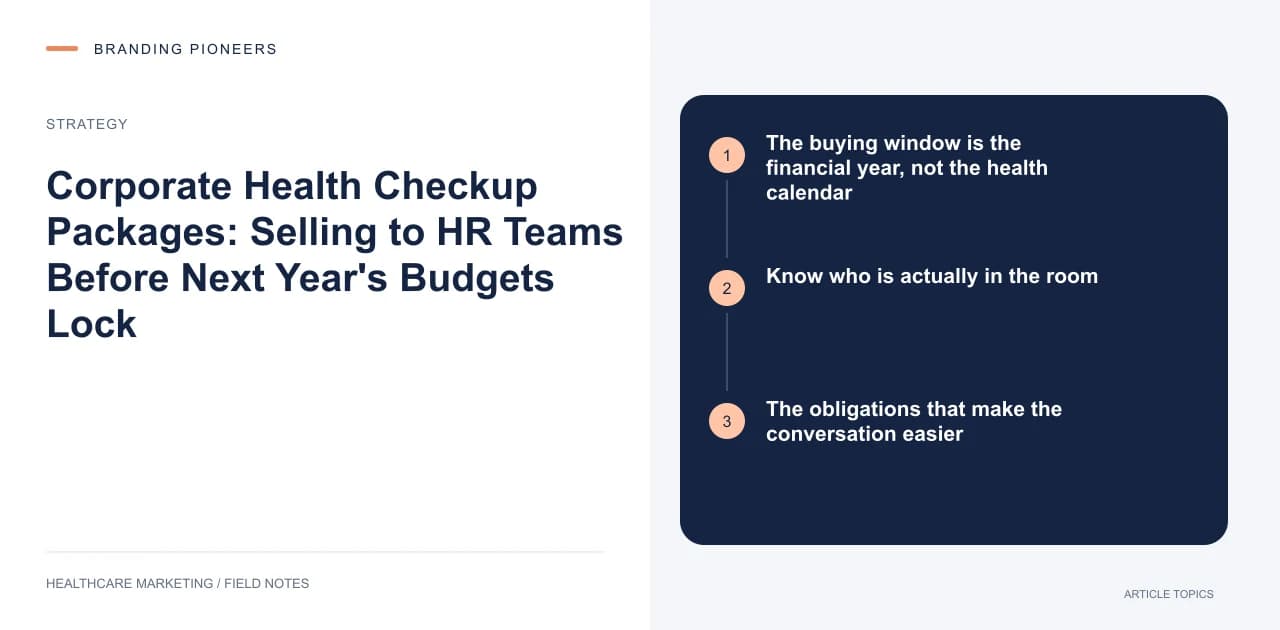
The buying window is the financial year, not the health calendar
Indian corporate budgets run April to March. Wellness and employee-benefit lines are argued through January and February and locked before the year turns.
Which means the pipeline work happens now, in the last quarter of the calendar year, for spending that gets committed in the first quarter of the next one. A hospital that starts its corporate outreach in April is selling into a budget that closed a month ago, and will be told to come back — twelve months later.
Two practical consequences. Your outreach calendar should peak in November through February. And the renewal conversation for an existing account has to start in January, before the client's own planning closes, not in the month the last camp expires.
Know who is actually in the room
Four people, usually, with different objections.
The HR or people lead owns the decision and worries about participation. If half the office skips it, they have spent the budget and gained nothing.
The admin or facilities lead owns the day. Rooms, queues, curtains, whether phlebotomy can happen without blocking the pantry.
Finance wants a per-head number that is comparable and a scope that will not expand halfway through.
In manufacturing and industrial clients, there is an EHS or safety officer whose interest is statutory rather than discretionary, and who is often the easiest person in the building to convince.
A proposal written for HR alone loses on logistics or on price. Write for all four.
The obligations that make the conversation easier
Some corporate health screening in India is not discretionary.
The Factories Act 1948 requires periodic medical examination of workers engaged in hazardous processes, with the detail sitting in the associated rules and the schedules of notified processes. The Occupational Safety, Health and Working Conditions Code 2020 consolidates several of these obligations and provides for free annual health examinations for specified classes of workers — it has been passed, and its commencement status should be checked before you quote it, because that has moved more than once. Employees covered by ESIC have their own entitlements that sit alongside, not instead of, an employer programme.
Use this accurately. Overstating a legal mandate to close a sale is the fastest way to lose the account at renewal, and any competent HR team will check. Stating it correctly is usually enough — a statutory requirement moves a decision from should we to who with.
Data handling is where the deal is won or lost
This is the part hospitals put in an annexure and HR reads first.
Under the Digital Personal Data Protection Act 2023 and the DPDP Rules 2025, enforced by the Data Protection Board of India, employee health results are personal data, and the employee is the person whose consent matters. The employer is not entitled to individual results simply because it paid for the test.
What a serious proposal states on its own page: that individual reports go to the employee, that the employer receives aggregate, de-identified reporting only, what the specific consent notice says and when it is presented, how long data is retained and what happens at the end, who the named contact is for a data question, and what the breach notification path looks like.
Put that in front of the HR head in the first meeting. It is the single strongest differentiator against a competitor who is discounting, because it is the risk that keeps the buyer awake.
What belongs in the package that is not a test
The test panel is table stakes and every competitor has the same one. The differentiators are operational.
Turnaround time for reports, stated as a commitment rather than an aspiration. Whether the camp is on-site, at the centre, or both, and how a hybrid is coordinated. A teleconsultation for anyone with an abnormal result, included rather than upsold. A defined escalation path for a critical value found at four in the afternoon. A portal or app the employee can actually log into months later. A report format HR can circulate without redacting it themselves. A named account manager with a phone number.
Accreditation matters here and is worth stating plainly — NABH for the hospital, NABL for the laboratory — because a procurement team will ask.
Lead with scope, not with a per-head number
The moment you open with a price per employee, you are in a spreadsheet next to three competitors and the only variable is the number.
Open with scope: headcount, sites, shifts, the split between office and plant, whether spouses are included, what happens for remote employees. The price follows from that, and by the time you state it the buyer understands what is inside it. Our pricing page sets out how we structure engagement ranges on the marketing side; the same logic applies to a health package — define the work, then the number.
How the pipeline actually gets built
A page that ranks. Corporate health checkup searches are commercial and local, and most hospital sites have a thin page or none. Build one that names the city, states the scope options, and asks for headcount and location in the form — those two fields let you qualify before the first call. This is the same demand-capture problem covered on the hospital lead generation pages.
LinkedIn, properly. HR is the one B2B audience that is genuinely and habitually on LinkedIn. Content written for HR — participation rates, data handling, what goes wrong on camp day — not patient content recycled.
Your existing panel. Your senior consultants already treat the decision-makers. That is not a database exercise; it is a conversation the medical director has, one at a time.
Insurance brokers and third-party administrators. They are already in the benefits conversation and they need a delivery partner. Structure the relationship so it is a referral, not a commission arrangement — professional-conduct rules on fee-splitting apply.
Industrial estates and associations. A single industrial association can carry twenty employers. One presentation, twenty conversations.
A quarterly HR breakfast. Small, in person, with a clinician presenting something genuinely useful. It converts better than a webinar and costs less than a stall at a conference.
The four objections, and what answers them
Participation will be low. Answer with mechanics, not promises: pre-registration by slot, shift-wise scheduling, an on-site option so nobody loses half a day, a reminder sequence, and a named coordinator who works the floor on the day. Offer to run a short pre-camp briefing.
This will eat my time. Answer with the runsheet. Show them the hour-by-hour plan, who from your side owns what, the equipment list, the room requirements, and the escalation number. An HR head who can see the day already planned stops treating it as a project.
We are worried about the data. Answer with the consent notice itself, not a reassurance. Show the actual wording an employee will see, the aggregate report format, and the retention period.
Your price is higher. Answer by putting the scope differences side by side — teleconsultation included or not, turnaround committed or not, accredited lab or not, on-site included or not. Most cheaper quotes are cheaper because something on that list is missing, and the buyer usually has not noticed which.
The proposal that wins is four pages
One page of scope. One page of logistics, including a camp-day runsheet and a worst-case plan. One page of data handling. One page of commercials.
Named single point of contact on the front. No stock photography of smiling models in lab coats. The corporate wellness solutions page sets out the shape we use.
After the camp is where the money is
Reports delivered on time, every time — this is the one operational failure that guarantees no renewal.
Abnormal-result follow-up, with consent, handled by a clinician rather than a call centre. This is also where a checkup programme becomes a patient pathway, and it is the part with the most commercial value and the most ethical care required: the follow-up must be clinically indicated, not a sales list. If it turns into an upsell, you lose the account and you should.
A January renewal reminder, timed to the client's budget cycle rather than to your contract end date.
Measure the pipeline, not the leads
Proposals issued and headcount quoted, not enquiries received. Camp-day attendance as a share of eligible employees, because that is what HR will be judged on internally. Report delivery against the stated turnaround. Renewal rate, which is the only number that tells you whether the programme works.
A hospital that tracks those four will find, usually, that it has been optimising the wrong end of the funnel for years.
---
If you want a view of where your corporate health pages sit and what your enquiry path is missing before budget season, get a free audit and we will send the findings whether or not you work with us. Or book a strategy call to build the B2B pipeline properly.
Filed undercorporate health checkup packagescorporate health checkupcorporate wellness marketingcorporate health screening

About the author
Nishu Sharma
Founder & CEO · Gurugram, India
Nishu founded Branding Pioneers in 2016 with one rule that hasn't changed since: healthcare only. She'd run digital strategy at a top-10 Indian agency and watched generalist marketing underserve medical clients who needed something built for how patients actually search and decide. So she left to build the specialist instead. It's now an 80-person team working with healthcare brands worldwide.
Free guide · 17 pages
The Patient Acquisition Blueprint
A 90-day plan from first search to booked appointment.