Strategy

Flu Shot Promotion Ideas for Clinics and Pharmacies

Flu vaccination is the one thing in healthcare with a hard expiry on demand. The marketing window closes when the season starts, not when the stock runs out — and most clinics start advertising a fortnight after the decision has been made.

NS
Founder & CEO · November 25, 2026 · 7 min read
FILE · FLU-SHOT
Flu Shot Promotion Ideas for Clinics and Pharmacies

Almost everything else a clinic markets can be sold late. A knee replacement booked in March instead of January is still a knee replacement. A flu shot given in January is a different product with a fraction of the value, and a lot of it goes in the bin.

That makes flu vaccination an unusually honest test of a marketing operation. There is no way to make up a slow October in December. Either the promotion ran before the decision window or it did not.

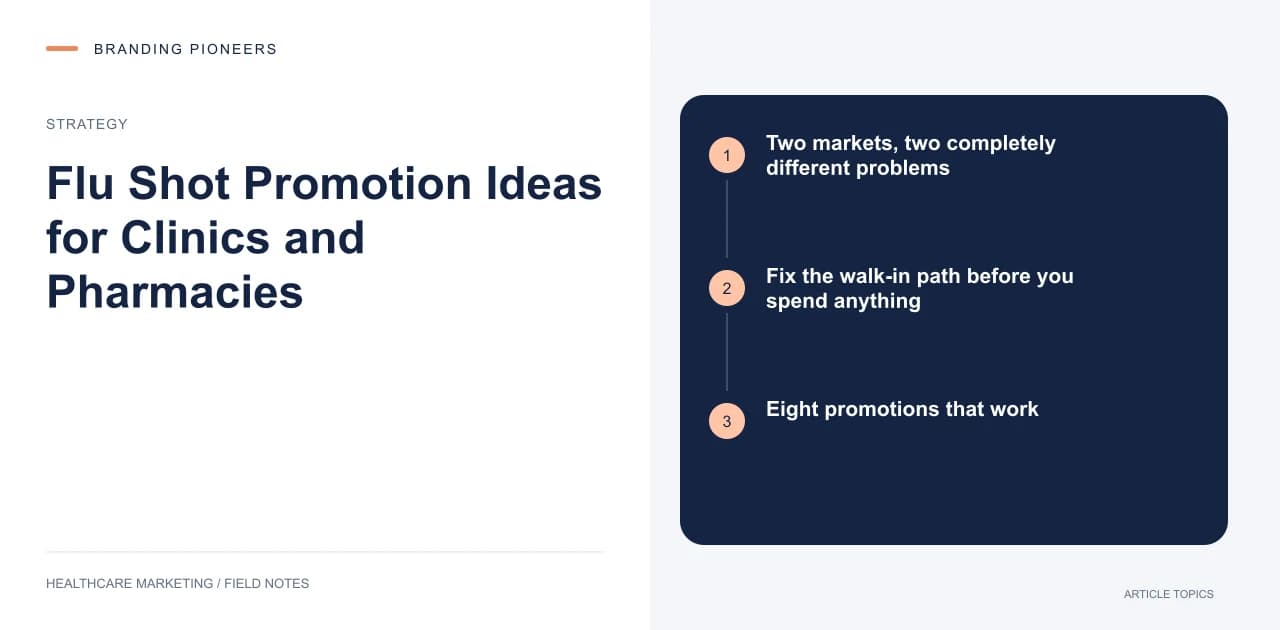
Two markets, two completely different problems

In the United States, the CDC recommends annual influenza vaccination for everyone six months and older, and advises being vaccinated by the end of October. Demand exists; the job is capture. Pharmacies administer under state scope-of-practice law and federal PREP Act declarations, which have been amended repeatedly — check the current declaration rather than a blog post about it. Most people already intend to get vaccinated somewhere, so the competition is over convenience, not persuasion.

In India, none of that holds. Influenza vaccination is largely out of pocket, the seasonality is different — peaks around the monsoon across much of the country and in winter in the north — and pharmacists do not administer vaccines the way they do in the US, so the shot happens at a clinic. Demand has to be created rather than harvested, which means education runs months before the offer.

A single campaign written for both markets will fail in both. Plan them separately.

Fix the walk-in path before you spend anything

The highest-yield change in a flu campaign is usually not the campaign.

Can a person standing on the pavement, or holding a phone, find out in under thirty seconds whether you have stock, whether they need an appointment, how long it will take and what it costs? If not, every rupee or dollar of promotion is pushing people into a question they will abandon.

Four things fix it: a page with stock status and a date on it, a Google Business Profile that names flu vaccination as a service with current hours, a booking link that works on a phone, and — where walk-ins are allowed — the word WALK-IN on the window in a size readable from a car.

The local SEO work behind this is unglamorous and it is what converts a seasonal campaign. The ads are downstream.

Eight promotions that work

1. The stock-status post, updated. A dated line saying vaccine is in, which formulation, and whether appointments are needed. Republish weekly through the season. It is the most-clicked seasonal post a clinic runs.

2. Employer on-site sessions. Sold in August and September in the US, and in India as a line inside a broader corporate wellness programme. One booked employer is worth a month of consumer advertising, and the conversation opens a B2B relationship that runs all year.

3. School and residents' association drives. In India, an RWA or apartment-society camp reaches families who would never book individually, and the society committee does the promotion for you. Bring the consent paperwork and the cold chain plan, not a banner.

4. The counter question. For pharmacies, the single most effective intervention is a trained staff member asking every eligible customer once, at the till. No media budget touches this.

5. Last season's list. People who were vaccinated last year are the easiest bookings of the season — if you captured consent at the time. In India that means a TRAI DLT-registered sender and clean consent under the DPDP Act 2023 and the DPDP Rules 2025. In the US it means TCPA compliance for anything to a mobile, and treating the list as PHI. Build the consent capture into the vaccination workflow this season so next season is easy. Our SMS automation work is mostly this: the reminder engine, not the blast.

6. Co-scheduling. Attach the flu shot to something already on the calendar — an annual health check, a diabetes follow-up, a paediatric visit, another due vaccine. The marginal cost of the conversation is zero and the uptake is far higher than a standalone campaign.

7. Four objections, four short videos. I got the flu from the shot. I never get the flu. It does not work. I will get it later. A clinician answering each in under a minute, with an honest acknowledgement that effectiveness varies by season. The honesty is what makes it persuasive.

8. The near-me page. A page targeting flu vaccination plus your locality, with hours, price and walk-in status, linked from the pharmacy pages or the vaccination clinic pages depending on who administers. This ranks year after year for a fortnight of very high intent.

In India, the campaign starts with the referral, not the consumer

Consumer demand for influenza vaccination in India is thin and does not respond well to being advertised at. What moves it is a doctor saying so.

Which means the marketing target for an Indian clinic is partly internal and partly professional. Internally: make sure every consultant in the building knows the vaccine is stocked, what it costs, and how to book it in the same visit. Most missed vaccinations in an Indian clinic are missed because the paediatrician or physician did not mention it, not because the patient refused.

Externally: general physicians, paediatricians, obstetricians and geriatricians in the catchment are the referral channel. A one-page note on availability, timing and price, sent before the season, does more than a social campaign. So does making it easy — a direct number, no queue, a walk-in slot.

The consumer-facing work then supports the recommendation rather than trying to replace it. Somebody told to get vaccinated will search for where. That is the moment your location page and your profile have to be right.

Pregnant women, older adults, people with diabetes or chronic respiratory disease, and healthcare workers are the groups where the recommendation is strongest and the conversation easiest. Segment the messaging accordingly instead of running one campaign at everybody.
What you cannot claim

No absolutes. A flu vaccine reduces risk; it does not guarantee that someone will not get influenza, and effectiveness varies from season to season depending on the match. Copy that promises protection is both wrong and a compliance problem.

In the US, the FTC polices health claims in advertising, and CDC materials are in the public domain, so the safest campaign assets are often the free ones.

In India, the Drugs and Magic Remedies (Objectionable Advertisements) Act 1954 and the ASCI code apply, and promotion of prescription products to the general public is restricted. Advertise the service and the appointment, not the product.

Neither market allows a fear campaign that overstates risk to a healthy adult. It also does not work; the people it frightens are the people who were already going to come.

Ad platform reality

Google's healthcare and medicines policy treats the promotion of a clinical service differently from the promotion of a medicine, and online pharmacies require certification in the countries where that is available. Meta's health and wellness restrictions limit targeting and constrain the event data you can send back from a booking page. Neither Google nor Meta signs a business associate agreement, so no patient-identifying data should reach them — which is a tracking constraint before it is a creative one.

Practical version: advertise the appointment, the location and the hours. Do not build audiences on inferred health status. Keep conversion tracking on the booking action, not on anything that identifies a person.

The pharmacy and clinic question

In the US the two compete for the same dose, and the clinic usually loses on convenience. The response is not to out-advertise a chain; it is to win the appointments where a conversation matters — paediatric schedules, pregnancy, chronic disease follow-up, older adults with several vaccines due — and to co-schedule rather than to campaign.

In India the relationship is the opposite: the pharmacy is a referral surface rather than a competitor, because administration happens at the clinic. A chemist who knows your clinic stocks the vaccine, knows the price, and has a card to hand over is a channel that costs nothing and runs all season.

Either way, the decision to make is which doses you are trying to win, not how loud the campaign is.

The asset you are really building

A flu campaign that ends when the stock runs out has produced nothing durable.

A flu campaign that ends with a consented, segmented list of everyone who was vaccinated, tagged by age band and site, has produced the next three seasons. That list also carries other work — pneumococcal and shingles vaccination in older adults, paediatric schedules, annual health checks — because the people on it have demonstrated that they act on preventive recommendations.

Make list capture a required field in the vaccination workflow, not an optional tick box that a busy nurse skips in November.

Measure the operation, not the campaign

Doses administered per clinic-hour tells you whether the bottleneck is demand or throughput. Walk-in share versus booked share tells you whether your booking path is helping or getting in the way. Reminder opt-in rate tells you whether next season starts warm. Cost per dose administered — calculated honestly, including staff time, and treated as illustrative rather than a benchmark — tells you whether the channel mix was right.

None of those numbers is available if your reporting stops at form fills, which is where most seasonal campaigns stop.

---

If you want a view of whether your vaccination pages, profile and booking path will hold up through a season, get a free audit and we will send the findings whether or not you work with us. Or book a strategy call to plan next season before the window opens.

FILED UNDERflu shot promotion ideasflu vaccine campaign ideasflu shot advertisement ideasvaccine awareness campaign ideas
Stop reading. Start ranking.
Get a free strategy audit — we'll show you exactly what's missing.
Book audit →
Author
Founder & CEO · Gurugram, India

Nishu founded Branding Pioneers in 2016 with one rule that hasn't changed since: healthcare only. She'd run digital strategy at a top-10 Indian agency and watched generalist marketing underserve medical clients who needed something built for how patients actually search and decide. So she left to build the specialist instead. It's now an 80-person team working with healthcare brands worldwide.

The Patient Acquisition Blueprint (2026 Edition) — guide cover
Free · 15 pages

The Patient Acquisition Blueprint (2026 Edition)

The exact 90-day patient-acquisition system, step by step.

We never share your details

FREE · 30 MIN
See your strategy opportunity gap.

Senior strategist, no boilerplate. Reply within 4 hours.

Book audit → Or call us directly
The Pioneers Brief · weekly
One essay. Three benchmarks. One teardown.
Subscribe — free
The Patient Acquisition Blueprint (2026 Edition) — guide cover
Free for strategy readers

The Patient Acquisition Blueprint (2026 Edition)

The exact 90-day patient-acquisition system, step by step.

  • The 90-day patient acquisition operating system
  • Channel-by-channel budget allocation (₹50L–₹5Cr/yr)
  • 12 real, named client engagements walked through
  • ROI tracking spreadsheet (CAC, LTV, payback)
15 pages · Used by 350+ healthcare clients · Updated for AI search

We never share your details

Continue reading

More on strategy.

BROWSE ALL →
From the studio

This thinking, applied.

Vizer — investor and go-to-market deck design system
Deck · Diagnostics
Vizer — investor and go-to-market deck
Meta Ads reach and delivery reporting
Meta Ads
Meta Ads — delivery and reach reporting
Doctor clients across specialties
Clients
Doctors we work with
Branding Pioneers on stage at a business awards night
Recognition
On stage at a business awards night
IVF clinic — brochure, standees, desk calendar and tent cards
Print · IVF
IVF clinic — brochure, standees and tent cards
Why choose us

Why healthcare brands choose us.

Six reasons hospitals, clinics, and doctors pick a healthcare-only firm over a generalist agency.

  • Healthcare-only

    It's all we do. No retail, no fintech — the whole team thinks in patient journeys, clinical trust, and the way people actually choose a doctor.

  • AI-first systems

    Receptionists, WhatsApp triage, and attribution built in-house — we answer patients in seconds and tie every click to a booked appointment.

  • Compliance built-in

    HIPAA-aware handling, ASCI-reviewed creative, and GDPR/DPDP sign-off on every campaign — our standard, not an upcharge or an afterthought.

  • Senior on every account

    The senior who pitched you stays on the engagement. No bait-and-switch to juniors learning on your budget.

  • Measured to the appointment

    Patient-level attribution across calls, forms, and walk-ins. Monthly reports show booked patients — not just clicks and impressions.

  • Receipts, not promises

    We name our clients and show the work. Quarterly reviews with the numbers attached, every cycle.

The Branding Pioneers healthcare-marketing team at work
Healthcare-only · since 2016
A team that does one thing well.
More from the brief

If this resonated, here’s what else lands.

Adjacent practices, the relevant tools, and the case files where we shipped this thinking against real patient-acquisition targets.

THE PIONEERS BRIEF · WEEKLY

One essay,
three benchmarks,
one teardown.

Healthcare growth, every Thursday morning. No hype, no fluff.