Hyderabad is the Indian metro where a single citywide marketing plan fails most visibly. The city contains at least two distinct patient markets — the historic core and the western technology corridor — separated by language, income profile, insurance status, and expectations about how healthcare should be accessed. A practice in Gachibowli and a practice in Malakpet are not competing in the same market even when they offer the same service.
Getting this right is mostly a matter of deciding honestly which market you serve, and then serving it properly.
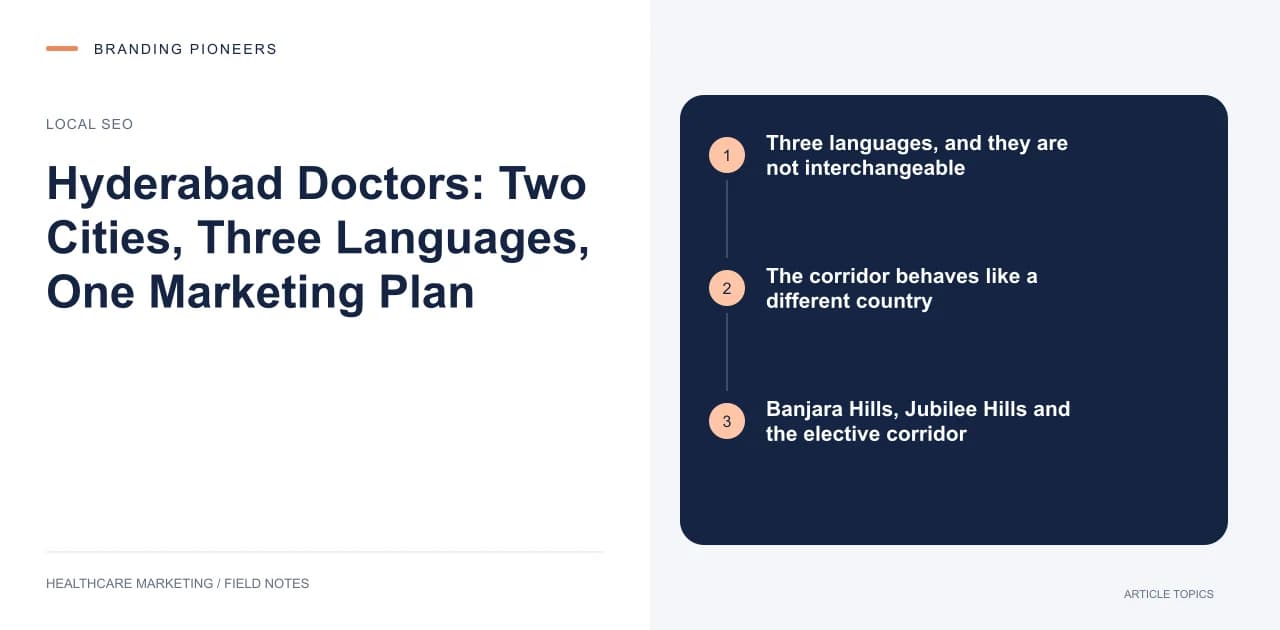
Three languages, and they are not interchangeable
Telugu, Urdu and English are all live search languages here, and the mix shifts geographically. Broad swathes of the city search primarily in Telugu — often transliterated into Roman script rather than in Telugu script. Significant communities in and around the old city search and consult in Urdu. The corridor from Madhapur through Gachibowli and Kondapur skews heavily English.
The implications are practical rather than abstract:
- Transliteration matters more than script. Most Telugu searching on mobile happens in Roman characters. Content that anticipates only formal Telugu script misses the majority of the demand.
- Voice search in Telugu is substantial and growing, particularly for symptom queries and among older patients whose children are searching on their behalf. Voice queries are conversational, so question-shaped content wins.
- YouTube is a primary health information channel in Telugu, not a secondary one. A clinician who explains conditions clearly in Telugu on video builds recognition that text content simply cannot match in this market.
- Urdu capability is a genuine differentiator for practices serving the old city, and it needs to extend to your front desk, not just your website.
The corridor behaves like a different country
The technology corridor — Madhapur, HITEC City, Gachibowli, Kondapur, Nanakramguda, Financial District — has a patient population that is young, employed by large corporates, comprehensively insured through employer group policies, mobile within India, and entirely comfortable booking online.
What that market rewards:
- Real-time online booking. Not a form that promises a callback — visible slots that can be taken immediately.
- Evening and weekend availability, because this population cannot attend during working hours.
- Teleconsultation as a standard option, particularly for follow-ups.
- Clarity about corporate insurance networks and cashless processing.
- Preventive and screening services, which this demographic actually buys.
There is also a genuine business-to-business channel that most clinics ignore: corporate health arrangements with the campuses themselves. Annual health checks, on-site camps, occupational health, and employee wellness programmes are a volume source that never appears in a search query, and they are won through relationships and credible proposals rather than advertising.
Banjara Hills, Jubilee Hills and the elective corridor
The stretch through Banjara Hills and Jubilee Hills concentrates aesthetics, dermatology, dentistry, fertility and elective surgery, and the competitive dynamics there differ again. Patients in this segment research heavily, compare practitioners rather than facilities, and are influenced strongly by the clinician's own visible expertise.
For a practitioner in these fields, personal brand does more work than clinic brand. That means a substantive profile page, consistent educational content in your own voice, and video where you actually appear. It does not mean testimonial marketing or transformation photography. Since 6 October 2026 the National Medical Commission's advertising guidelines bar doctors from requesting or sharing patient testimonials for promotion (Explanation V to para 3.2) and from posting before-and-after photos outside strictly educational, anonymised settings (para 8.1(v)), even with consent. In this segment they also read as low-trust signals to exactly the patients you want. Every post should instead carry your name, qualifications and State Medical Council registration number; our NMC guidelines hub covers the rest.