NewNMC’s advertising guidelines for doctors are in force from 6 Oct 2026. See what to change, and get a free compliance auditNew NMC advertising rules for doctors: what to change
Paid Ads

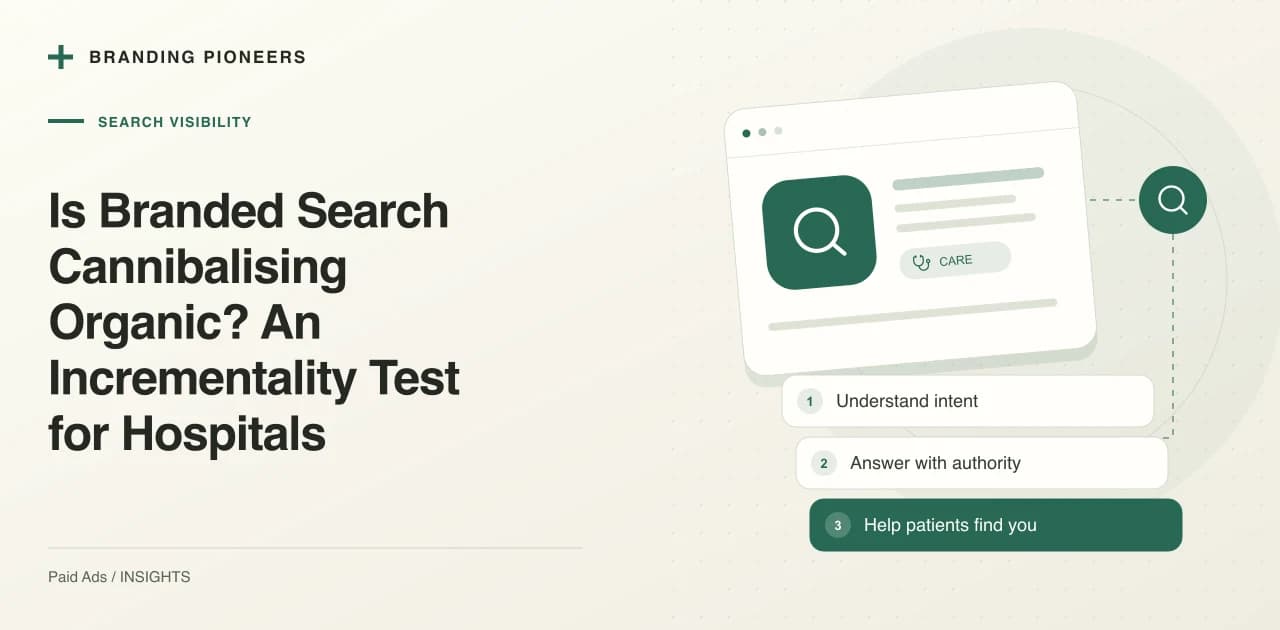
Is Branded Search Cannibalising Organic? An Incrementality Test for Hospitals

Branded search ads look cheap and convert well, but many of those patients would have clicked your organic result anyway. Here is how to run a pause test and read it with Search Console data.

Is Branded Search Cannibalising Organic? An Incrementality Test for Hospitals

This post is for hospital and clinic-chain marketing teams that run Google Ads on their own name and want to know whether that spend produces bookings or simply re-labels bookings that would have happened anyway. It is a method, not a result. We do not publish a benchmark here, because the right answer depends on your market, your competitors and how well your organic listing performs.

Branded campaigns are the easiest ones to defend. Cost per click is low, conversion rate is high, and the cost per enquiry looks excellent next to a generic "knee replacement" campaign. That is precisely the problem. A person who types a hospital's name into Google has already decided to consider it, and the ad is often the first of two links to the same website. The reporting credits the ad. The question is how many of those patients would have clicked the organic result, the Google Business Profile, or called the number in the knowledge panel if the ad had not been there.

If you manage a wider account, our Google Ads audit covers the rest of the structure. Here we deal with one question and one test.

What "incremental" means for a branded click

An incremental conversion is one that would not have happened without the ad. For branded search there are three outcomes when you remove the ad:

  • Recaptured. The patient clicks your organic result or profile instead. The booking happens; you saved the ad cost.
  • Lost. The patient does not find another route to you, or a competitor or aggregator ad takes the click. The booking is gone.
  • Shifted. The patient still reaches you, but through a slower or less trackable route, for instance by calling the main switchboard instead of a tracked landing page.

The ad's true value is the lost group. Its apparent value in last-click reporting is all three groups together. The gap between the two is what the test measures. This is the same logic behind any attribution question: the credit a report assigns is not the same as the contribution.

Why hospitals differ from other advertisers

Three features of healthcare search change the maths.

Competitors and aggregators bid on hospital names. Doctor-discovery platforms, other hospitals and lead-generation sites often bid on a hospital's name. If you pause, they may take the top of the page. Use the auction insights report on your brand campaign to see who is showing alongside you, and how often.

Brand queries include doctor and department names. Your brand term set is wider than the hospital name. "Dr [surname] cardiology Gurugram" is a branded query. So is a misspelling, a short form used by locals, and "[hospital] appointment". Decide the term list before the test, and keep it fixed.

The SERP is crowded with free assets. The map pack, the knowledge panel, sitelinks and the profile's call button all compete with the ad. If those assets are strong, recapture tends to be higher. If your listing is weak, the ad may be doing work that the organic result cannot.

Test designs, from simplest to most reliable

Option 1: Time-based pause

Pause the brand campaign for three to four weeks and compare with a matched pre-period. This is the easiest design and the weakest. Seasonality, a campaign launch, festival weeks or a news story can all move branded demand during the test. Use it when nothing else is feasible, and say so in the report.

Option 2: Geographic holdout

If you operate in several cities, pause brand ads in some and keep them running in others. Match the pairs on baseline branded demand and population type (for example, two similar tier-2 cities). Compare the change in total branded conversions in paused cities with the change in kept cities over the same weeks. This controls for time-based noise, because both groups experience the same calendar.

A single-site hospital can approximate this by splitting by pincode group where the ad platform allows location exclusions, but the groups are small and overlap through people who travel. Treat the result as directional.

Option 3: Partial pause

If stopping everything is too risky, split the brand term set. Pause the generic-brand terms (the hospital name alone) and keep the competitive ones. This answers a narrower question but it is a safer first step.

Whichever design you use, write the hypothesis, the term list, the duration, the paired locations and the success rule down before starting. The most common failure is to decide the rule after seeing the numbers.

What to measure

Count conversions across all routes, not only the ad's own:

  • Search Console: clicks and impressions for a saved brand filter. Create a query filter with a regular expression covering your hospital name, abbreviations, misspellings and doctor names, and check how clicks, impressions and position are defined in Google's performance report documentation. Search Console anonymises some rare queries, so the filtered total will undercount; use the same filter on both sides of the test and the bias cancels out.
  • Google Ads: brand campaign clicks, conversions and impression share before the pause.
  • Business Profile: calls, direction requests and website clicks from the profile insights.
  • Call tracking and CRM: total appointments requested, with source fields, including calls to the main number. If your CRM source field is poor, fix that first.
  • Direct and referral sessions in GA4, because some patients will switch to typing the URL.

The headline metric is total branded conversions across all routes. Ad-attributed conversions alone will fall to zero during the pause by definition and tell you nothing.
Want this applied to your practice? Get a free paid ads audit.

Book my free audit

A worked example (hypothetical numbers)

Take a hypothetical 200-bed hospital in Pune. These figures are invented to show the arithmetic, not to suggest a typical result.

  • In the four weeks before the pause, the brand campaign received 4,800 clicks and the saved Search Console brand filter showed 9,000 organic clicks. Total branded clicks: 13,800.
  • During four paused weeks, matched for calendar and with no other campaign changes, organic clicks rose to 12,600 and ad clicks were zero. Total branded clicks: 12,600.

Ad clicks removed: 4,800. Organic clicks gained: 3,600. Net branded clicks lost: 1,200.

The recapture rate is 3,600 divided by 4,800, which is three in four. One in four ad clicks was incremental. Now apply it to bookings: if the brand campaign was credited with 240 enquiries, roughly 60 were incremental on this simple assumption. If the campaign cost 1.2 lakh rupees, the cost per incremental enquiry is 2,000 rupees, not the 500 rupees that last-click reporting shows. That figure can be compared honestly with a generic campaign.

Two warnings on the example. First, click counts are a proxy for enquiries; check that conversion rates on organic and ad landing pages are similar before assuming the same ratio, because a dedicated ad landing page may convert better. Second, one test is one data point. Repeat it in a different quarter if the budget is large.

Check that the test was clean

Before you trust the number, answer five questions from your change log. Did any competitor start or stop bidding on your name during the window? Did the hospital run PR, a health camp or an offline campaign that lifted brand searches? Did your organic listing change, for example a new knowledge panel, a changed page title or a lost sitelink? Did the ad landing page differ from the organic page in a way that affects conversion? Did tracking change? If the answer to any is yes, either extend the test or note the contamination beside the result. A clean test with a modest answer is more useful than a dramatic one that nobody can reproduce.

How to read the result

Recapture rateWhat it suggestsTypical action
High, and no competitors in auction insightsOrganic and profile do most of the workCut brand budget sharply, keep a minimal exact-match campaign
High, but competitors appear when you pauseAd defends against conquestingKeep, but cap budget and bid, and watch the competitor
LowAd captures patients your organic result does notKeep, and look at why organic underperforms on branded queries
Mixed by city or service lineDifferent SERP conditionsMake the decision per city or service line

Do not apply the result to non-brand campaigns. A person searching "bariatric surgeon near me" has no prior relationship with you, and the incremental share there will usually be a different story.

Guard rails specific to healthcare

  • Never pause emergency-intent terms. Queries such as "[hospital] emergency number" or "[hospital] ambulance" should stay covered by ads, a call extension and a clean profile, whatever the test says. A lost click here is not a marketing statistic.
  • Keep policies in mind. Google's healthcare and medicines advertising rules apply to the keywords and ad text you keep running, and an unrelated disapproval during the test will contaminate it.
  • Log everything. Record every change to ads, landing pages, profiles, press activity and offline campaigns during the test window.
  • Protect patient data. Do not export call recordings or appointment details into the analysis. Aggregate counts are enough.

Where to start

  1. List the brand terms, including doctor names and misspellings, and save the Search Console filter.
  2. Pull auction insights for the last 90 days and note who bids on your name.
  3. Choose the design (geographic holdout if you have several cities, otherwise a time-based pause with a matched pre-period).
  4. Write the hypothesis and decision rule before the pause.
  5. Run it for three to four weeks, then calculate recapture rate and cost per incremental enquiry.
  6. Re-invest any saved budget into generic and condition-level campaigns, and report both numbers to leadership.

For the broader setup, see our Google Ads guide for healthcare, and check for overlap between paid and organic pages with the keyword cannibalisation definition.

Filed underbrand search incrementalitybranded search ads hospitalpause branded campaign testbranded keywords cannibalisationGoogle Ads brand campaign organic overlaphospital branded search

About the author

Co-Founder & CTO · Gurugram, India

Arush builds the systems the rest of the company runs on — the patient-acquisition pipelines, the AI chatbots, the analytics that tie a single click to a booked appointment. If a campaign reports a number, it's because something his team built is tracking it.

Free guide · 17 pages

The Patient Acquisition Blueprint

A 90-day plan from first search to booked appointment.

The Pioneers Brief — one essay, three benchmarks, one teardown, every Thursday. Subscribe free →

Free paid ads audit

Your next chapter starts with a conversation.

Three quick questions. We come prepared with a plan for your specialty and city.

  • A 30-minute call with a healthcare specialist
  • Your top three growth opportunities, in writing
  • Honest advice — even if that means not hiring us
  • No obligation and no hard sell
You’ll speak with a senior strategist
Consultations are hosted by Arush Thapar’s team.
Step 1 of 3Takes 30 seconds

What do you want to improve first?

Details stay privateNo obligationReply within 1 working day

Client portfolio · SEO & search visibility

Work relevant to is branded search cannibalising organic an incrementality test.

Explore client work →