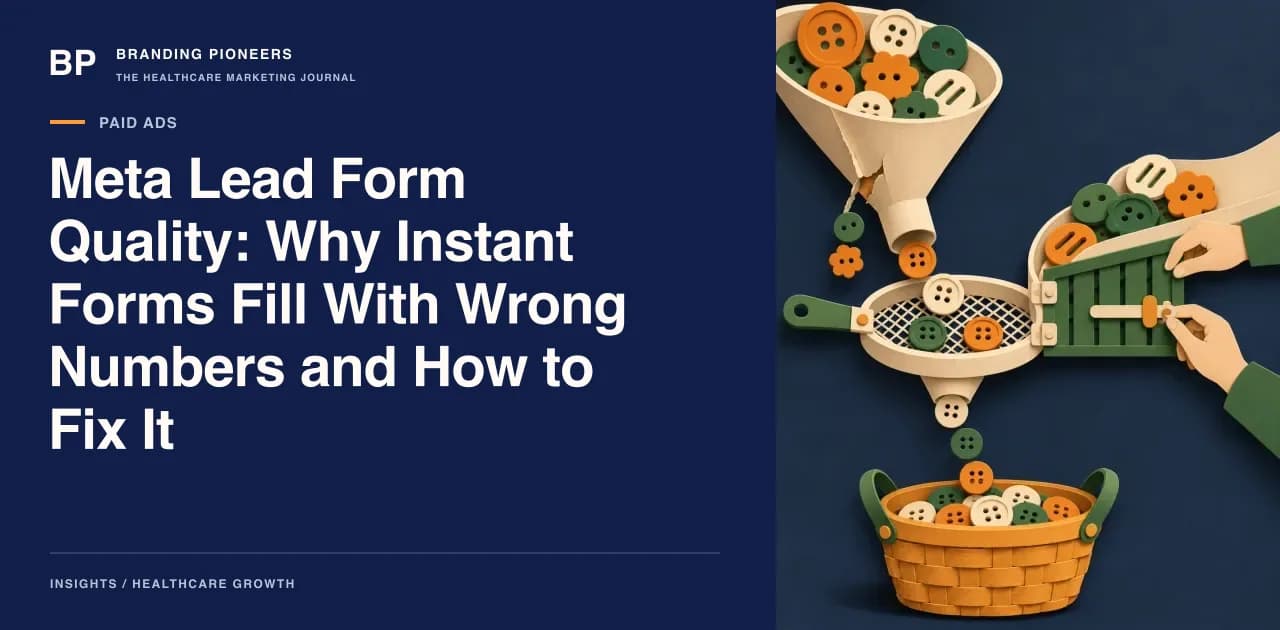
This piece is for clinic owners and marketing coordinators who run Meta lead ads and are tired of calling numbers that do not exist, belong to someone else, or ring out. It explains why instant forms collect poor contact details and what to change in the form, the follow-up process and the feedback you give back to Meta.
An instant form is built for speed. Meta pre-fills the fields from the person's profile, the form opens inside the app, and submission takes two taps. That speed is the point, and it is also the problem. If it takes two taps to submit, it takes two taps to submit by accident, by curiosity, or with an old number attached to the profile.
Before changing anything, measure the problem. The target is not a lower cost per lead. It is a higher share of leads that answer a call, confirm interest and book. We cannot publish our own validity figures here, so the method below is what you run on your own account.
Why the numbers are wrong
There are four common causes, and they need different fixes.
- Stale pre-filled data. Pre-filled fields come from the profile. Many people have an old or secondary number there, and they submit without checking.
- Accidental or low-effort submission. A person who taps through to see what happens leaves a number they never intended to share.
- Wrong intent. The ad promised something vague, such as a free consultation, and the person wanted information, not an appointment.
- Bad handling after submission. The number is fine, but the first call comes hours later, from an unknown number, and goes unanswered. The lead looks invalid when the process failed.
Separate these before you edit the form. Take thirty recent leads, call each from the number the clinic normally uses, and tag the outcome: wrong number, no answer, answered but uninterested, answered and interested. That small sample will tell you whether the issue is data quality or follow-up.
Choose the form type deliberately
Meta's instant form types offer more volume, higher intent and rich creative. The higher intent type adds a review step where the person checks the details they are submitting before it sends, which gives them a chance to correct a pre-filled number. Meta's page on lead ads with instant forms covers the wider feature set.
For appointment-led clinics, higher intent is usually the better starting point. You will see fewer submissions, and you should judge the form by booked consultations, not by lead count. Run it as a controlled comparison against the volume type with the same creative and budget before deciding.
Design the form to filter, not just collect
A good clinic form asks for the minimum contact details and one or two questions that separate a ready patient from a browser.
- Name and phone first. Put phone ahead of email. For clinics in India, a mobile number is the channel that gets used.
- One qualifying question with fixed options. For example: "When are you looking to be seen?" with options such as this week, this month, just exploring. That tells the front desk who to call first.
- A location or preferred branch question for multi-site providers, so the call goes to the right team.
- No clinical questions. Do not ask about symptoms, diagnoses or medical history in an ad form. It collects more sensitive data than you need, it creates a compliance burden, and it sits uneasily with Meta's rules on health information. Take that history during the consultation, under the provider's own processes.
- A short, honest intro and a privacy link. Say what happens next: "The clinic team will call you within the working day to arrange an appointment." Include your privacy policy, and have your adviser review how it describes use of the data under the DPDP Act.
Ask the clinical lead to review any question that touches on a condition before it goes live.
Make the ad promise match the form
Many poor leads are created upstream of the form. An ad that says "Free consultation" attracts people who want something for free. An ad that names the service, the location and what the first visit involves attracts people who are ready for that.
Write the ad and the form together. If the ad shows a doctor at a named location, the form should confirm that location. Any claim must stay within advertising rules for your market; the Indian provider's advertising obligations apply to the ad copy and the form intro alike.
Fix the process after submission
The fastest improvement in lead quality is often not in the form at all.
- Respond within minutes. Someone who submitted a form is at their most engaged immediately afterward. A same-hour call or message beats a next-morning call.
- Use a recognisable sender. Call from a number the clinic publishes, and send a short message first saying the call is coming.
- Two attempts, then a message. If the first call fails, send a message with a booking link and try again later in the day.
- Record the outcome in one place. Without a recorded outcome you cannot improve anything. The CRM should store the lead source, the first-contact time, and the final status. Pioneer CRM is one place to hold enquiries, ownership, follow-ups and pipeline visibility if you do not have one yet.
Our related piece on accessible clinic appointment forms covers how to make the booking step itself easier to complete, which also reduces mistakes in contact details on your own website forms.