A specialist in Jaipur, Indore, Coimbatore, Lucknow, Nagpur, Bhopal, Kochi or Vizag operates in a market that is structurally easier to win than any metro — and most do not realise it, because they benchmark themselves against metro playbooks that do not apply.
The advantages are real: far less competition for search visibility, cheaper paid attention, a catchment radius several times larger than a metro clinic's, and a baseline of local clinic websites so poor that a competent one stands out immediately. The catch is that patient behaviour differs enough that metro tactics under-perform badly.
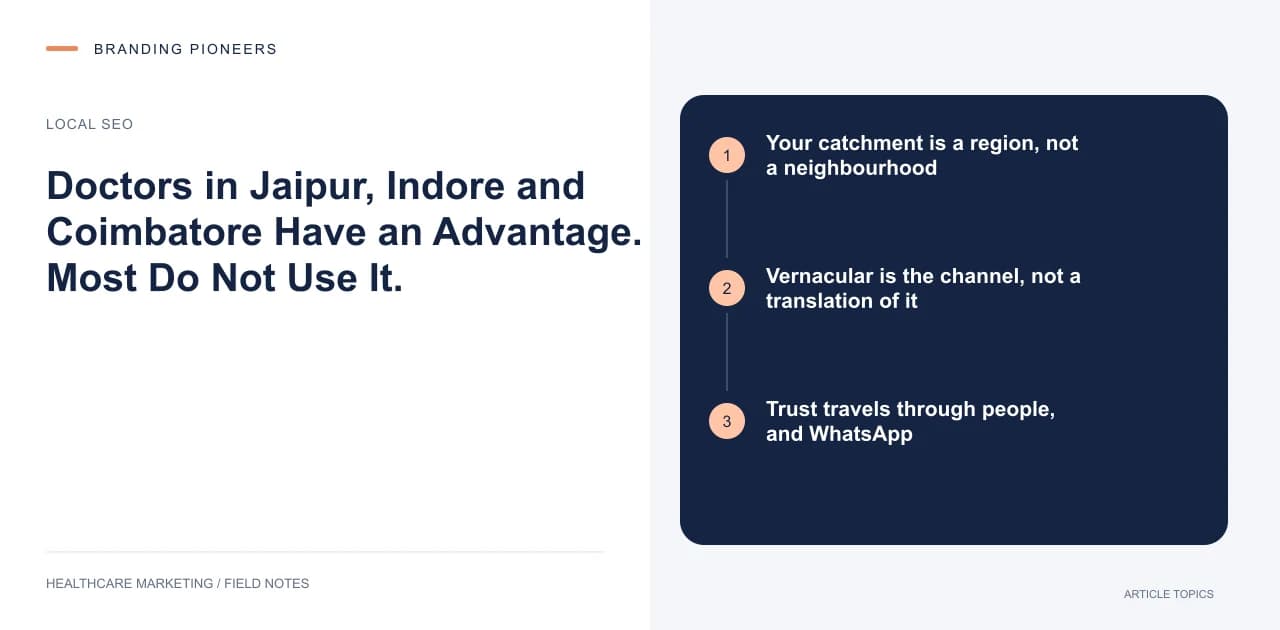
Your catchment is a region, not a neighbourhood
This is the biggest single difference. A metro clinic serves a few kilometres. A tier-2 specialist serves the city plus the surrounding districts, and patients will travel a hundred kilometres or more for a specialist opinion they cannot get closer to home.
That reframes everything. You are not competing with the clinic down the road — you are the destination for a whole catchment of smaller towns that have no local specialist at all. Your content should speak to that patient: someone deciding whether the journey is worth making, who wants to know whether everything can be done in one visit, whether the scans can be done the same day, and what the whole thing will cost.
Practices that publish this — one-visit pathways, same-day diagnostics, realistic total costs, and clear guidance on what to bring — convert district patients that competitors never even see.
Vernacular is the channel, not a translation of it
Search in these markets happens overwhelmingly in the local language, and increasingly by voice. Hindi in Jaipur, Indore, Lucknow and Bhopal; Marathi in Nagpur; Tamil in Coimbatore; Malayalam in Kochi; Telugu in Vizag — and in every one of those, mostly transliterated into Roman script rather than typed in native script.
Two consequences most agencies miss:
Voice queries are conversational and question-shaped. Someone asks their phone what causes a symptom, or whether a condition needs an operation. Content organised around real questions in the patient's own phrasing gets surfaced; keyword-stuffed service pages do not.
Video does more work than text. YouTube is a primary health information source in vernacular languages, not a supplementary one. A clinician who explains common conditions plainly, in the local language, on camera, builds a level of recognition that no amount of text content will match — and the production bar is low. A phone, decent light, and five honest minutes beats a polished corporate video.
Trust travels through people, and WhatsApp
Referral and word of mouth carry more weight here than in metros, and they mostly move through WhatsApp. Family groups share doctor recommendations, forward clinic details, and pass around a photo of a prescription for a second view.
That has direct implications:
- WhatsApp should be your primary enquiry channel, not a footer icon. Web forms consistently under-perform in these markets; a number people can message converts far better.
- Make your details forwardable. A clean, mobile-first page that loads fast on a modest connection, with the address, timings and number immediately visible, is what gets shared. A heavy site with a popup does not.
- Missed-call and callback flows still work, particularly for older patients and for patients from surrounding districts.
- Your digital presence mostly validates referrals rather than creating demand. A patient given your name searches it before travelling. What they find either confirms the recommendation or quietly kills it.
Google Business Profile is most of the job
In a metro, a complete Business Profile is table stakes. In a tier-2 city it is frequently decisive, because so many competitors have an unclaimed listing, wrong hours, no photographs, or an address that does not resolve.
Do this properly and you have done the majority of the work:
- Claim and verify the listing. Correct primary category — this matters more than practices realise.
- Accurate hours, including the split shifts most practices here run, and holiday closures.
- Real photographs: the building from the road, the entrance, the waiting area, the parking.
- Directions written the way locals actually give them, by landmark.
- A steady flow of genuine reviews in the local language, replied to briefly and factually, never confirming that anyone was a patient.