NewNMC’s advertising guidelines for doctors are in force from 6 Oct 2026. See what to change, and get a free compliance auditNew NMC advertising rules for doctors: what to change
AI & Automation

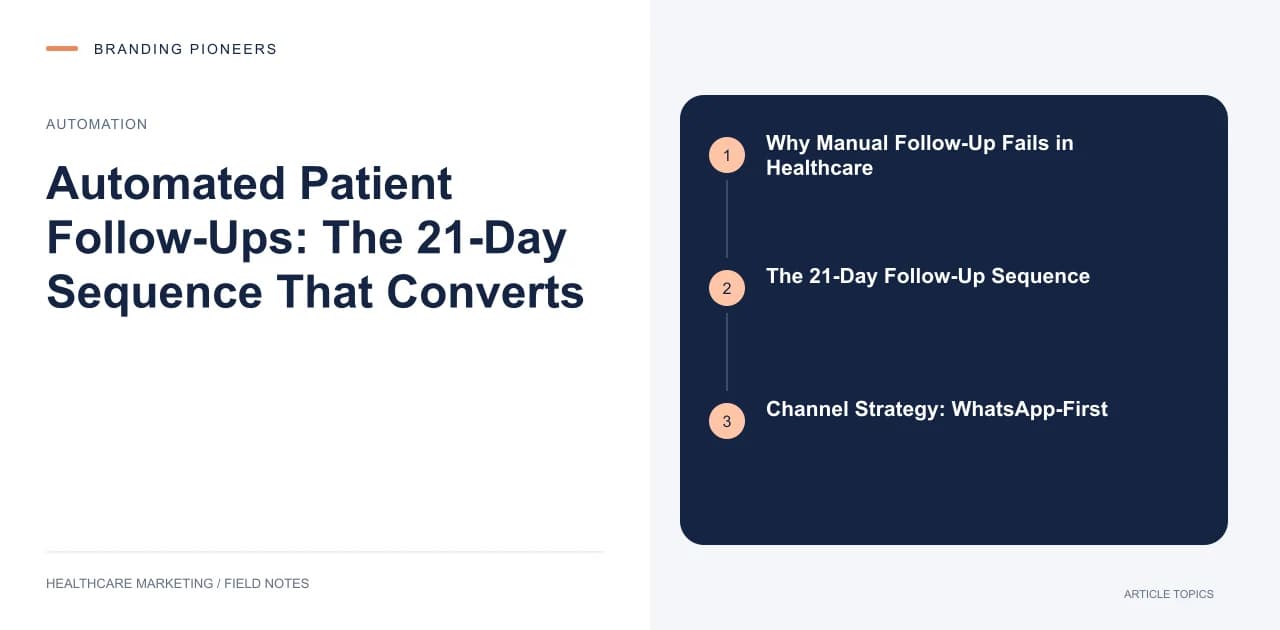
Automated Patient Follow-Ups: The 21-Day Sequence That Converts

Most healthcare leads require 3 to 7 touchpoints before booking. Manual follow-up fails at scale. Here is the automated 21-day sequence that converts cold inquiries into confirmed appointments.

Automated Patient Follow-Ups: The 21-Day Sequence That Converts

Why Manual Follow-Up Fails in Healthcare

Your front desk receives 20 new inquiries today. They respond to each one, then move on to tomorrow's 20 inquiries. By day three, yesterday's leads are forgotten. By day seven, the leads from a week ago have already booked with a competitor.

Many healthcare leads need several follow-up touchpoints before they book, yet the average practice follows up exactly once. This gap represents one of the biggest revenue leaks in healthcare marketing — you have already paid to acquire the lead, but you lose the patient through inadequate follow-up.

Automation solves this by removing human memory and discipline from the equation. Once a lead enters your system, a pre-built sequence delivers the right message at the right time through the right channel, every single time, without anyone on your team remembering to do it.

The 21-Day Follow-Up Sequence

In practice, a sequence like this consistently converts a meaningful share of unbooked leads into appointments. Adjust the specific messaging for your specialty, but follow the timing and channel strategy closely.

Day 0, Hour 0 (Immediate): Acknowledgment. Channel: WhatsApp + SMS. Message: Thank the patient for their inquiry, confirm what they asked about, and offer a specific next step. "Thank you for inquiring about a cardiology consultation with Dr. Sharma. We have appointments available this week. Would you like to book for [date] at [time]?"

This message must go out within 5 minutes of the inquiry. Automated triggers in your CRM handle this instantly.

Day 0, Hour 4: Value follow-up. Channel: WhatsApp. Message: Send a brief piece of relevant content — a 2-minute video about your doctor, a link to a relevant FAQ page, or a quick guide about what to expect during the consultation. This positions you as helpful rather than pushy.

Day 1: Direct call attempt. Channel: Phone call from your team. This is the one human touchpoint in the early sequence. Your patient coordinator calls the lead with context from the chatbot or form submission. If no answer, leave a voicemail and move to the next step.

Day 2: Social proof message. Channel: WhatsApp. Message: Share a patient testimonial or review relevant to the service the lead inquired about. (Check local rules first: in India, NMC's 2026 guidelines bar doctors from requesting or sharing patient testimonials, even with consent — see our NMC guide; in Australia, AHPRA bans testimonials about clinical aspects.) "Here is what a recent patient shared about their experience with Dr. Sharma: [testimonial quote]. Would you like to schedule a consultation?"

Day 4: Overcome objection. Channel: SMS or Email. Message: Address the most common reason patients delay booking for your specialty. For elective procedures: "Many patients worry about taking time off work for recovery. Most of our knee replacement patients return to desk work within 2 weeks. Happy to answer any questions about timing."

Day 7: Availability nudge. Channel: WhatsApp. Message: Create gentle urgency around availability. "Dr. Sharma has 3 consultation slots remaining this week. Would you like me to hold one for you?" Do not fabricate scarcity — use actual availability data.

Day 10: Educational content. Channel: Email. Message: Send a comprehensive, non-promotional article or guide about the condition or treatment the patient inquired about. Position this as a resource: "I thought you might find this guide helpful as you consider your options for [treatment]."

Day 14: Direct check-in. Channel: WhatsApp. Message: Simple, personal check-in. "Hi [name], I wanted to check in — are you still considering a consultation about [concern]? Happy to help with any questions or scheduling."

Day 21: Long-term nurture entry. Channel: Email. Message: If the lead has not converted, transition them to a monthly newsletter or content sequence. "We will send you occasional updates about [specialty] health topics. Feel free to reach out anytime when you are ready to book."
Want this applied to your practice? Get a free ai & automation audit.

Book my free audit

Channel Strategy: WhatsApp-First

In markets like India and the Middle East, WhatsApp generates 3 to 5 times higher response rates than email and 2 times higher than SMS. Make WhatsApp your primary follow-up channel, with SMS as backup for patients who are not on WhatsApp, and email for longer-form content.

Use WhatsApp Business API (not the personal WhatsApp Business app) for automated sequences. The API supports template messages, automated triggers, and CRM integration. Popular platforms for healthcare WhatsApp automation include WATI, AiSensy, and Interakt.

Setting Up the Automation

The technical implementation requires three components: a CRM system (HubSpot, GoHighLevel, or Salesforce), a WhatsApp Business API provider, and integration between your website forms/chatbot and the CRM.

When a lead submits an inquiry, the CRM creates a contact, assigns a lead score, and enrolls the contact in the appropriate follow-up sequence based on their inquiry type. Messages are sent automatically on the schedule defined above. If the patient responds at any point, the automation pauses and a human takes over.

The "pause on reply" behavior is critical. Nothing destroys patient trust faster than receiving an automated message after they have already engaged in a real conversation with your team.

Measuring Sequence Performance

Track these metrics for each step in the sequence: delivery rate, open rate, response rate, and conversion rate (lead to appointment). Identify the steps with the highest drop-off and optimize those first.

Common findings: Day 0 immediate acknowledgment alone converts 15 to 20 percent of leads. The social proof message on Day 2 typically generates the highest response rate. The Day 7 availability nudge produces the most bookings after the initial response. Steps beyond Day 14 have low individual conversion rates but cumulatively recover 5 to 8 percent of leads that would otherwise be lost.

A well-optimized 21-day sequence recovers 25 to 35 percent of leads that would have been lost to manual follow-up failure. For a practice spending 2 lakhs per month on marketing and generating 100 leads, that represents 25 to 35 additional patients per month at zero incremental acquisition cost.

Filed underautomated patient follow-uphealthcare lead nurturingmedical practice automationpatient follow-up sequence

About the author

Co-Founder & CTO · Gurugram, India

Arush builds the systems the rest of the company runs on — the patient-acquisition pipelines, the AI chatbots, the analytics that tie a single click to a booked appointment. If a campaign reports a number, it's because something his team built is tracking it.

Free guide · 17 pages

The Patient Acquisition Blueprint

A 90-day plan from first search to booked appointment.

The Pioneers Brief — one essay, three benchmarks, one teardown, every Thursday. Subscribe free →

Related guide: Healthcare AI & Automation: Complete Guide

Free ai & automation audit

Your next chapter starts with a conversation.

Three quick questions. We come prepared with a plan for your specialty and city.

  • A 30-minute call with a healthcare specialist
  • Your top three growth opportunities, in writing
  • Honest advice — even if that means not hiring us
  • No obligation and no hard sell
You’ll speak with a senior strategist
Consultations are hosted by Arush Thapar’s team.
Step 1 of 3Takes 30 seconds

What do you want to improve first?

Details stay privateNo obligationReply within 1 working day

Client portfolio · Healthcare websites

Work relevant to automated patient follow up sequences.

Explore client work →