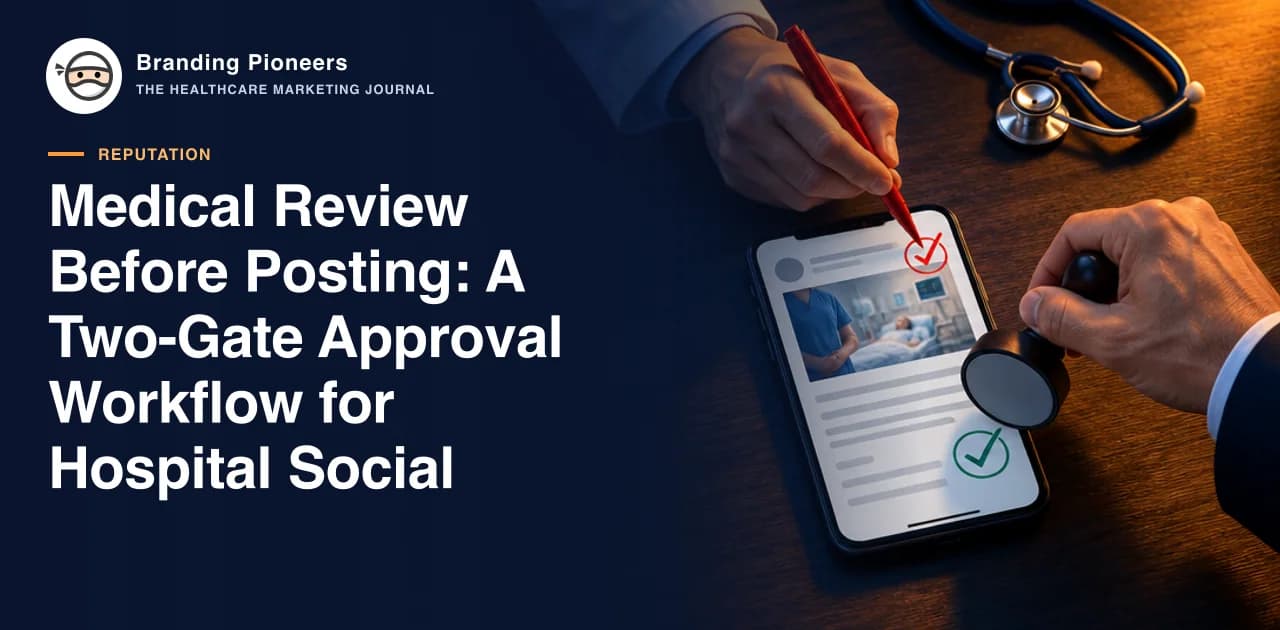
This article is for hospital marketing teams, and for the compliance and clinical leads who sign off their work. You probably already have an approval step. The question is whether it catches the two different kinds of error that hospital social content produces, and whether it is fast enough that the team does not route around it.
A post can be clinically wrong and perfectly compliant. It can also be clinically correct and still breach advertising rules. One reviewer, asked to check both in a hurry, tends to check whichever is more familiar to them. The two-gate workflow below separates the questions, gives each gate a turnaround limit, and records the outcome so you can learn from it.
It assumes you already have a content calendar. If not, start with the monthly social media calendar guide, then come back. For the wider strategy, the complete healthcare social media strategy covers channels and formats. This piece covers only what happens between draft and publish.
Why the stakes went up in October 2026
On 6 October 2026 the NMC's Ethics and Medical Registration Board issued its Guidelines on Ethical Advertising and Public Communication. According to Medical Dialogues' report they took effect immediately and cover registered practitioners, hospitals and medical institutions, and platforms that host practitioners.
Two points in that reporting bear directly on workflow design. First, content published through agencies, influencers or other third parties does not absolve a practitioner or institution that authorised, sponsored or knowingly permitted it. An approval trail is how you show you took the responsibility seriously. Second, penalties are graded and require a show-cause notice before an order, so being able to produce your record quickly matters.
Separately, the ASCI Code expects claims about objectively ascertainable facts to be capable of substantiation, and expects advertisers to produce that substantiation when ASCI asks. It also says that where a claim rests on independent research, the source and date should be shown. Your workflow needs somewhere to hold both.
Read the primary texts with your compliance lead. This article describes a process, not a legal opinion.
The two gates
Gate 1: clinical accuracy
Reviewer: a clinician in the relevant department, named in advance. Not the marketing manager, and not whoever happens to be on the ward.
Question it answers: is what this post says about health true, current, and safe to say to a general audience?
What the reviewer checks:
- Every clinical statement against the cited source, or against the department's current practice for statements that do not need a citation.
- Whether the post could be read as individual advice.
- Whether anything could lead a reader with an urgent symptom to wait instead of seeking care. If the topic touches an emergency, the post should include the hospital's approved emergency wording, not text written by marketing.
- Whether the framing is appropriate for the intended audience.
What the reviewer does not check: advertising rules, tone, brand, design. If you ask a consultant to approve a graphic's colour scheme, you are spending their goodwill.
Gate 2: compliance
Reviewer: a compliance owner or a trained marketing lead who has read the NMC notice, the ASCI Code and your hospital's own policy.
Question it answers: is this content permitted to be published by this institution, in this form, to this audience?
What the reviewer checks:
- Superlatives and comparisons ("best", "No.1", "most advanced") and any ranking or award claim that cannot be verified.
- Testimonials, patient stories, before-and-after images and any patient-identifying detail. Under the reported guidelines, identifiable details must be cropped, blurred or removed, and patient consent does not make a prohibited testimonial permissible.
- Outcome language. Anything that sounds like a guarantee or a promise of results.
- Whether a named doctor is being promoted by the hospital page in a way that the hospital's own policy does not allow.
- AI-generated content. The reported rules do not permit promotional AI-generated content, and permitted AI-generated material must be marked.
- Consent and data handling for any person visible in the frame. For the underlying data law, see our DPDP Act guide for healthcare marketing.
- For posts that cross borders, the target market's rules. UAE content, for example, follows a different regime from India; the UAE compliance guide is the place to start.
Order matters. Gate 1 comes first. There is no point spending compliance time on a post that clinicians will rewrite.
The claim register: one line per claim
Both gates are faster if every statistic, source and clinical claim in a draft is logged once and reused. The register does not have to be elaborate. A spreadsheet with these columns is enough to begin:
| Column | Example (hypothetical) |
|---|---|
| Claim ID | C-0142 |
| Claim text, exactly as published | "Knee replacement recovery varies from person to person" |
| Source and link | Department protocol v3 / published guideline |
| Source date | 2026-03 |
| Gate 1 reviewer and date | Dr A, 2026-11-03 |
| Gate 2 reviewer and date | Compliance, 2026-11-03 |
| Review-by date | 2027-05-03 |
| Used in | Post P-0388 |
A post that reuses an approved claim and has not changed its wording can skip a full Gate 1 pass. The reviewer only confirms that the claim is still current. This is where the time saving comes from.
Turnaround limits
A review process that takes a week gets bypassed. Set limits, publish them to the team, and escalate when they are missed. These are illustrative starting points, not benchmarks:
| Item | Gate 1 limit | Gate 2 limit |
|---|---|---|
| Routine post using already-approved claims | Same working day | Same working day |
| New clinical content | 2 working days | 1 working day |
| Video or Reel | 2 working days, with script approved before shooting | 1 working day on script, 1 on final cut |
| Anything involving a patient, a named doctor or a complaint | 2 working days | Same-day priority, with the compliance owner involved |
| Urgent response (public health event, crisis) | 2 hours by phone with a named delegate | 2 hours |
Two rules keep this honest. If a reviewer misses a limit, the post does not go out by default; it escalates to the department head or the compliance lead. And every reviewer has a named delegate for leave, so a holiday does not stall the calendar.