Bangalore's patient population behaves differently from any other Indian metro, and the difference is not subtle. Patients arrive at the first consultation having read your profile, compared you against two or three alternatives, read the reviews carefully rather than glancing at the star rating, and formed a view on whether your clinic is worth the commute. By the time they book, most of the decision is already made.
That reorders what matters. The marketing question in Bangalore is rarely "how do we create demand" — it is "why are we losing comparisons we should win".
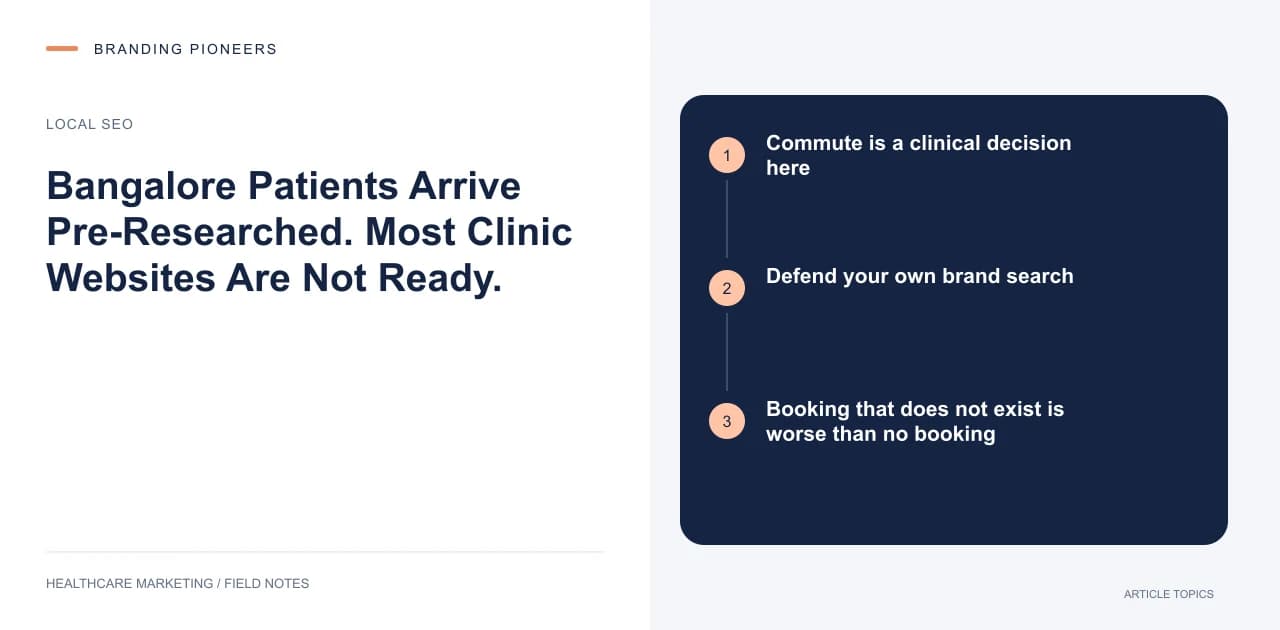
Commute is a clinical decision here
Distance in Bangalore is measured in time, not kilometres, and the variance is brutal. A patient in Whitefield evaluating a specialist in Jayanagar is not weighing a distance — they are weighing ninety minutes each way, twice, plus a follow-up.
The practical consequence is that hyperlocal visibility beats citywide visibility by a wide margin. Ranking for a citywide term draws clicks from people who will never travel to you; ranking within Indiranagar, Koramangala, HSR Layout, Whitefield, Sarjapur Road, Bellandur, Jayanagar, Malleshwaram or Yelahanka draws patients who will actually attend.
This also means your Google Business Profile is doing more work than your website. Map results resolve the "who is near me and open now" question, and that question precedes almost every other one. Correct primary category, genuinely accurate hours, real photographs, and clear directions including the parking reality.
Defend your own brand search
A specific Bangalore problem: health aggregators and booking platforms compete effectively for searches on your own clinic and practitioner names. A patient who has decided to see you searches your name, sees a platform listing above your own site, books through it, and now a third party owns the relationship, the data and a commission.
Some practices are happy with that trade. Many are paying for it without realising they had a choice. Either way, the fix is the same: own your own name in search. A complete Google Business Profile, a substantive practitioner profile page on your own domain, consistent name and address details everywhere you appear, and a booking route on your own site that is at least as easy as the aggregator's.
Booking that does not exist is worse than no booking
The single most common conversion failure in this market is a booking experience that asks for effort and returns uncertainty. A form that collects six fields and promises a callback loses to a competitor showing three real slots for tomorrow.
What this population expects:
- Visible, real availability rather than a request.
- Immediate confirmation, not "our team will contact you".
- A short form. Name, number, preferred time. Everything else can be collected later.
- WhatsApp as a first-class channel, not a footer icon.
- Teleconsultation for follow-ups, offered by default where clinically appropriate.
If your booking system cannot do this, fixing it will produce a larger return than any amount of additional traffic.
Speed and technical quality are conversion factors
This is a market of good devices and good connections, which has trained an unusually low tolerance for slow pages. A heavy website — oversized images, a stack of third-party scripts, a chat widget loading before the content — loses patients before the page finishes rendering, and search engines measure it too.
Three things worth doing properly:
- Serve appropriately sized, modern-format images. Medical sites are usually image-heavy and almost always over-serving.
- Audit third-party scripts and delete the ones nobody looks at the data from. Most clinic sites carry several.
- Make the mobile experience the primary build. Almost all of this traffic is mobile, and a desktop-first design with a responsive afterthought is visible immediately.
While you are in there: keep condition names out of URLs and query strings, and make sure your analytics and advertising tags are not receiving them. It is good privacy practice and it costs nothing to design in.