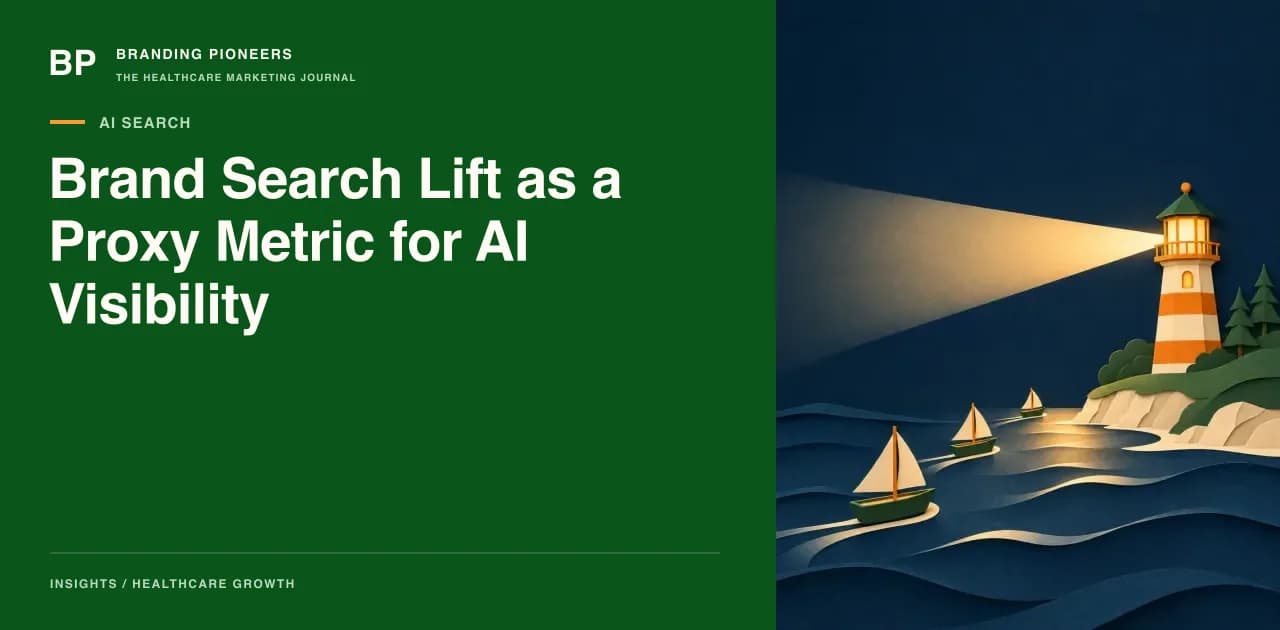
When an AI answer names your hospital and the reader never clicks, your analytics records nothing. The patient may still remember the name, search for it later and book. That later search is the part you can see, and it is the idea behind brand search lift: treat growth in people searching for you by name as an indirect signal that you are being surfaced elsewhere.
This article is for hospital marketing and analytics teams who have been asked whether AI search is working. It explains what to measure, how to separate the signal from seasonality and campaigns, and where the method breaks. It makes no claim that AI visibility causes any given rise in branded search. That is the point to keep in mind throughout: this is a proxy, and proxies need controls.
Why click-based reporting understates the problem
Seer Interactive studied informational queries across 42 client organisations and reported that on queries where an AI Overview appeared, organic click-through rate fell from 1.76% to 0.61% between June 2024 and September 2025, and paid click-through rate fell from 19.70% to 6.34%. The same study found that brands cited in the overview had higher click-through rates than those not cited, 0.70% against 0.52% for organic in Q3 2025. Seer cautions that this is a retrospective cohort, that the paid sample is much smaller, and that cited brands may simply be the stronger brands. It also notes results may not carry over to commercial, transactional or local queries.
For a hospital the practical reading is modest. Clicks on informational queries are under pressure, being named matters, and the effect of being named does not always show up as a session. Hospital decisions are also often made after discussion with family, which means the person who asked the AI and the person who later searches your name may use different devices. A proxy metric is not a luxury here.
The signals, and what each can and cannot tell you
| Signal | Where to get it | What it suggests | Main weakness |
|---|---|---|---|
| Branded query impressions and clicks | Search Console Performance report | Awareness of the name | Affected by PR, ads, offline campaigns |
| Branded query share of total | Same, as a ratio | Shift towards name-led discovery | Ratio can move because non-branded fell |
| Direct traffic | GA4 | People typing or pasting the URL, plus untracked sources | Includes dark traffic from apps, email, WhatsApp |
| Google Business Profile searches for your name | Business Profile performance data | Local branded demand | Mixed with map-led discovery |
| Branded and doctor-name interest | Google Trends | Public-interest trend in relative terms | Relative index, not volumes |
| Enquiry source answers | Call and form intake | Patients' own account of discovery | Self-reported, partial |
No single row proves anything. The method relies on several moving together, in a direction and at a time that fits what you did.
Set up the branded baseline
Google has added a branded queries filter to Search Console that splits the Performance report into branded and non-branded queries. Availability depends on the property, and the filter only classifies data from when it became available, so it is not a replacement for history you saved earlier. Where the filter is not available to you, build your own list: hospital name, common abbreviations, misspellings, Hindi and transliterated forms, doctor names and the names of flagship centres.
Keep three branded groups separate, because they behave differently:
- Institution name. The hospital and its sub-brands.
- Doctor names. Often the largest branded group for specialty practices.
- Branded service names. For example a named programme or centre.
Export weekly rather than monthly if you can. A month hides campaign spikes. Save the exports yourself, since Search Console keeps a limited data window.
Control for what else is moving
A rise in branded search is easy to find and hard to attribute. Before you claim anything, build a calendar of everything that could produce one:
- Paid campaigns, including Google Ads, Meta and outdoor.
- PR and media coverage, interviews, TV appearances.
- Health camps and CSR events, which create offline name recall.
- Seasonal patterns: fertility, cardiac and orthopaedic demand all have their own cycles, and monsoon and festival periods change search behaviour.
- Competitor events and news about your hospital.
- Site changes, migrations or tracking changes.
- Changes to Google's result pages that affect how brands are displayed.
Mark these on the trend chart. Compare year on year as well as week on week, because seasonality is the first thing a sceptical board member will raise.
Build a simple comparison
A practical design for a hospital, using only data you already collect:
- Pick the baseline window. Eight to twelve weeks before you start publishing and earning citations.
- Define the intervention list. For example: schema and entity clean-up, a batch of doctor pages, third-party profile corrections, press placements. Record dates.
- Define comparison series. Branded queries for your service lines against non-branded queries for the same service lines, and, if you operate in several cities, cities where you did not act as a rough control.
- Track at the right lag. Allow weeks, not days. A patient might see a name in an answer today and search it after a family discussion next week.
- Read movements together. Look for branded impressions rising for the service lines where you improved visibility, while branded impressions for untouched lines stay flat.
If all branded lines rise equally, something broad is driving it, probably a campaign or seasonality.
A hypothetical illustration, with invented numbers: a 200-bed hospital in Pune improves its oncology and maternity pages and corrects third-party profiles. Branded impressions for oncology rise over ten weeks while maternity, which had no outside campaign, rises too and a radio campaign for maternity ran in week six. The honest conclusion is that oncology supports the idea, maternity is confounded and the board should not be told that AI visibility caused either rise.