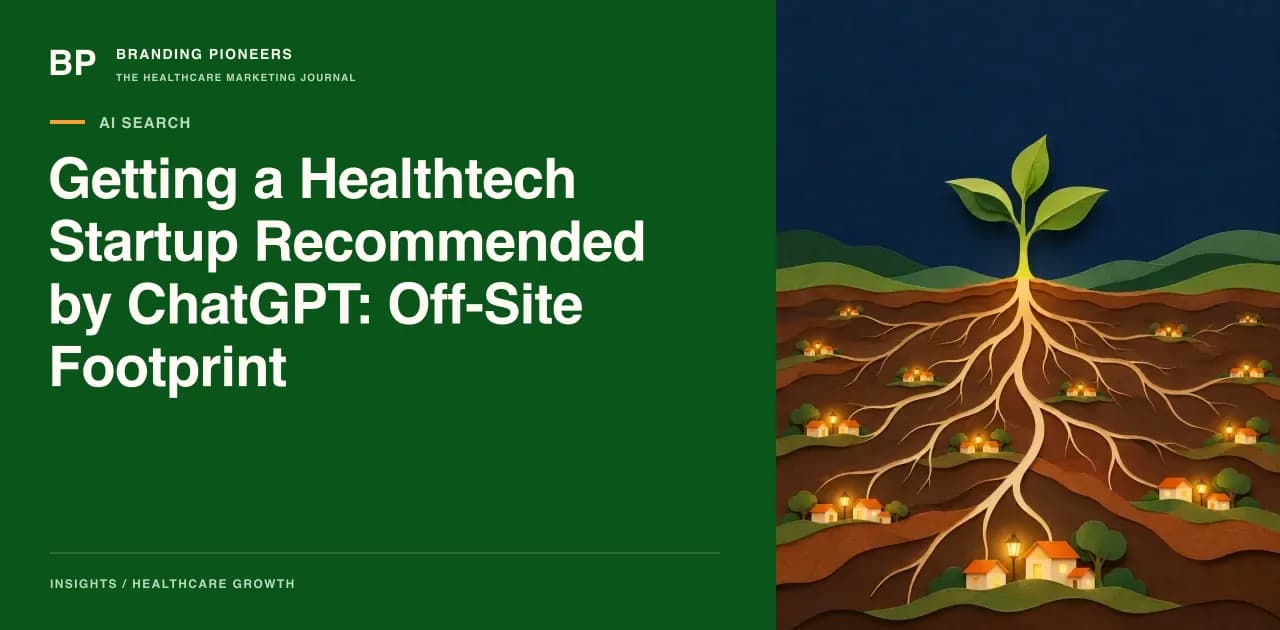
Founders of health apps and digital health platforms often ask the same question: how do we get ChatGPT to recommend us when someone asks for the best app for diabetes tracking, tele-consultation or medication reminders? Fixing your own website is necessary and usually not sufficient. For "best X for Y" questions, AI systems tend to rely on what other places say about you.
This article is for healthtech founders and marketing leads in India and the GCC. It describes the off-site footprint AI answers draw on, how to audit it and how to build it honestly. It makes no promise that any assistant will recommend a product, since no one controls that. What you can control is whether the evidence that you exist, what you do and who trusts you is easy to find and consistent. Our overview of AI search optimisation covers on-site foundations; this piece covers everything outside them.
What the data says about cited sources
Peec AI analysed 30 million sources cited across ChatGPT, Google AI Mode, Gemini, Perplexity and AI Overviews, all from US queries, and published the most-cited domains in AI search in March 2026. The top of the list, in order, was Reddit, YouTube, LinkedIn, Wikipedia and Forbes, followed by review and directory sites such as G2 and Yelp. Peec itself cautions that the list is a general starting point, that industries have their own leading sources, that rankings differ by platform, and that the data is US-only and a single point in time.
So treat it as a prompt, not a rule. For a healthtech startup the lesson is that AI answers cite community discussion, video, professional networks, reference sites and review platforms heavily. Your next step is to find out which of those matter for your category, in your market.
Audit your category, not the average
Start by running the questions your buyers would ask. For a startup selling to hospitals, that is "best hospital management software in India", "tele-ICU platforms", "AI tools for radiology reporting". For a consumer app, it is "best app to track blood sugar", "online doctor consultation app in UAE", "mental health app in Arabic".
For each query:
- Run it on at least ChatGPT, Gemini, Perplexity and Google, with search enabled where available. Repeat three times.
- Record which products are named, in what order, and which URLs are cited.
- Classify cited URLs: review platform, community thread, YouTube, LinkedIn, Wikipedia or Wikidata, news or trade media, app store, listicle blog, government or society page, competitor site, your site.
- Count how often each source type appears for the winners. Those are the footprints to match.
Fifty queries across your core use cases is enough for a baseline. Do the same for Arabic queries if you serve the GCC, because the cited sources can differ by language.
The footprint layers
Layer 1: identity and consistency
Before building anything new, make your identity unambiguous. Use the same company name, product name, description, founding year and website across LinkedIn, the app stores, Crunchbase-style startup databases, your press page and any directory. Write a single 50-word and 150-word description and reuse them. Inconsistent naming makes the same company look like several.
Layer 2: product evidence
AI answers about software often cite documentation, pricing pages, integration lists and release notes. Publish those on your site in plain HTML. A visible changelog and an API or integration page tell systems what the product does today, not what the homepage says it will do.
Layer 3: independent reviews and comparisons
Review platforms and comparison articles supply the "best for" framing. Claim your profiles where they exist. Ask real customers to review, with no incentives that platform rules prohibit, and do not write reviews yourself. Check each platform's rules, because many ban undisclosed incentives and some ban solicitation in specific forms. For hospital software, hospital IT buyers' communities and trade publications play this role.
Layer 4: community discussion
Reddit appears high in the Peec list, and forums and Q&A communities shape how people describe products. The ethical approach is simple: have founders and staff take part where they can help, disclose their affiliation every time, follow each community's rules on promotion and never create fake accounts. A single honest, detailed answer to a real question is worth more than campaigns that moderators will remove. In the GCC, check which local communities and Arabic-language forums your users actually use.
Layer 5: video and professional presence
YouTube features near the top of cited domains, and product walkthroughs are exactly what "how does X work" questions retrieve. Publish demos with captions and a clear description of who the product is for. On LinkedIn, make sure the company page, founders and clinical advisers have complete profiles with consistent roles, since AI systems frequently cite LinkedIn.
Layer 6: reference and third-party validation
Wikipedia has notability rules that most early-stage startups will not meet, and editing your own page is discouraged. Do not attempt it unless you have independent, substantial coverage. Instead, earn coverage that could eventually support one: trade media, conference programmes, society partnerships, published studies and government programme listings. Where your product has clinical validation, publish the study reference accurately, and have a clinician review any wording about outcomes.
Layer 7: app stores and distribution pages
For apps, the store listing is itself a source. Keep descriptions accurate, list supported languages, keep screenshots current and answer reviews in a measured tone. For the GCC, include Arabic listing text with the same facts as the English version.
India and GCC differences
India and the GCC differ in language, platforms and regulation, so footprints differ.
| Factor | India | GCC |
|---|---|---|
| Languages | English plus Hindi and regional | English plus Arabic, with dialect variation |
| Typical sources | Trade media, hospital IT communities, startup databases, YouTube | Regional media, health authority listings, LinkedIn, English and Arabic communities |
| Trust signals | Hospital partners, NABH-linked deployments, publications | Licensing statements where applicable, regional hospital partners |
| Caution | Doctor-facing claims follow NMC rules | Health authority rules on advertising and licensing vary by emirate and country |
Check applicable health authority requirements for your product category before you publish regulatory claims in each market, and do not state licences you cannot document.
Claims discipline
Healthtech is an area where overstatement is common. Use these rules:
- No outcome promises. Describe features, workflows and evidence, not guaranteed health results.
- Clinical statements are reviewed by a clinician on your team or advisory panel.
- Name only customers who have given written permission.
- Describe security and data handling accurately. If you mention compliance, keep it to what is documented.
- Keep pricing and feature pages current, since stale ones are cited as fact.