Specialty Marketing

Breast Cancer Awareness Month Marketing Ideas for Hospitals: Campaigns That Book Screenings

Breast Cancer Awareness Month runs through October. Most hospital campaigns produce pink lighting and a week of posts. The ones worth running produce mammograms — and that starts with the radiology diary, not the creative brief.

NS
Founder & CEO · September 22, 2026 · 7 min read
FILE · BREAST-C
Breast Cancer Awareness Month Marketing Ideas for Hospitals: Campaigns That Book Screenings

Breast Cancer Awareness Month runs through October, and by the first week of it every hospital in your city will have gone pink.

The lobby, the logo, the staff photograph, the walk. All of it sincere, most of it indistinguishable from the hospital next door, and almost none of it connected to a screening appointment anyone can actually book.

A campaign that books screenings looks different from the first planning meeting onwards, because it starts with a capacity question rather than a creative one.

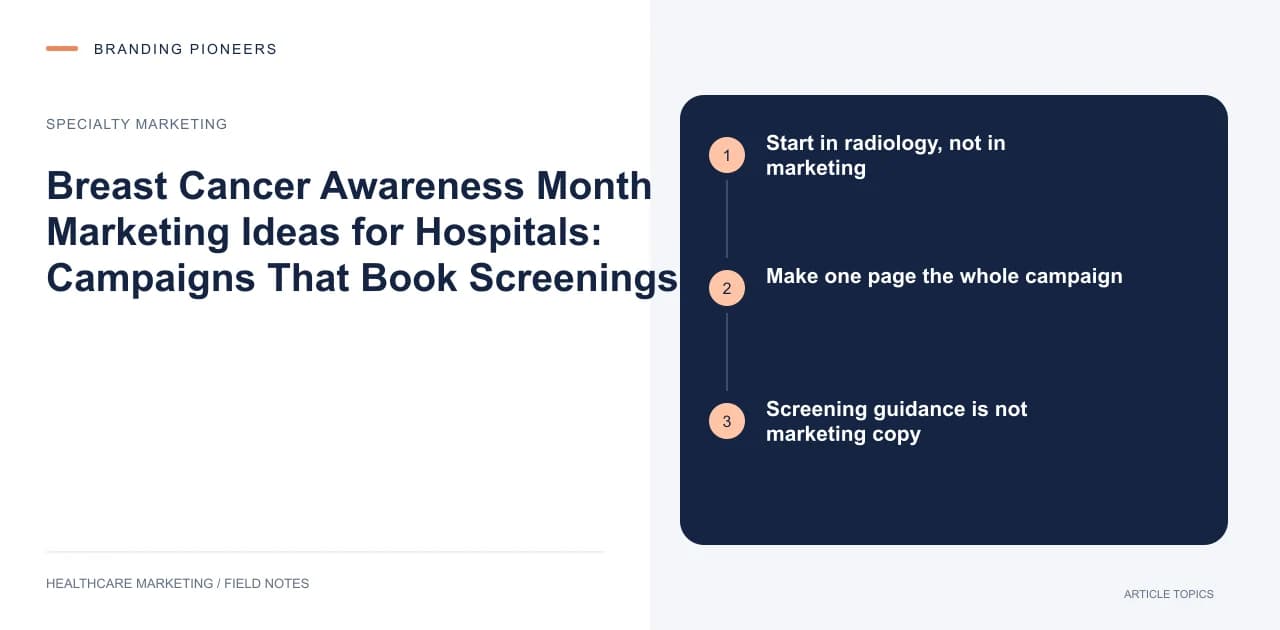
Start in radiology, not in marketing

How many mammography slots can you add in October without pushing symptomatic patients further back in the queue? What is the current wait? Who reads the films, and how quickly does a report come back? What happens the same week if something is found — who does the patient see, and how soon?

Answer those four questions first, then size the campaign to them.

This ordering matters more here than for any other awareness month, because the downside of getting it wrong is not a wasted budget. It is a woman who responded to your campaign, waited three weeks for a scan, and then waited again for a result. A screening drive that outruns its diagnostic pathway does harm, and it does it to exactly the people it set out to help. Our radiology and imaging pages cover the capacity side of the same question for imaging centres.

Make one page the whole campaign

Everything the campaign does should point at a single page that answers, in plain language: who this screening is for, what the appointment involves, how long it takes, what it costs, what happens to the images, when the result comes back, and what happens if something is found.

Publish the price. Ambiguity about cost is the largest single reason a woman who intended to book does not, and "call for details" reads as expensive.

Make it bookable on a phone in two taps, and make the alternative a WhatsApp number that a human answers. In India and the Gulf that second route will carry more volume than the form.

Screening guidance is not marketing copy

Recommended screening ages and intervals differ by country and by guideline body — the United States Preventive Services Task Force recommendation in the US, national programme guidance under the NP-NCD in India, and separate national programmes across the Gulf and the UK.

Do not write an age or an interval into a creative asset without checking the guideline that applies to your patients, and attribute it on the page. A hospital publishing a screening age that contradicts the national programme creates confusion that outlives the campaign.

Equally, be careful with what screening is claimed to do. Screening detects; it does not prevent. Copy implying that a mammogram stops cancer, or that early detection guarantees an outcome, fails both the evidence and the advertising rules — the ASCI code in India, the NMC's professional conduct regulations for practitioners, and the pre-approval regimes at DHA, DOH, MOH in the UAE and MOH in Saudi Arabia. In the United States, patient stories require a signed HIPAA authorisation before a single image or first name is published.

Ideas that produce bookings

A named screening window with real slots. Dates, times, and a number of appointments. Specificity converts; "throughout October" does not.

Workplace screening. Corporate HR budgets have money for this in October that they do not have in March, and a mobile unit or a partnership with the company's clinic reaches women who would not otherwise take a morning off. Build the follow-up route before you agree the date.

The referral push nobody runs. Gynaecologists, general practitioners, and family physicians in your catchment see the women you want to reach, every day, and most hospitals do nothing to make referral easy in October. A single-page note to every practice in five kilometres — what you are offering, the dates, the direct number, the turnaround on reports — outperforms a lot of paid media. The system behind that sits on our patient referral system page.

Self-examination content that routes somewhere. Useful, widely searched, and usually published as a dead end. End every piece with what to do if you find something, including the fact that most lumps are not cancer and all of them need assessing.

A survivor's story, told with control returned to her. Written consent, her words, her decision about the photograph, and no outcome promise attached to it. One honest story is worth a month of pink.

Staff-facing screening. Offer it to your own employees first. It is the most credible version of the campaign and the easiest to organise.

The full calendar entry, with lead times for the month, is at Breast Cancer Awareness Month.

What to avoid

Fear as the mechanism. Mortality statistics in creative are both ethically poor and commercially weak, because fear produces avoidance as often as it produces action.

Pink for pink's sake. If the campaign's only output is a colour, it is a decoration expense.

Anything that trivialises. The jokey hashtag campaigns that surface every October are reliably experienced as insulting by women who have been through treatment, and they surface again when someone screenshots them.

Borrowed imagery. Stock photographs of Western women in pink ribbons do not describe your hospital, your city, or your patients.

English-only creative in a market that does not work in English. In India that usually means Hindi or the state language alongside English, and the translation needs a reviewer rather than a tool, because the vocabulary around breast health carries weight that machine translation flattens. In the Gulf it means Arabic, and it means the Arabic version needs its own regulatory approval.

Consent treated as an afterthought. Photographs of a screening camp include identifiable women who came for a private reason. Ask on the day, in writing, and accept no as an answer without negotiating.
Every hospital, every diagnostic chain, and every awareness organisation in your city bids on the same terms in the same four weeks. Auction prices rise, creative blurs together, and the campaign that would have worked in July returns less.

Three adjustments help. Go narrow on geography, because a screening appointment is a local purchase and reach outside your catchment is wasted. Bid on booking intent — "mammogram near me", "breast screening appointment", the clinic's own name plus screening — rather than on awareness terms that collect readers. And put more of the budget into the channels where you are not competing with everyone: your own patient list, your referring practices, and the corporate relationships you already have.

Meta's health and wellness advertising policy restricts targeting based on inferred health conditions, so building an audience of "women likely to be concerned about breast cancer" is neither available nor appropriate. Target by geography and age band, and let the page do the qualifying.

If you are a clinic rather than a hospital

The advice above assumes a diagnostic pathway you control. A small clinic, a gynaecology practice, or a general physician has a different, smaller, and entirely legitimate campaign available.

Be the place that arranges the scan. Publish where you refer for mammography, what it costs there, how quickly the report comes back, and offer to handle the booking. Add one clinic session a week dedicated to breast examination and concerns. That is honest, useful, and deliverable — and it produces consultations rather than pink.

Do not stop on 31 October

The campaign creates two assets that outlast the month, and both are usually thrown away.

The first is a recall list: every woman screened, with the date she is next due. If your system can hold that with consent — and in India that consent needs to satisfy the Digital Personal Data Protection Act 2023 and the DPDP Rules 2025, with a stated purpose and a retention period — then next October's campaign starts with a list instead of from zero.

The second is the page itself. A well-built screening page with a clear price and an honest description of the appointment ranks and converts in January as well as it does in October. Keep it live, keep it updated, and link it from your oncology and imaging pages all year.

Measure five things

Screening appointments booked. Attended. Reports issued within your stated turnaround. Referrals into further diagnostics. And the share of bookings from each source, so next year's plan is based on something.

Reach and impressions belong in the communications report, not in this one.

A four-week schedule

Four weeks out: confirm radiology capacity, fix the package and the price, decide the primary audience. Three weeks out: build the page, submit anything needing regulatory pre-approval, approach corporate partners and referring practices. Two weeks out: produce the creative, brief the front desk and the call handlers, set up the consent and recall fields. One week out: publish, begin promotion, confirm the diagnostic pathway is staffed for the month. Through October: answer the phone, and watch the report turnaround rather than the engagement rate.

---

If you want to know how your screening and oncology pages currently perform before you plan October, get a free audit and we will send the findings whether or not you work with us. Or book a strategy call to build the month properly.

FILED UNDERbreast cancer awareness month marketing ideasbreast cancer awareness month campaign ideaspink october campaign ideasbreast cancer awareness campaign
Stop reading. Start ranking.
Get a free specialty marketing audit — we'll show you exactly what's missing.
Book audit →
Author
Founder & CEO · Gurugram, India

Nishu founded Branding Pioneers in 2016 with one rule that hasn't changed since: healthcare only. She'd run digital strategy at a top-10 Indian agency and watched generalist marketing underserve medical clients who needed something built for how patients actually search and decide. So she left to build the specialist instead. It's now an 80-person team working with healthcare brands worldwide.

The Patient Acquisition Blueprint (2026 Edition) — guide cover
Free · 15 pages

The Patient Acquisition Blueprint (2026 Edition)

The exact 90-day patient-acquisition system, step by step.

We never share your details

FREE · 30 MIN
See your specialty marketing opportunity gap.

Senior strategist, no boilerplate. Reply within 4 hours.

Book audit → Or call us directly
The Pioneers Brief · weekly
One essay. Three benchmarks. One teardown.
Subscribe — free
The Patient Acquisition Blueprint (2026 Edition) — guide cover
Free for specialty marketing readers

The Patient Acquisition Blueprint (2026 Edition)

The exact 90-day patient-acquisition system, step by step.

  • The 90-day patient acquisition operating system
  • Channel-by-channel budget allocation (₹50L–₹5Cr/yr)
  • 12 real, named client engagements walked through
  • ROI tracking spreadsheet (CAC, LTV, payback)
15 pages · Used by 350+ healthcare clients · Updated for AI search

We never share your details

Continue reading

More on specialty marketing.

BROWSE ALL →
From the studio

This thinking, applied.

Healthcare content marketing work
Content
Clinically reviewed content programmes
Google reviews and ratings management
Reputation
Review and rating operations
Doctor clients across specialties
Clients
Doctors we work with
Corporate hospital clients
Clients
Corporate hospital systems
A sculpted head dissolving into media fragments — search, video and analytics
Editorial
Attention, fragmented across every surface
Why choose us

Why healthcare brands choose us.

Six reasons hospitals, clinics, and doctors pick a healthcare-only firm over a generalist agency.

  • Healthcare-only

    It's all we do. No retail, no fintech — the whole team thinks in patient journeys, clinical trust, and the way people actually choose a doctor.

  • AI-first systems

    Receptionists, WhatsApp triage, and attribution built in-house — we answer patients in seconds and tie every click to a booked appointment.

  • Compliance built-in

    HIPAA-aware handling, ASCI-reviewed creative, and GDPR/DPDP sign-off on every campaign — our standard, not an upcharge or an afterthought.

  • Senior on every account

    The senior who pitched you stays on the engagement. No bait-and-switch to juniors learning on your budget.

  • Measured to the appointment

    Patient-level attribution across calls, forms, and walk-ins. Monthly reports show booked patients — not just clicks and impressions.

  • Receipts, not promises

    We name our clients and show the work. Quarterly reviews with the numbers attached, every cycle.

The Branding Pioneers healthcare-marketing team at work
Healthcare-only · since 2016
A team that does one thing well.
More from the brief

If this resonated, here’s what else lands.

Adjacent practices, the relevant tools, and the case files where we shipped this thinking against real patient-acquisition targets.

THE PIONEERS BRIEF · WEEKLY

One essay,
three benchmarks,
one teardown.

Healthcare growth, every Thursday morning. No hype, no fluff.

breast cancer awareness month marketing ideas · Portfolio

Healthcare websites: selected work

Explore the collection →