Chennai punishes generic healthcare SEO more than most Indian cities, for two reasons that compound each other. The search demand is genuinely bilingual — the same patient will type a query in English, in transliterated Tamil, and occasionally in Tamil script, depending on the device and who is helping them. And the branded search landscape is dominated by large multispecialty names with decades of equity, so a single-specialty practice competing on broad city-level terms is competing badly.
The practices that do well here stop fighting on that ground and win somewhere narrower.
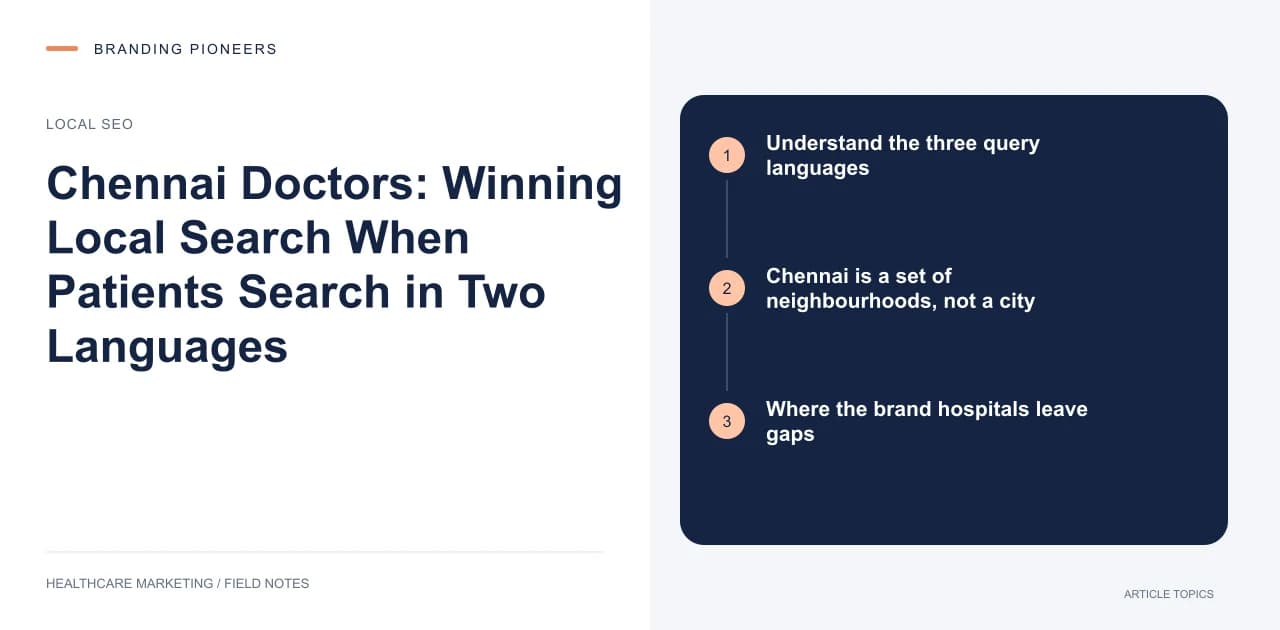
Understand the three query languages
A patient with knee pain in Chennai might search any of these, and they are not the same keyword:
- The English clinical or lay term — knee pain doctor, orthopedic near me.
- The transliterated Tamil term typed in Roman script — this is the most common pattern on mobile and the one most practices ignore entirely.
- The Tamil script term, increasingly via voice, particularly among older patients and those in the surrounding districts.
Voice matters disproportionately here. Voice queries are longer, more conversational, and phrased as a question, which means content structured around real questions gets surfaced where keyword-stuffed service pages do not.
The mistake to avoid: running English content through a translation tool and publishing the output as your Tamil pages. Clinical Tamil produced by machine translation is not what patients type, and it reads as machine output to anyone who actually speaks the language — which damages trust at precisely the moment you were trying to build it. Write Tamil content originally, or do not publish it.
Chennai is a set of neighbourhoods, not a city
For outpatient care, patients choose within a travel radius they consider reasonable, and in Chennai that radius is small. Someone in Anna Nagar is not routinely travelling to Adyar for a dermatology consultation. The IT corridor along OMR behaves almost as a separate market with its own demographics, its own working hours, and its own expectations about online booking.
This is good news for a single-clinic practice. You do not need to rank for "best dermatologist in Chennai" — a term dominated by aggregators and large hospital brands. You need to be the obvious answer within your catchment: T. Nagar, Adyar, Velachery, Anna Nagar, Porur, Ambattur, Perungudi, Thoraipakkam, or wherever your patients actually come from.
Practically that means:
- Your Google Business Profile is the primary asset, not your website. Correct primary category, accurate hours including the split-shift timings many Chennai practices run, real photographs of the actual clinic and its entrance, and the landmarks people use to find you.
- Reference the neighbourhood naturally in your content because that is how patients describe their own search — and resist inventing thin pages for every locality, which reads as spam to search engines and to patients.
- Directions content that acknowledges reality: parking, the nearest bus route or metro station, and whether the entrance is accessible.
Where the brand hospitals leave gaps
Large multispecialty groups dominate broad terms but they are structurally weak on depth for individual procedures and individual practitioners. That is the opening.
Practitioner-level presence. Many patients search a doctor's name directly, having been given it by a friend or a referring GP. If searching your name returns a thin directory listing rather than your own profile page, you have handed that patient to an aggregator. A substantial profile — training, years in practice, conditions treated, procedures performed, languages spoken, hospital affiliations, publications — should be the top result for your own name.
Procedure-level depth. A page that genuinely explains what a procedure involves, what preparation looks like, what recovery actually feels like week by week, and what determines the cost, will outperform a hospital's one-paragraph service listing. This is also the content most likely to be cited when search engines summarise an answer.
Question content. Patients ask specific, practical things — whether a condition needs surgery, what a scan will show, whether a treatment can wait until after an exam or a wedding. Answer those directly, in both languages, in the patient's own phrasing.