Ask ten Indian doctors whether they are allowed to advertise and you will get ten different answers, most of them confident and several of them wrong. The confusion is understandable: the professional ethics code is restrictive, the regulatory picture has been unsettled, and meanwhile the market is visibly full of clinicians running advertisements and building large followings.
Here is a plain reading of what actually governs a doctor's marketing in India, and where the real risk sits — which is usually not where practitioners think it is.
This is a practitioner's summary written by marketers, not legal advice. Regulations change, and enforcement varies. Confirm the current text with your regulator or your own counsel before you publish.
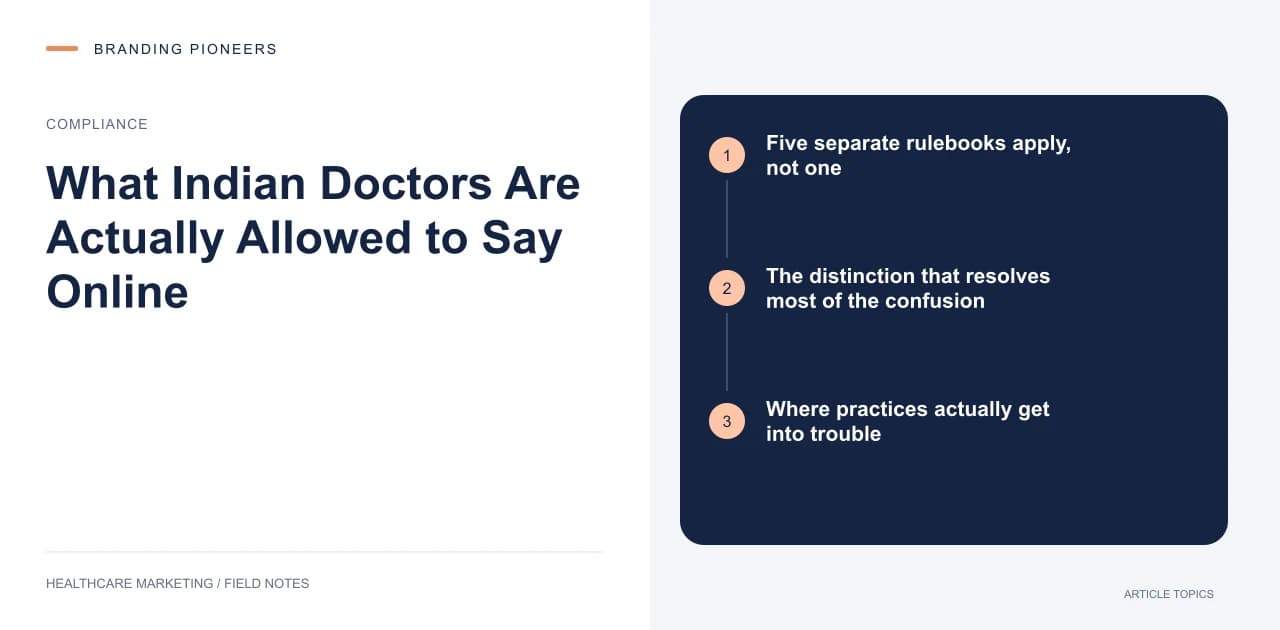
Five separate rulebooks apply, not one
The professional ethics code. The Indian Medical Council's Code of Ethics Regulations, 2002 treats soliciting patients — directly or indirectly — as unethical, and restricts advertising by registered practitioners. The National Medical Commission notified a replacement set of professional conduct regulations in 2023 which were subsequently kept in abeyance, leaving the 2002 code as the operative reference while the position is settled. State medical councils enforce, and their interpretations are not uniform.
The Drugs and Magic Remedies (Objectionable Advertisements) Act, 1954. Old, narrow and still enforced. It prohibits advertising remedies claiming to diagnose, cure or prevent a schedule of specified conditions. Any marketing that promises to cure a listed condition is exposed here regardless of the ethics code.
Consumer protection law. The Consumer Protection Act, 2019 and the central authority's guidelines on misleading advertisements and endorsements bring healthcare claims squarely into consumer-protection territory, with disclosure obligations attaching to endorsements.
Self-regulatory advertising standards. The Advertising Standards Council of India's code applies to advertising generally, and its guidance for health and wellness content sets expectations around who may give health advice in influencer content and how qualifications and material connections must be disclosed.
Data protection. The Digital Personal Data Protection Act, 2023 governs consent, notice, purpose limitation and data-principal rights for every enquiry form, CRM record and marketing list you hold. This is the newest surface and the one most practices have not addressed at all.
Layered on top: the Telemedicine Practice Guidelines constrain how teleconsultation may be promoted, and clinical establishment registration and accreditation carry their own representation requirements.
The distinction that resolves most of the confusion
The ethics code targets solicitation — canvassing for patients, touting, claims of superiority, inducement. It does not prohibit a doctor from being findable, from being accurately described, or from educating the public.
That distinction does most of the practical work:
Clearly on the safe side. A factual website. Accurate qualifications, registration details and areas of practice. Services offered, timings, location, fees. A complete Google Business Profile. Genuine patient education explaining conditions and procedures. Answering public questions honestly. Accreditation status where held. Content that helps a patient understand their options — including when a procedure is not indicated.
Clearly on the wrong side. Superlatives — best, top, number one, leading. Guarantees of outcome. Success-rate figures presented without proper qualification and evidence. Claims to cure a condition covered by the 1954 Act. Paid or incentivised testimonials. Purchased reviews. Inducements and discounting attached to medical procedures. Comparative claims disparaging other practitioners. Undisclosed commercial arrangements in influencer content.
Genuinely grey, so proceed carefully. Patient stories, even with consent, where they imply a typical outcome. Before-and-after imagery, particularly for aesthetic work. Aggressive scarcity messaging. Personal-brand content that drifts from education into promotion.
Where practices actually get into trouble
In our experience the complaints and disputes rarely arise from advertising in the abstract. They arise from three specific things.
A superlative in a headline. "Best fertility specialist in the city" is not a marketing flourish, it is an unsubstantiable comparative claim, and it is the most common single problem on Indian clinic websites.
An outcome number with nothing behind it. Success rates, cure rates, satisfaction percentages — often inherited from an agency that invented them for design purposes. They cannot be defended and they are exactly what a complaint will cite.
A testimonial that promises. A genuine, consented patient story is defensible. The same story edited into a promise of results is not.
Fixing these three costs nothing and removes most of the exposure.